Category Archives: Ranch Journal

Ridenhour Creek


20170126-a40a2879


At the top of the watershed, the Paregien Ranch feeds Ridenhour Creek on its way to Dry Creek. The higher ground is saturated with springs popping up out of cow trails that become small rivulets adding to the seeps to contribute to its flow. It’s not often that we see Ridenhour run this much water at about 25% of its flow, judging by the high-water mark, during the height of our storms of two weeks ago.


Paregian Rain Gauge


20170126-img_1634


With her iPhone, Terri caught me measuring and ciphering 9.25” of rain since December 24th on the Paregien Ranch. That’s how long it’s been since we’ve seen our cattle, since the rains began in earnest at the 1st of the year. With 16.70” here on Dry Creek thus far, we have already surpassed our average annual rainfall for the season that generally ends on April 30th.

Job Security


20170126-a40a2869


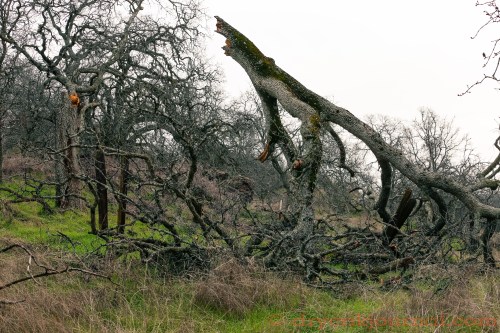
Unbelievably, only one wire is broken beneath the top of this Blue Oak, a victim of the drought and the high winds from the last storm on the Paregien Ranch. Kubota only, the roads are wet, water running in every crease. It will take at least a week without rain before we can get back in a pickup at about 2,400’, or before gathering horseback. The long-range forecast is for more rain at the end of next week.

Not a business to schedule by the calendar, the three major variables we must contend with are the weather, the market and politics. After four years of drought, we’ve found new extremes to our adaptability, thinking well outside the box of past-experience. Just how we will adapt will be interesting. Furthermore, the cattle market is off about a third of the prices received three years ago, and most producers have had to cull their cow herds so deeply that reduced calf-crops may not cover costs.

No one knows the impact of the current politics, other than markets for almost every commodity will probably not be stable. Additionally, much of the domestic beef business depends on exports, of late reduced by a stronger dollar. With existing global trade agreements under fire, there is perhaps less certainty about the market for beef since the fiasco of the first Dairy-Out Program nearly 40 years ago.

We have plenty of places to busy our hands and occupy our minds as we develop a near-term plan around all three variables of this business. Even though we are at the mercy of the weather, the market and politics, we do have job security, for a while.

CABIN FEVER


img_1747


I regret to report the creek
is still too high to cross,
running muddy with white caps

                    where summer cobbles baked
                    beneath bleached moss
                    housing aquatic bugs—little
                    towns anticipating rain—

a month’s work on the other side:
clearing roads of trees, fences
under limbs, slick black calves
waiting to be stretched for an iron

and I’m inside polishing poetry
instead of oiling my saddle
I’m almost too old to ride.

No one behind your desk
to report to for twenty years,
no one to argue how to spend
time and money improving
how to get the work done
when the creek subsides.

                    I’ve yet to learn
                    where the tree frogs go,
                    four years drought
                    between symphonies.

I regret to report I’m tired
of the world beyond our fences
where there is no truth,
no beauty left in the storm
of news I’m addicted to
waiting for my daily fix,
each outrageous episode
is drama enough

                    to keep from thinking,
                    to keep from working
                    to keep from wanting
                    anything more than
                    where the tree frogs go.


1st of 3


20170118-a40a2860


We’ve been busy returning our replacement heifers to the Wagyu bulls after we could ford the creek, 40 or so scattered over our neighbors with no watergaps between us. Moving some cows and calves away from the creek this morning before the first of three storms arrives to linger through Tuesday, about 3 more inches of rain predicted, but the the bulk of the storms are aimed at the wet and icy Northwest. Here we go again.


WINTER PICTURES


20170116-a40a2838


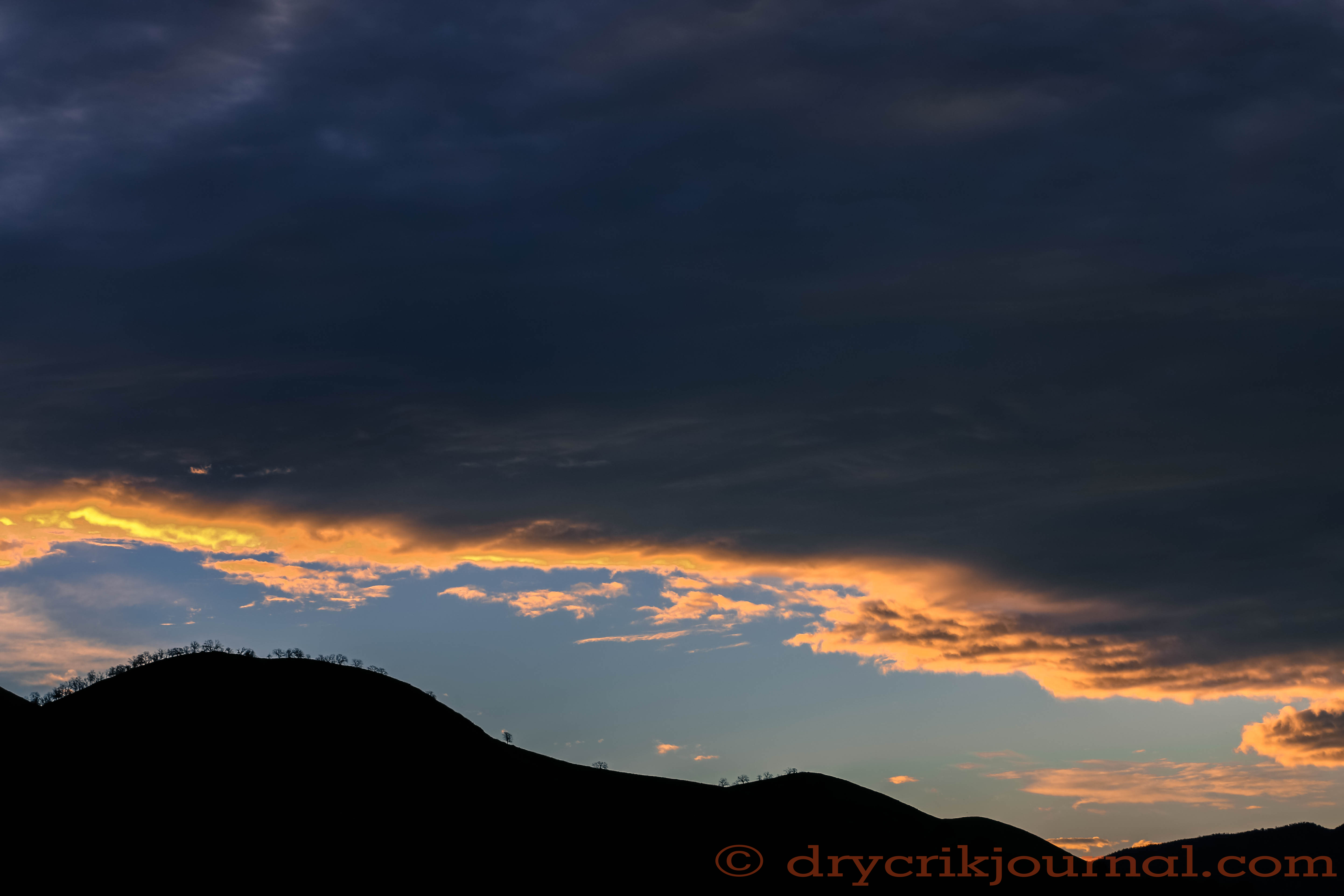
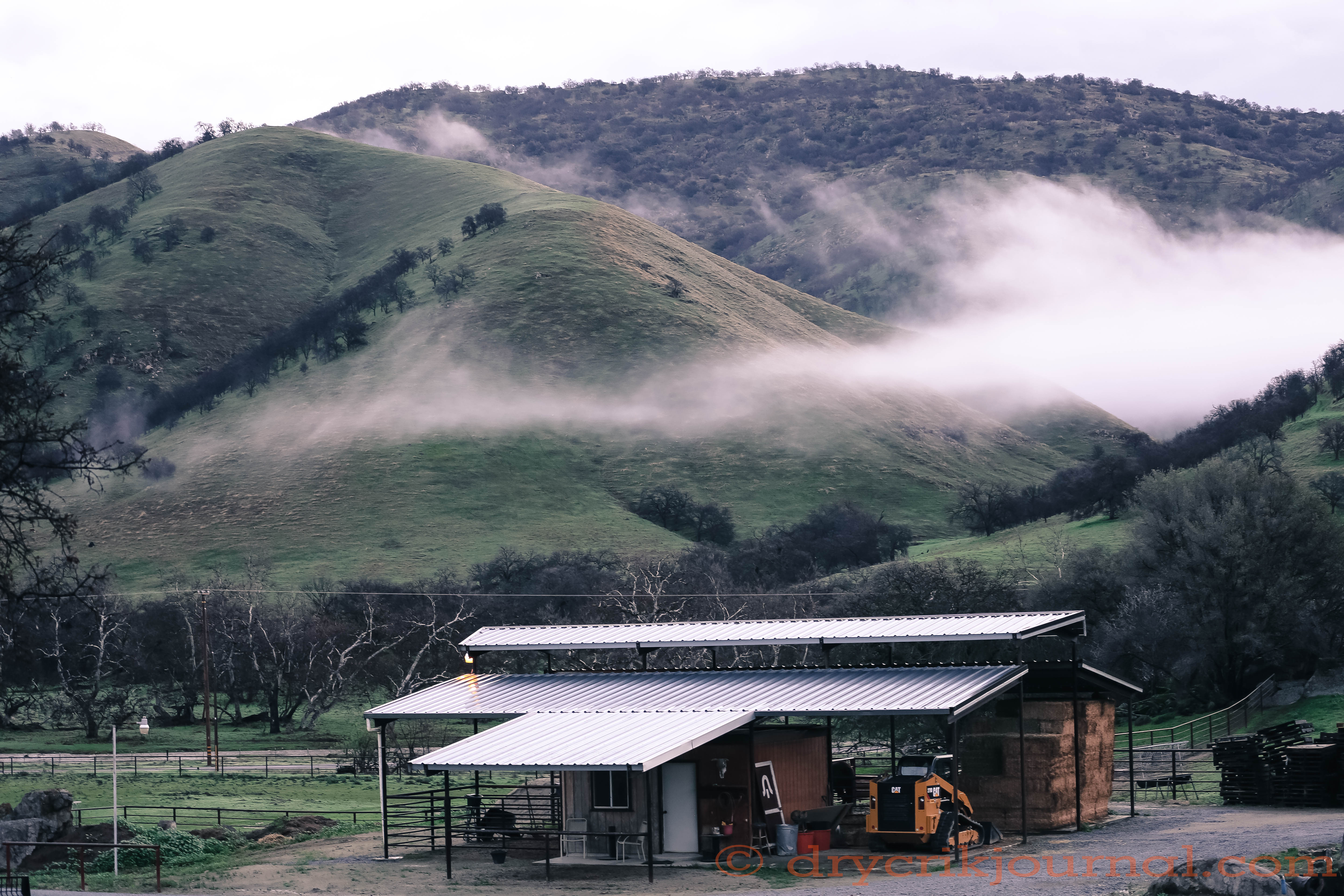
High cold wet fog after rain
puts a lid on summer’s cauldron
earth wet to rock, each crease
leaks rivulets into the canyon
to join a muddy creek.

Curiosity burns in his belly,
lone winter coyote edging closer
by different approaches
                    mid-day or night—
                    dogs hold him at bay
                    until he leaves the edge
                    of our territory.

Young downstream cowboys try
clay flat, pickup, gooseneck
just inside the gate, diggings
piled behind the drive wheels
as I pass by.
                    Twenty years ago
                    I’d have stopped to help
                    got stuck
                    and they learn nothing.
                    Two hours back from town
                    with a burn permit,
                    they’re hooking up
                    on muddy asphalt.

High cold wet fog after rain
creek too high to cross
I clear my desk, bag years
of paper files for proof
                    of our busyness
                    for the burn pile:
                    dry summer prunings
                    up in smoke
                    lost in fog.


Rain Update


20170113-a40a2822-2


Dry Creek is running over 500 cfs this morning @ 6:00 a.m., after over an inch of rain in the past two days, over 6” for the first half of January—10 consecutive days of measurable precipitation—it’s wet! Any plans to cross the creek to fix fences and sort cattle won’t happen today. Furthermore, the moisture is deep, a good thing, but the only vehicle we have to get to the fence work will be the Kubota and I’d prefer to wait until Dry Creek is running less than 100 cfs.

Oh, I know the stories when Earl McKee and his sorrel horse swam the channel to ride five miles to free cattle locked in his Greasy corrals; or Clarence Holdbrooks swimming his red horse to move cattle stranded on the other side of the creek fifty years ago. They are my heroes still. All we have at risk with our current cattle mix-up is that our replacement heifers are running with the neighbor’s steers, at a time of the month, unfortunately, when the majority will be cycling, yet not exposed to the Wagyu bulls. But no livestock is at risk.

According to the 10-day forecast, we have a 5-day window to dry out before the next series of storms begin on the 18th, then 5 more days projected to leave 2.5” of rain. But no one’s complaining, yet, no one’s hollered ‘uncle’.

Not unlike the drought, Robbin and I have been making contingency plans. It dawned on me last night that making a ranch work within all the variables of the weather requires some hands-on creativity—that the art of cattle ranching starts with thinking well-outside the box. C’est la vie!


Weekly Photo Challenge: ‘Ambience’


Video

Dry Creek Brush Catchers #2


Too wet for us to get off the road or cross the creek, but Kaweah Delta was back on Dry Creek cleaning the lower brush catchers this morning before the next storm starts about 4 p.m., forecast to bring 1.5 – 2” of rain through Thursday. Dry Creek: 236 cfs. Operator: Erik Avila.


Dry Creek Brush Catchers


Dry Creek peaked at 7:00 a.m. this morning @ 2,526 cfs at the gauging station immediately above the lower brush catchers, minus a couple of teeth, despite the cleaning of debris by the Kaweah Delta Water Conservation District yesterday between storms.


Lifeblood


10:00 a.m., January 8, 2017: 629 cfs

10:00 a.m., January 8, 2017: 629 cfs


Not quite the storm of the decade, Dry Creek peaked at 1,390 cfs early yesterday morning. As of this morning, accumulated rainfall since the first of the year on lower Dry Creek has been a little over 4 inches, with yet another storm forecast to bring about 1.5″ due midday tomorrow—all welcome.

The continual gray clouds and rain of late seems miraculous when contrasted with the bare hills and dust of the past four years that have been permanently imprinted in our minds as more normal than not. The drought changed our thought processes and how we operate the ranch. And despite the ample availability of water streaming in nearly every canyon, I have often caught myself still worrying about stockwater. It’s how we lived, day to day, for a long time.

It’s good to see the creek running, the literal lifeblood of the canyon, a psychological lift as we inhale the moist air and relax a little before addressing the work that waits ahead of us. We have calves to brand and watergaps to fix as soon as we can physically get to them, when the roads dry out and creek goes down, which probably won’t be until next week if tomorrow’s storm materializes.