We train our young replacement heifers to be gentle and to follow the Kubota or feed truck when we feed so when they go up the hill in the next year or two, we can gather them and their calves easily. Having been through the same process, their mothers and grandmothers have imprinted this same calmness on their calves.
Due to the atmospheric rivers, we were unable to see our cattle for 3 months, but the calves gentled down quickly in the weaning pen on alfalfa hay. Now weaned about 30 days, they’ve been turned out along the creek on native feed and a little extra green due to the spring rains. We’ve been supplementing them once-a -week. While I was photographing the floods’ ensuing boulder fields and patches of cockleburs, they heard the Kubota and followed me, on the march, towards the feed ground, hoping it was the right day.
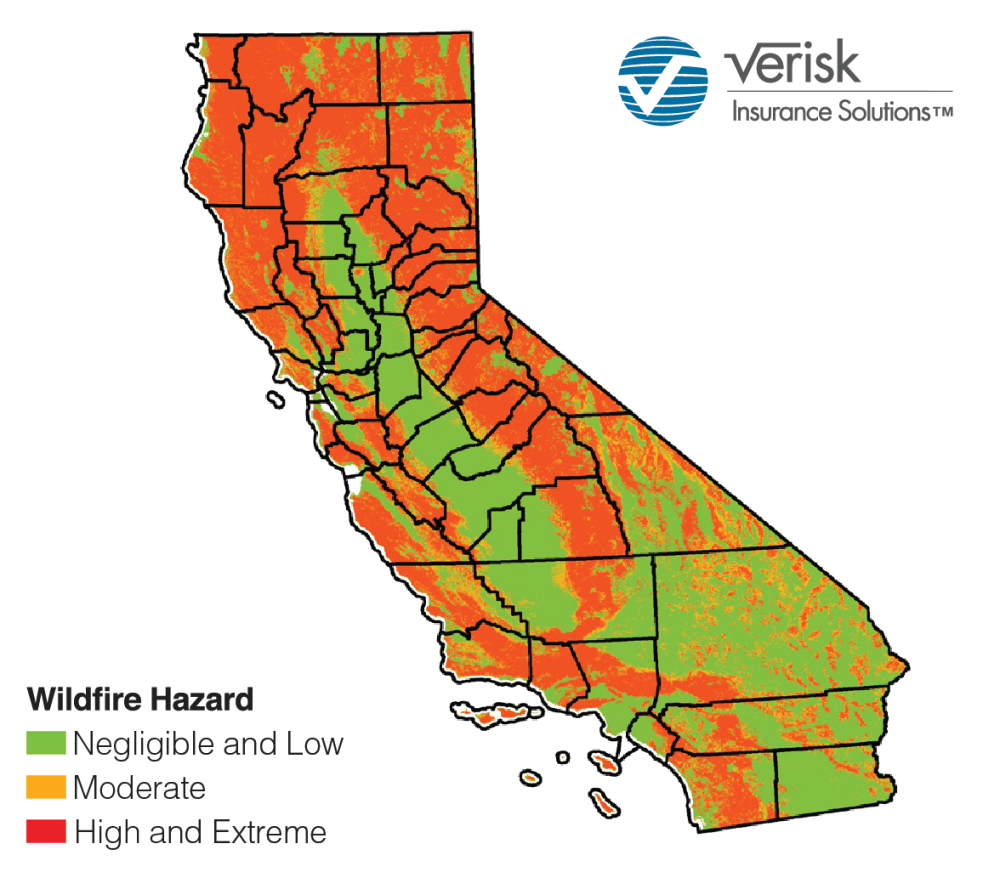
We are among the many home and ranch owners whose insurance policies have been canceled because they were located in the revised California’s High Risk Fire Area that includes almost half of the state.
Drought conditions in 2017, 2018, 2020 and 2021 combined with poorly maintained PGE transmission lines in Northern California charred over 8 million acres that left insurance companies holding the bag for losses and fire suppression costs. After a month-long process, we found one other carrier with less coverage at twice the cost.
A decade or so ago, Tulare County used to spray the weeds on the shoulders of Dry Creek Road to reduce fire danger from catalytic converters, hot brakes and dragging safety chains. Currently, 4-foot tall dry weeds encroach on the eroding asphalt adding to our risk of fire.
An independent onsite inspection was necessary to establish baseline conditions for home, barns, tack room and shop. I waited at the end of the driveway for the inspector from the Bay Area who had become lost. Up the drive in a cloud of dust she parked in the shade of a redbud as I followed in the Kubota. As she stepped out of her 2017 Chevy Volt, it began to roll down the slope, as she grabbed the door trying both to hold it and to get back in, towards our 500 gallon fire-fighting water wagon to veer at the last moment into the skid steer. She could have been seriously injured.
Though the hybrid rocked the skid steer upon impact, it survived unscathed. After assessing the damages to her car, we tied the plastic together with duct tape and hay string and tested the brake and turn signal lights. Drivable and legal, she went about her business of asking questions and photographing the structures while I showed her our firebreaks, plumbing for filling fire trucks and water wagon from our wells, while explaining that I had even stopped one fire myself with the skid steer.
Having made it home safely, she conducted the remainder of her inspection with questions over the phone and texts over the next two days. I repeated many of the photographs she had taken because of the glare from her cell phone, plus additional pictures of electrical service boxes and their manufacturers with interiors of all structures. In order not to have to dedicate another afternoon for another inspection, I essentially accomplished the onsite portion of her inspection.
I recount this calamitous and ill-advised process from a 75 year-old’s perspective, dumbfounded by the inefficient technological progress in that span of years. Frankly, she had no more business navigating and assessing rural California than we would be navigating and judging San Francisco, the ironic culture clash between us resounding loudly.
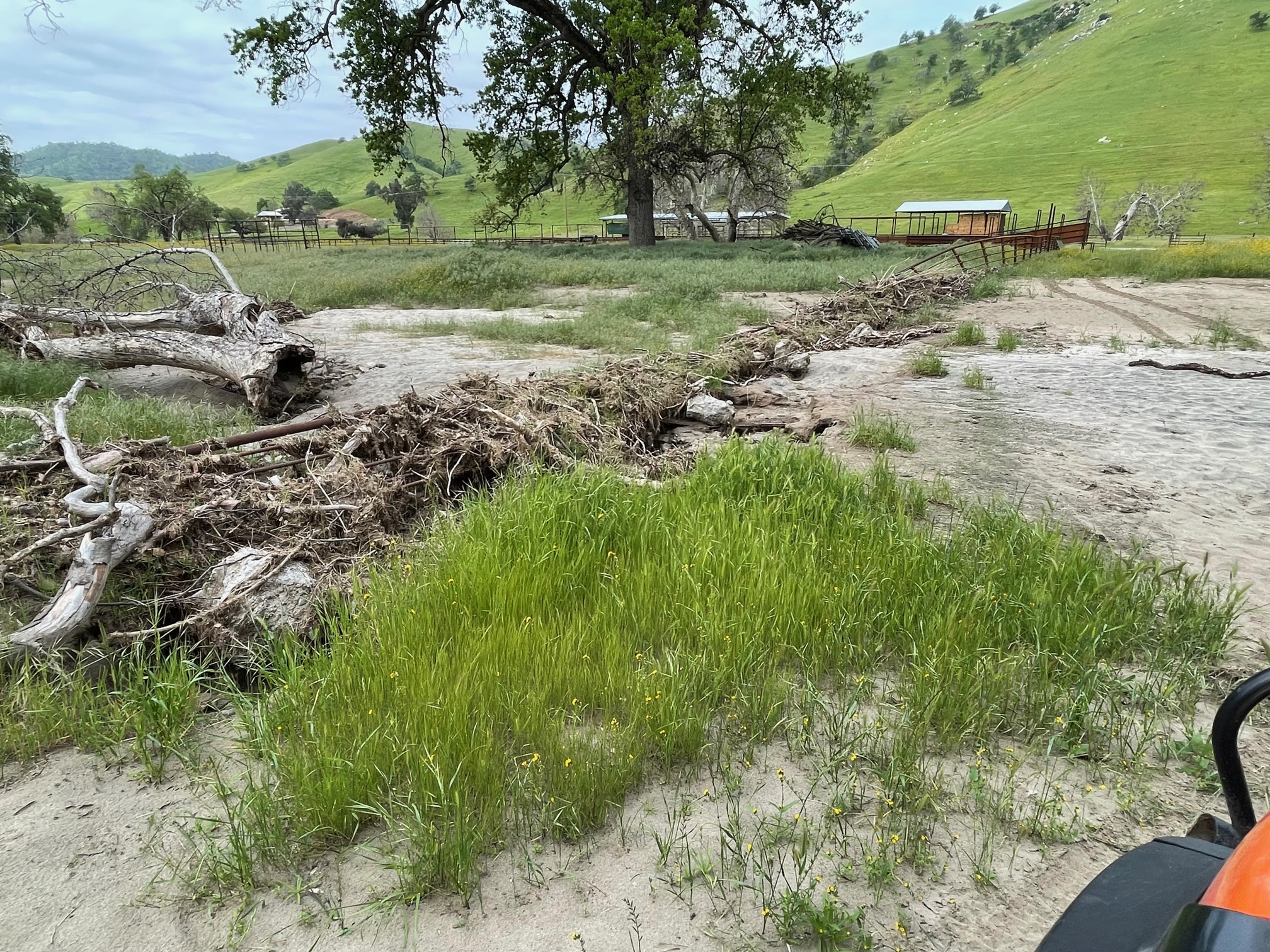
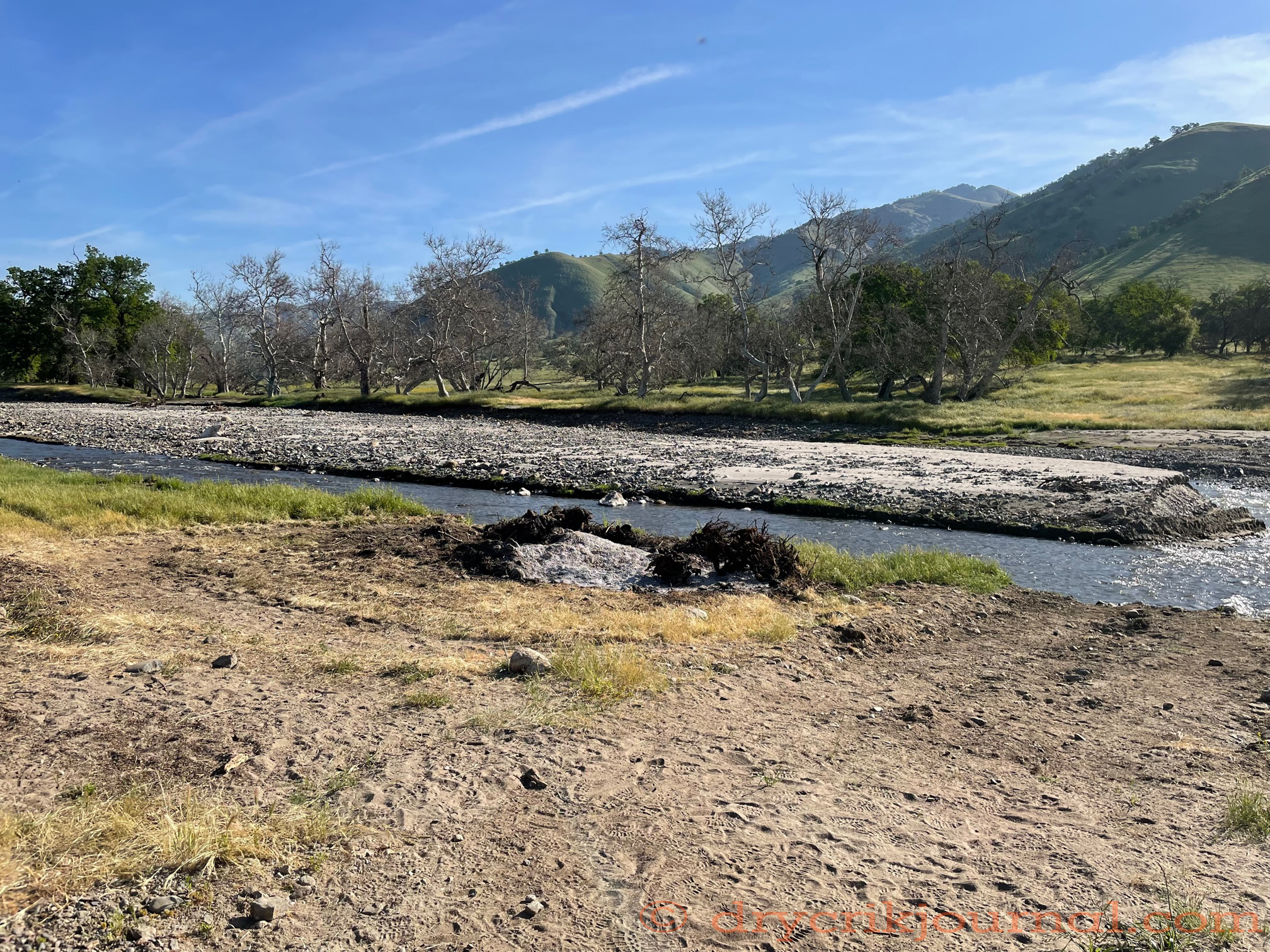
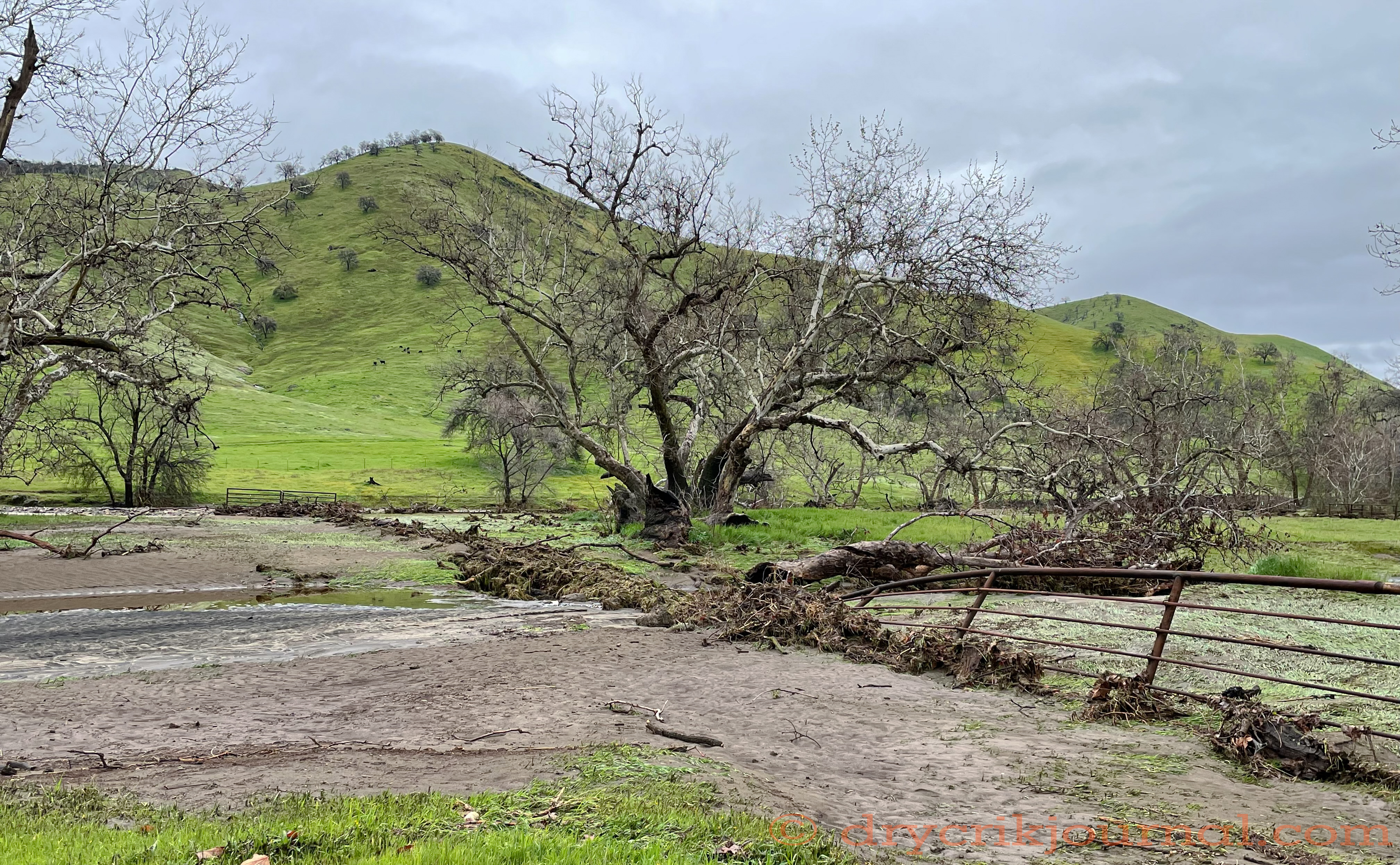
I think we’ve finally caught up and close to being on time with our ranch work since the last Atmospheric River at the end of March. We got across the creek towards the end of April when flow was down to 90 cfs to see our cows while trying to get our fences up to hold them when we gathered and weaned. Since the ARs, Dry Creek is spider-webbed with streams of sand in new high-water channels requiring some leveling with the skid steer to replace fencing and to approach the creek. Meanwhile on this side of the road and creek, we’ve had a crew building fence to better accommodate the acreage changes since Robbin and I have scaled down our activities.
But on time, our first bunch of calves will be weaned and ready for Visalia Livestock Market’s “Off the Grass Sale” on Wednesday, May 17th. They are 7-weight Vintage-sired steers. The market has been strong, though slightly weaker lately. With our cow numbers down due to acreage changes and past years of drought, we will need whatever extra money the market will offer us.
After seven days a week for nearly two months, it’s a relief to feel caught up.
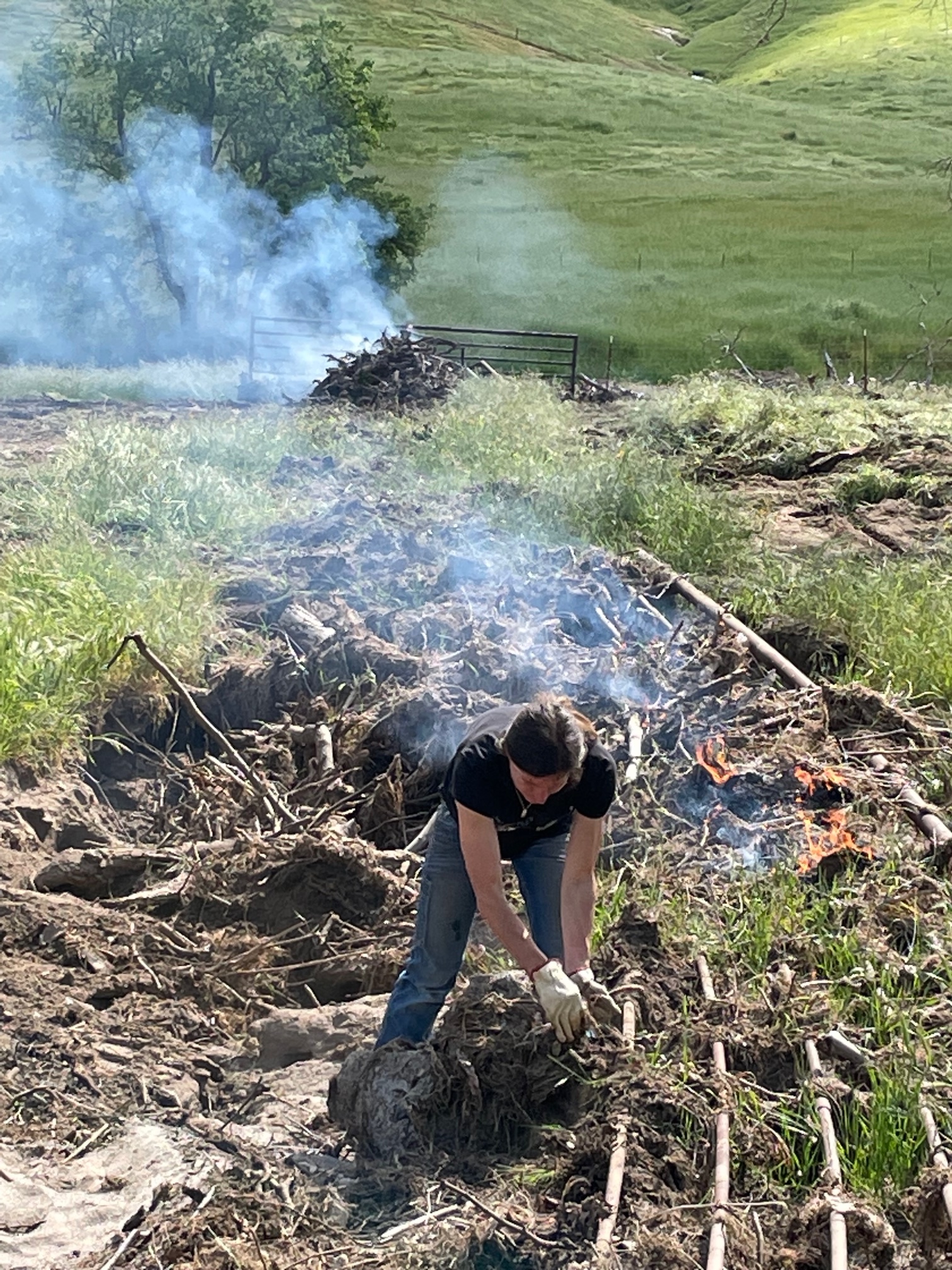
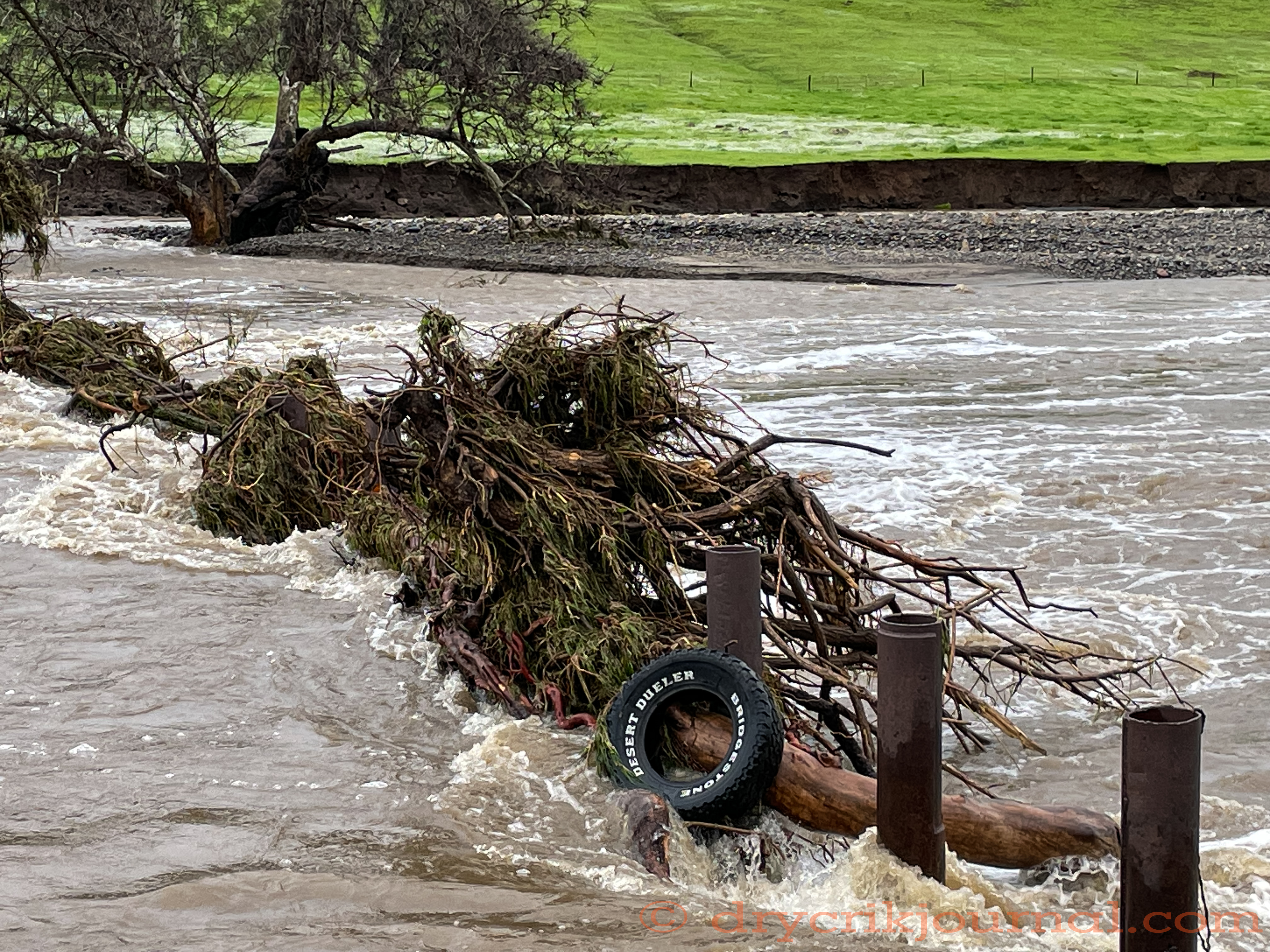
The grass has turned while we’ve been busy repairing our fences in order to sort and ship our calves to town. Because the brush catchers upstream failed to hold all the debris, our pipe fence across the high water channels when the creek was flowing 8,000 cfs (cubic feet/second) collected what leaked by until it was overwhelmed.
It’s been a slow process, but neighbors and friends brought their hydraulic muscle to stand it upright Sunday morning in a couple of hours. We had to cut it in sections and finished welding them together yesterday.
We haven’t been able to cross Dry Creek for three months due to the series of Atmospheric Rivers that began last December. Subsequently, Robbin and I haven’t seen the cattle for three months.
Fortunately, we had a dozer nearby to spread the cobble and sand bar evenly across the channel.
Salt hungry, they’ve been doing fine without us. We were quite pleased with both cows and calves.
Road closures everywhere, San Joaquin Valley flooded, haven’t left Dry Creek Rd. for a week. Glad we’re on higher ground. 3.5″ more forecast Sunday thru Friday next week.
I am reminded of Christmas Eve, 1955. Much to my father’s chagrin and contrary to his good judgement, we celebrated with my mother’s parents, Dorothy and Floyd Cutler in Green Acres, Visalia. Mill Creek ran beside the home and we all took turns watching it rise on the concrete steps leading up from their garage. When it was time to leave, my Dad carried us three kids and Christmas presents through 3 feet of water to the car, then got the ’53 Buick stuck. My grandfather hooked on to it with his Studebaker pickup and we drove back to Exeter through the swamps (Lovers Lane to Anderson Road) on the two-lane highway in two plus feet of water (Kaweah River before the Terminus Dam), wincing every time we met another vehicle’s wake in the headlights.










 drycrikjournal