Category Archives: Ranch Journal

Rock Wren Nest


Always mysteries on the ranch, we look for clues, search for signs of the inexplicable.


Utilizing the Kubotas to get around the past five months, my pickup has been parked most of the time. A month or so ago, we noticed its exhaust pipes were full of gravel from the driveway. Removing the gravel with a long spoon, we found a loose nest where the two pipes join. We also a noticed a pack rat nest in the frame at the same time, started, we assume, while I spent several hours trying to drain the runoff from our corrals in early March, a nest that included a surveyor’s lath, marking the location of a nearby power pole, as it’s foundation. Because we found them both at the same time, we assumed the same culprit.
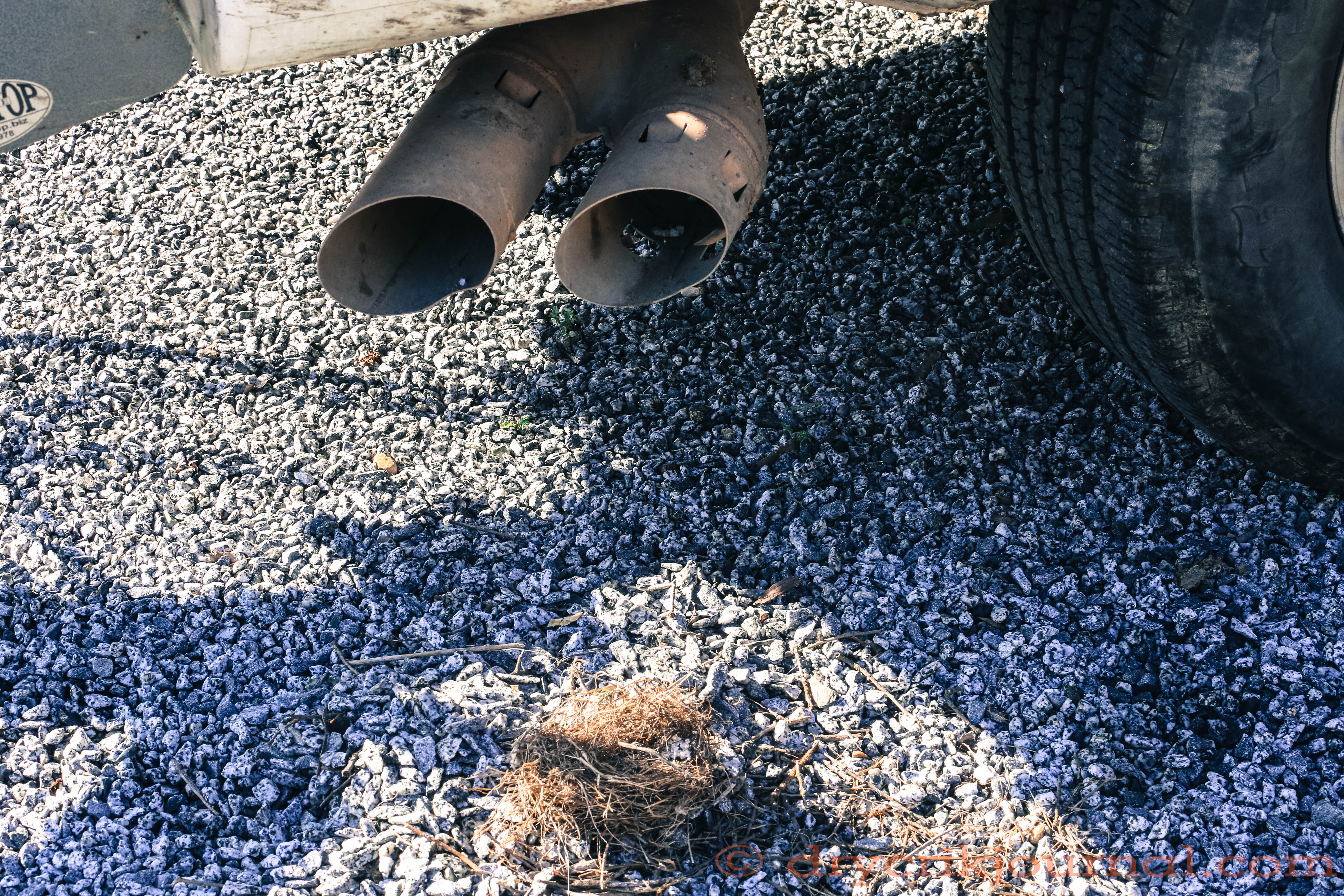


Though we removed the pack rat nest, gravel continued to build up in the exhaust pipes, and another nest removed that contained an egg and eggshell remains. Beginning cattle work, I often leave the gooseneck hooked-up to my pickup and park it elsewhere for several days in a row. We then noticed that exhaust pipe of Robbin’s car was acquiring several gravel stones of its own.


After Googling ‘nest in exhaust pipe’, the best suspect was a Eurasian Bushtit, a pretty tiny bird, but not native to this continent. I assumed the gravel was placed by its plainer relative, the Bushtit, of which we have many, but none observed around my pickup. But considering the size of the egg and that of the Bushtit, not much bigger than a thumb, I was beginning to have doubts as the gravel continued to accumulate in the tailpipes.

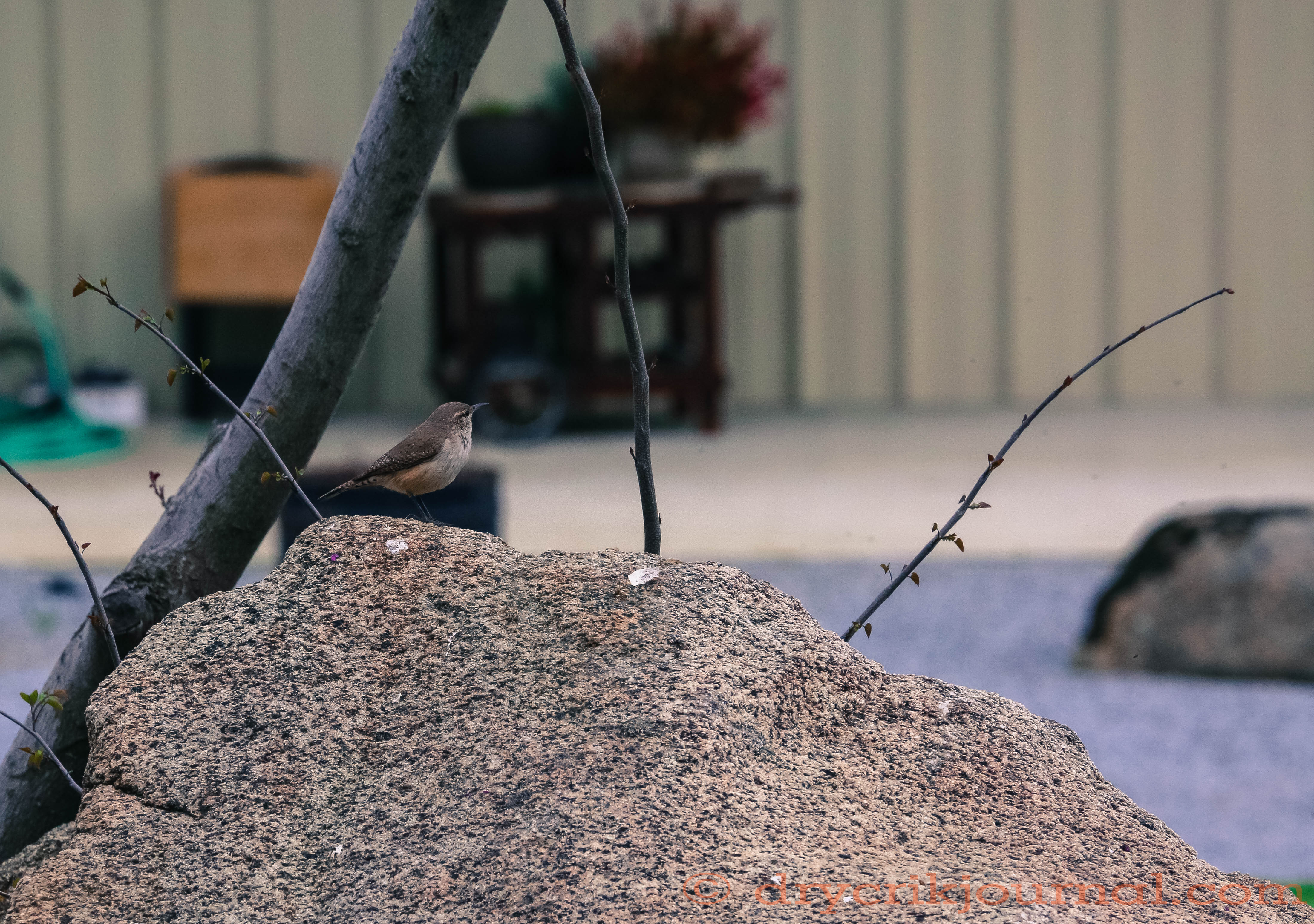
We enjoy watching the fairly tame Rock Wrens bob around the yard, collecting bugs, extricating spiders from under tables and chairs, cleaning window screens. Yesterday, one hopped out from under my pickup. Once again, I went online to find some interesting facts.


Almost Stuck


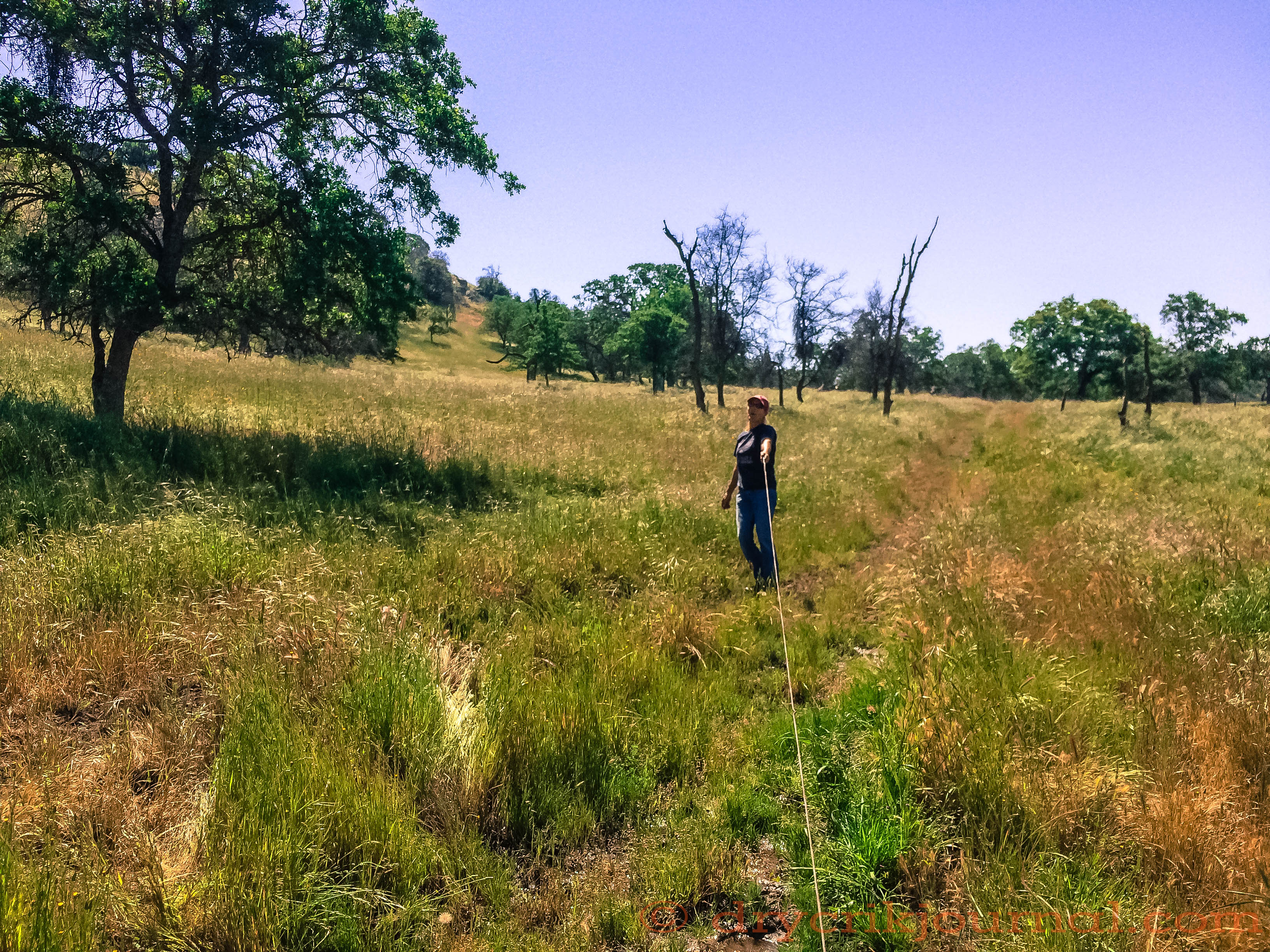
While I was blading a dusty firebreak along Dry Creek Road, Terri and Robbin went up to the Paregien Ranch in the Kubota to corral some dry cows that we’ve earmarked for town, when and if we can get to them with a gooseneck. Roughly 2,000 feet higher in elevation with 25 inches of rain, it’s still wet and boggy in places under our tall feed. They corralled the cows, but had to turn them out into the gathering field because it’s still too wet to load them. Afterwards, while putting out salt and mineral, they found a loblolly in the middle of the road that we have driven over several times this season with no problems.


Short of boasting this year, we’ve been fortunate not to have gotten stuck somewhere on the ranch considering our many close calls and all the ‘stuck’ stories we’ve heard from our neighbors. Sharing her iPhone photos, Robbin was quick to refine the definition of being stuck as when you have to walk home, or call someone to pull you out of a mud hole. Down on its frame, luckily they found an oak close enough to winch the Kubota onto hard ground.


With four years of drought fresh in our minds, we’ve not complained about our near-record rainfall, but it has presented a number of new problems, including not getting our upper-country calves branded before we wean in a few weeks—when and if we can haul them off the hill. Hard to believe it was 95 degrees yesterday. Careful what we wish for as we deal with a very different year, we’re looking forward to something a little closer to normal.


BLACK PLASTIC


So little water, we left
pasture gates open, turned
ranch management over

to the cows until
December brandings—
forgotten plans

stirred and mixed
to leave with dust devils
for four years straight.

Then so much rain
the rising water
took every fence between

neighbors, cattle free,
to graze up or down
twenty miles of stream

too high to cross
to cut the bull calves
as late as April aspirations

bellowing and packed
into a swaggering
700 pounds.

We wade the creek
repairing watergaps
with black plastic mesh

designed to herd humans,
an experiment worth trying
to run a ranch.


Easter Sunday contined…


My sister and I circled the mountain pasture behind the house in the Kubota after opening the gates to the flat below for the first-calf heifers and their Wagyu X calves before we drive the bunch to our scales and processing corrals next week. The calves need to be revaccinated before we ship them in May to Snake River Farms to be finished as American Kobe Beef. Not quite the same as gathering a horseback, she managed to see a lot of country where the cattle had been before we finally found them—a steep, rough ride nonetheless.

Gentle and Kubota-broke, our cows spend their first three years in our low country before graduating up the hill, and managing to gather them all was not a surprise, but offered an up-close look at the cows and calves for my city sister to see. Also, part of our purpose for gathering them a little early was to begin grazing the tall ripe feed around the house that will become a fire hazard this summer, despite the firebreak I’ve bladed with the skid steer.

Within a couple of hours, as if invited to Easter dinner, some of the cattle had gathered below our ‘sip ‘n’ dip’ for a visit.


Black-headed Grosbeak


With a few exceptions, I tend to lump all the little birds together, especially in the spring. The constant flittering that seems to begin with the house finches courting on the railing, the rosy chests of crooning males that seem to intensify in the process, followed by a period of squabbling with neighbors while claiming space along the beam with a steady rain of dry materials from construction and deconstruction overhead. With space enough for half-a-dozen households, it’s entertaining, but messy.

My sister, who was visiting from the Bay Area, was impressed with all the avian activity when Robbin and I both noticed a bird we hadn’t seen before, bigger than a finch, but smaller than the clan of blackbirds, who’ve taken residence in two coastal redwoods, strutting across the lawn between unabashed breedings. To add more birds for our entertainment, Robbin filled the bird feeders for the first time in months that drew the stranger in, along with a pair of Bullock Orioles. Even noting the distinguished details of the stranger with binoculars, I couldn’t identify it online or within the several bird books on hand.

So taking a page out of my wildflower identification experience, I photographed it last evening on the feeder. Only in the photograph did I really see its ‘large’ beak, then went online this morning: I think it’s a Black-headed Grosbeak!


Black-headed Grosbeak


White Western Redbud – Cercis occidentalis ‘Alba’


One of the pleasures of helping Kenny and Virginia McKee brand their calves in Woolley Canyon is the early morning drive up Dry Creek to the Mountain House, then down CA 245 as first light strikes the plentiful magenta redbuds in bloom, a gloriously slow and winding 45 minute trip with a pickup and gooseneck load of horses. Midway between Mountain House and the entrance to Woolley Canyon grows the fabled ‘white redbud’ overlooking 5,000 acres of overgrowth that takes a week for young men and dogs to gather before we arrive.

It was the late Ed Vollmer, a native of Badger, that related stories to me of how Cutch Cooper and others, several generations ago, tried and failed many times to propagate this rare find from seed. One must assume they also tried grafting to a normal redbud. Though extremely rare to the Southern Sierra Nevada, my Google search discovered that the white redbud is available from nurseries in northern California and Oregon. Nevertheless, it has become a game for us on our annual trek around the vernal equinox to locate the tree and be assured that our ‘white redbud’ is still alive.


Blue Oak Casualties


Oftentimes during a year of stress, some Blue Oaks shut down, loose their leaves, only to come back to life the following season. But our 4-year drought was too much and too long for whole slopes of oaks, despite above-average rainfall this season. Now, as the survivors begin to leaf-out, the casualties are fairly easy to distinguish. Most, it seems, are below 2,000 feet in elevation on north to west-facing hillsides. As these trees have been here all my life, I’m guessing they are over 100 years old, but most have probably been here less than 200 years. Usually at the top of these slopes is an older tree, or remnants of an older tree, a grandfather oak that provided the acorns.

(Facebook viewers can enlarge the photo by linking to the blog)


Vernal Equinox, 2017


Not a normal spring, Robbin and I made the loop of Greasy Creek yesterday with 750 lbs. of salt and mineral. We’ve not seen the cows and calves since before we left for Elko at the end of January, due to high water in Dry Creek, a huge rock on the Mankin Flat Fire Road, and overall conditions too wet to travel.

We flirted with having to walk home before we reached the corrals where I emptied 6.85” from the rain gauge, a total to date for the season of 24.03”. Not unlike the Paregien Ranch, we can’t get to the corrals with a pickup or gooseneck, so branding the rest of our calves is not a consideration. Furthermore, we’re too late in our grass season for our 500 lbs. bull calves to effectively recover to then continue to gain weight again.

Our dilemma as delineated in the March 11th post is moot at this point, wet roads and weather having made the decision for us. More storms forecast with unsettled weather for the next 10-12 days, with all the colors of spring waiting to unfold. These toms were courting the hens on Greasy Creek yesterday, finding a bare spot in the road to fan their tails, drag their wings and gobble in unison, as the heads of hens watched from the tall grass.


Picnic


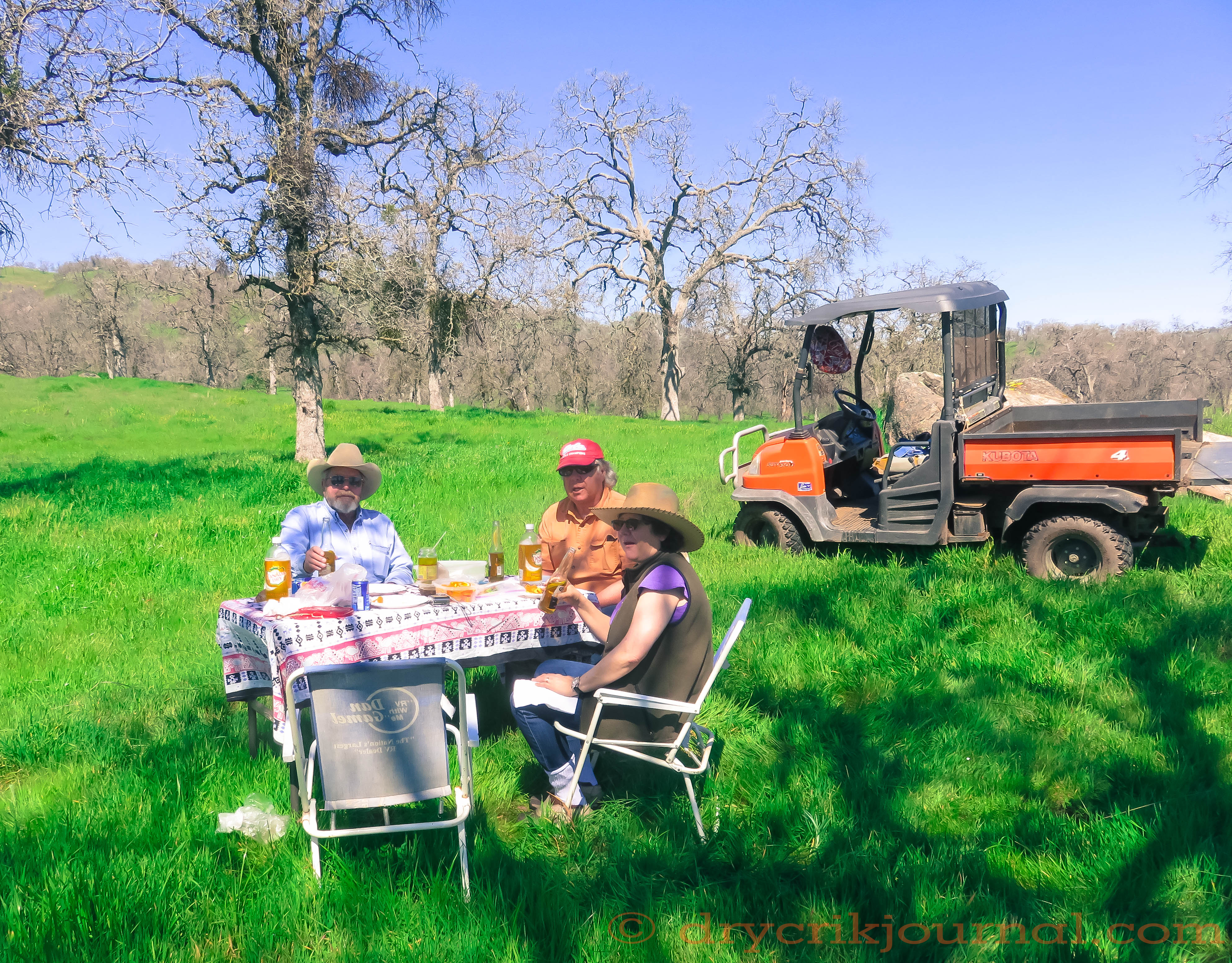
We’ve been sharing ranch life with our dear Canadian friends Denise Withnell and David Wilke from Cowboy Celtic for the past few days, exhausted as they head home to Victoria. Like kids, we’ve been having way too much fun while getting very little work done. Taking them on a tour of the Paregien ranch to put out salt and mineral while assessing the practicality of branding our bull calves, we found roads still too wet in places for a pickup or gooseneck.


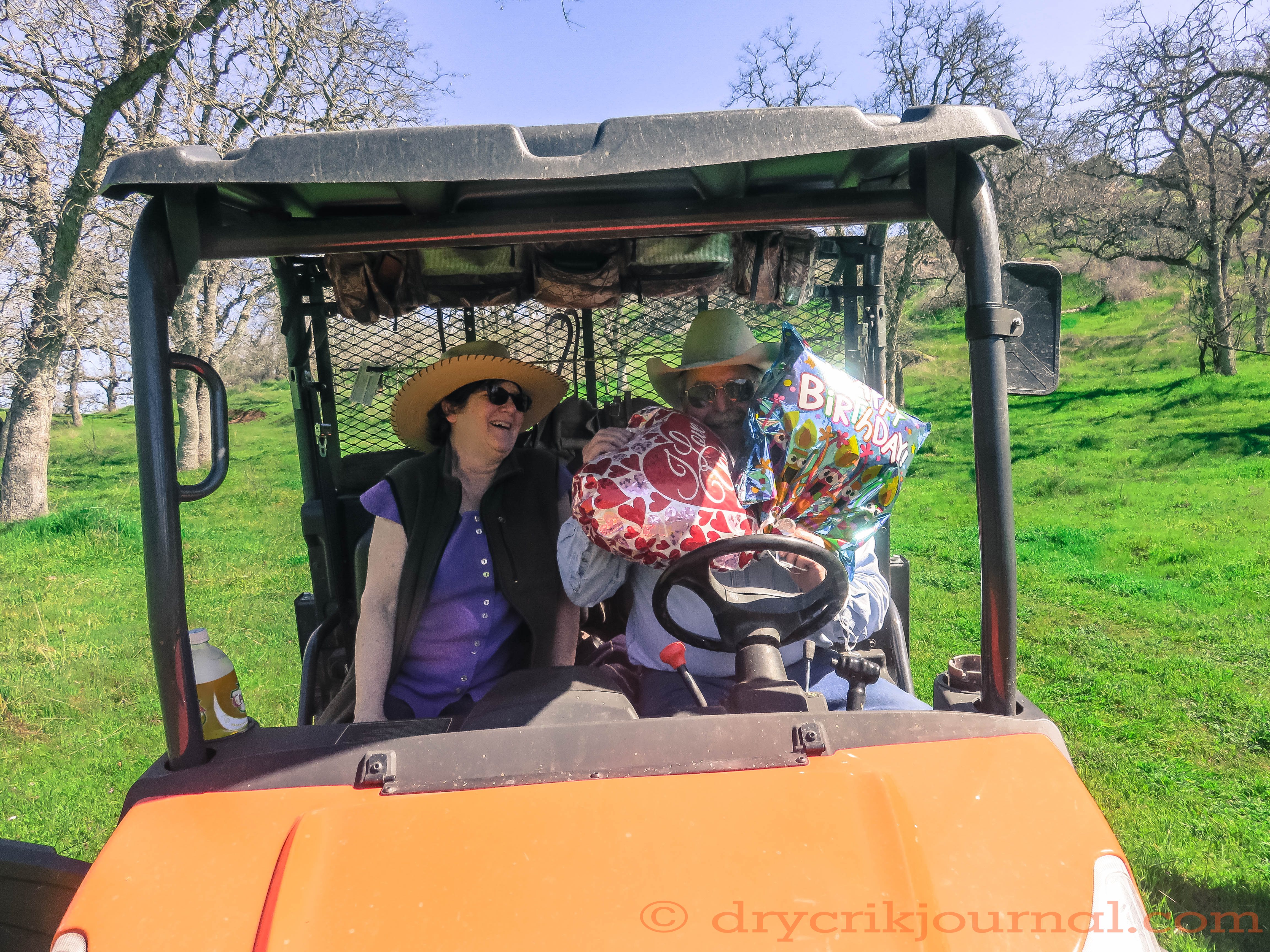
With two saved from oak tree entanglements, they had to endure my rant about why mylar balloons ought to be illegal.


Thank you, dear friends for helping to prove that you’re never too old for a picnic.


KAWEAH PEAKS


Summer water banked
above thirteen thousand feet
to leak as needed.