A season teeters
on the beam, calves condensing
strong grass on the hoof.

A season teeters
on the beam, calves condensing
strong grass on the hoof.
It doesn’t seem all that long ago (mid-September), when our first-calf heifers began calving with no real rain until mid-November, and only 3 inches through the end of February, one of the driest starts to our rainy season on record. We fed a lot of hay and fortunately we had some dry feed leftover from the year before, but a tough start for a two-year old, first-time mother and calf.
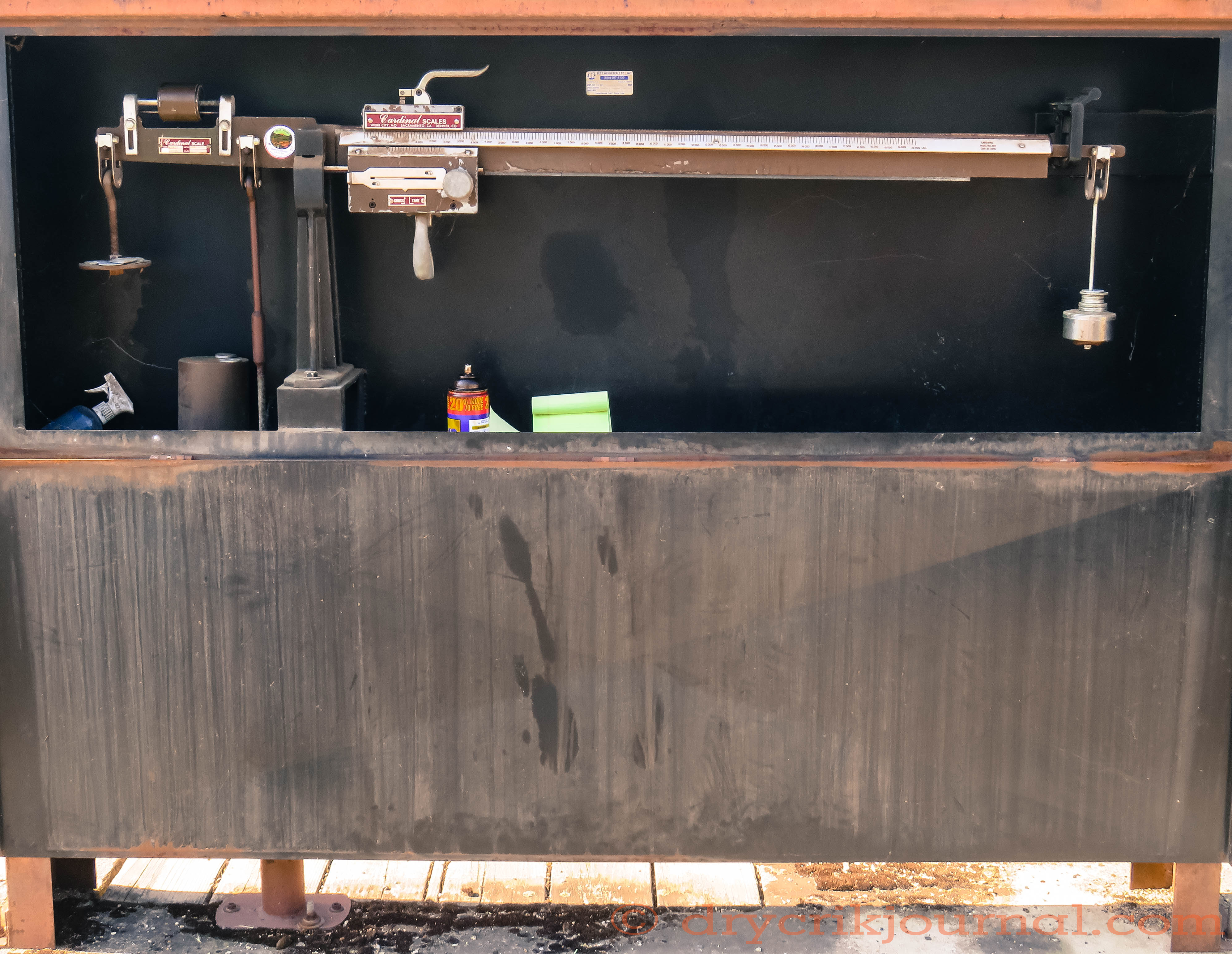
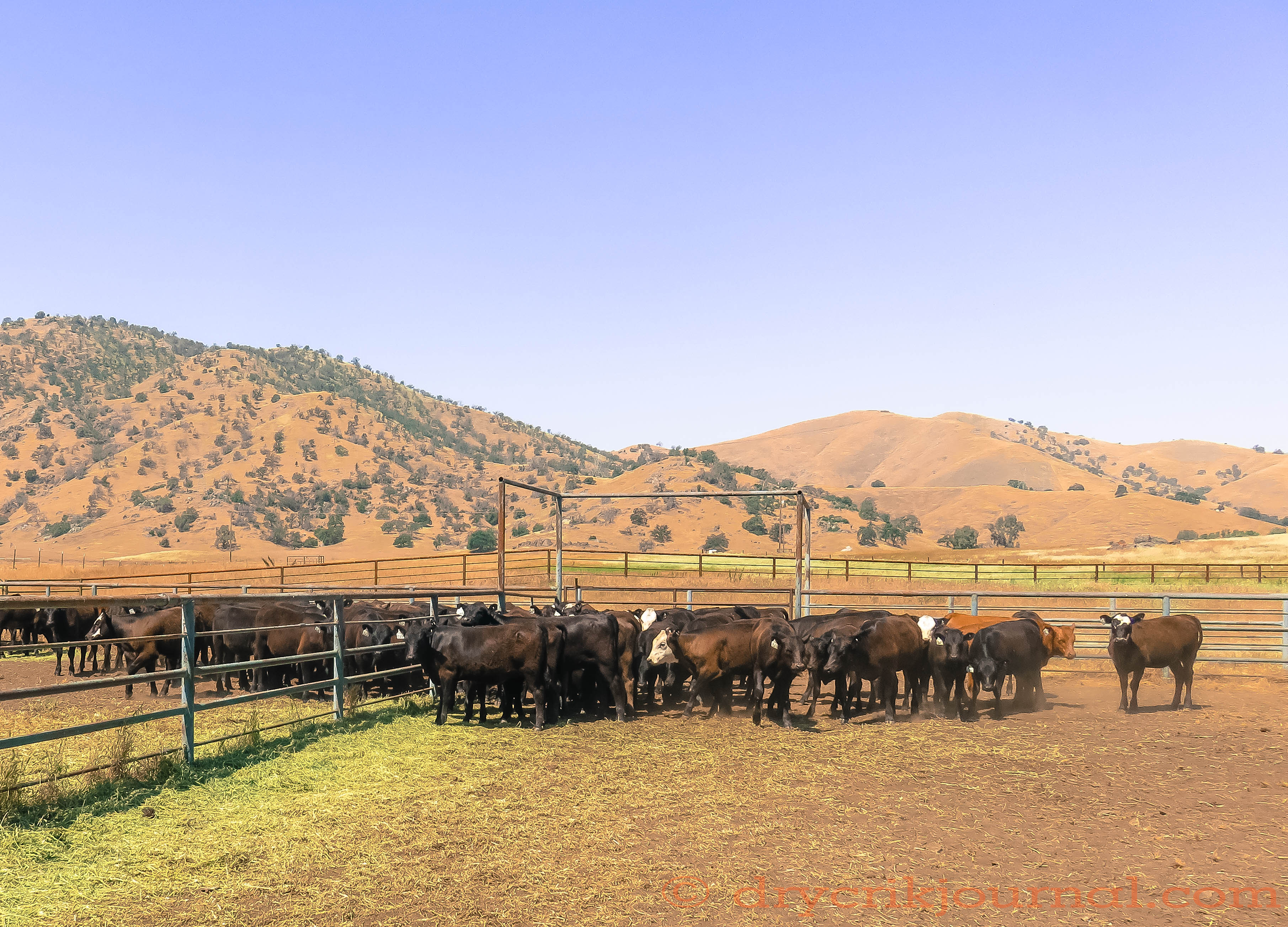
Thursday morning, these steer and heifer calves leave for Connell, Washington for Agri-Beef’s Snake River Farms’ program to be marketed as American Kobe Beef where they’ll be fed for 400-500 days. This is our second load of Wagyu X calves and typically we take the calves from their mothers, weigh and sort steers from heifers, then load them immediately onto the truck. However, since we’ve increased the number of cows that we breed to the Wagyu bulls, the first-calf heifers are pastured in two different fields two miles away from our loading corrals and scales that requires us to haul the calves. Half of the calves pictured above were weaned Monday, the balance yesterday as they wait for the truck.
Weaning is a stressful time in a calf’s life, and stress can be measured in pounds, and hence in dollars. It can also leave them susceptible to various respiratory problems. For these calves, this is not an ideal scenario, but temperatures are relatively cool and we’ve sprinkled the dust down, hoping for the best as we feed good alfalfa hay morning and night.
The rule of thumb for the time to wean an English calf is a week, but over the years we’ve noticed that after three or four days they’ve forgotten their mothers. Compared to our English calves weaned off mature cows, the Wagyu X calves generally weigh about 200 pounds less, but their mothers at two years old put on another 200-300 pounds while raising their Wagyu X calves. Quite remarkable, when 30 years ago we wouldn’t breed a replacement heifer until she was two to avoid calving problems or stunting her growth—all due to genetic improvements.
Assuming weight is a measure of stress, I don’t believe the calves will lose that much weight. What may be a pricy experiment, we weighed the calves off the trailers to compare to the shipping weights Thursday morning to prove or disprove our hypothesis. We’ll see.
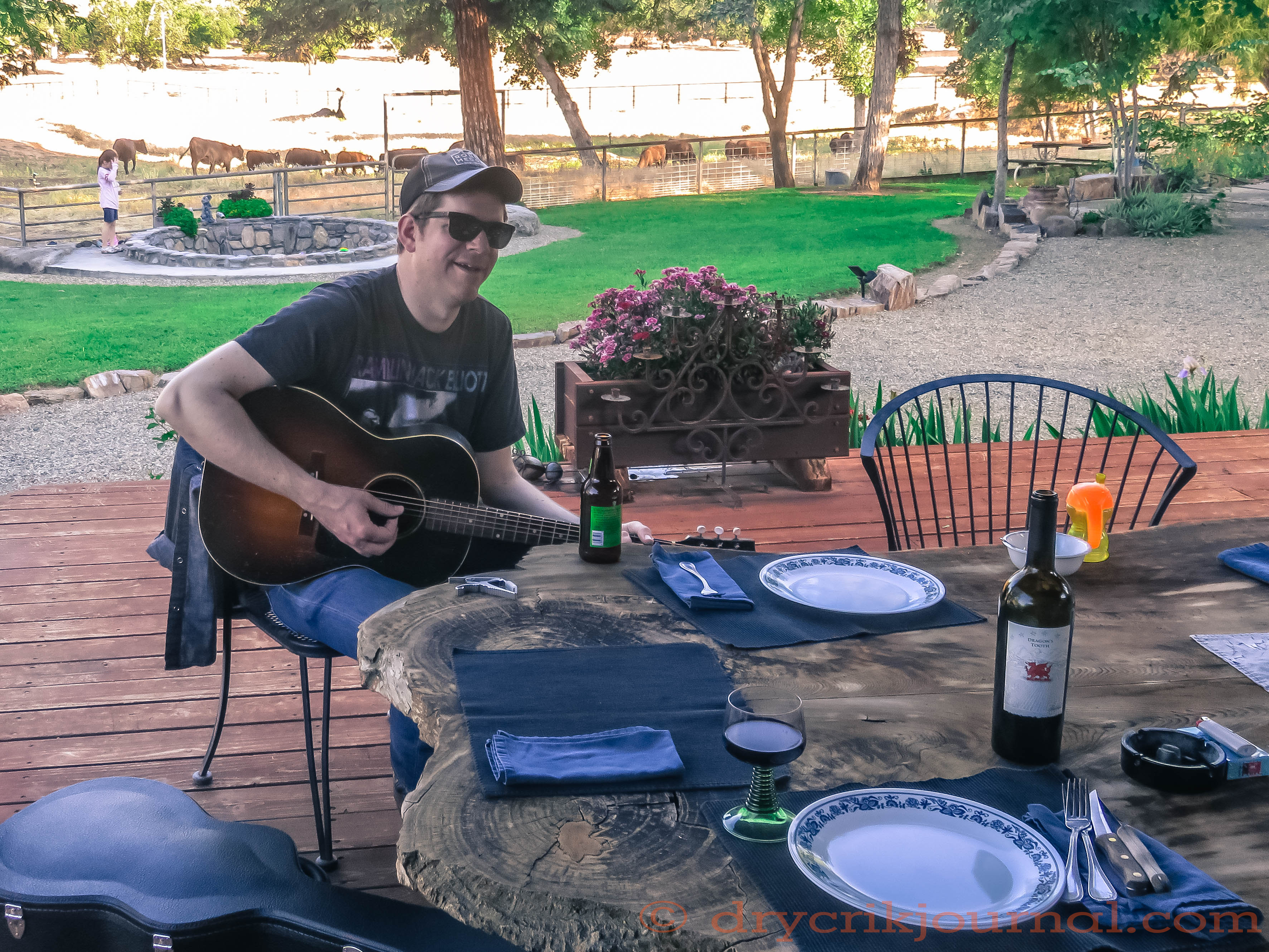
Amid gathering and shipping our first load of Wagyu X calves, we enjoyed the company of Andy, Alissa, Maggie Rose, Jubal and Josiah Hedges before they headed to Santa Cruz where Andy will play at Flynn’s Cabaret tomorrow night (May 11th), 8 p.m.
Jubal’s first step out of the car was toward a freshly transplanted flower to give to his mother Alissa. (I’m told there’s damn few flowers in West Texas.) Maggie Rose spent an afternoon in the ‘sip and dip’ training a young bullfrog while Josiah kept busy looking for something new to get into. Andy, Alissa and Robbin sang while swapping guitars until midnight—many delightful hours with a wonderful family we will cherish for a long time.
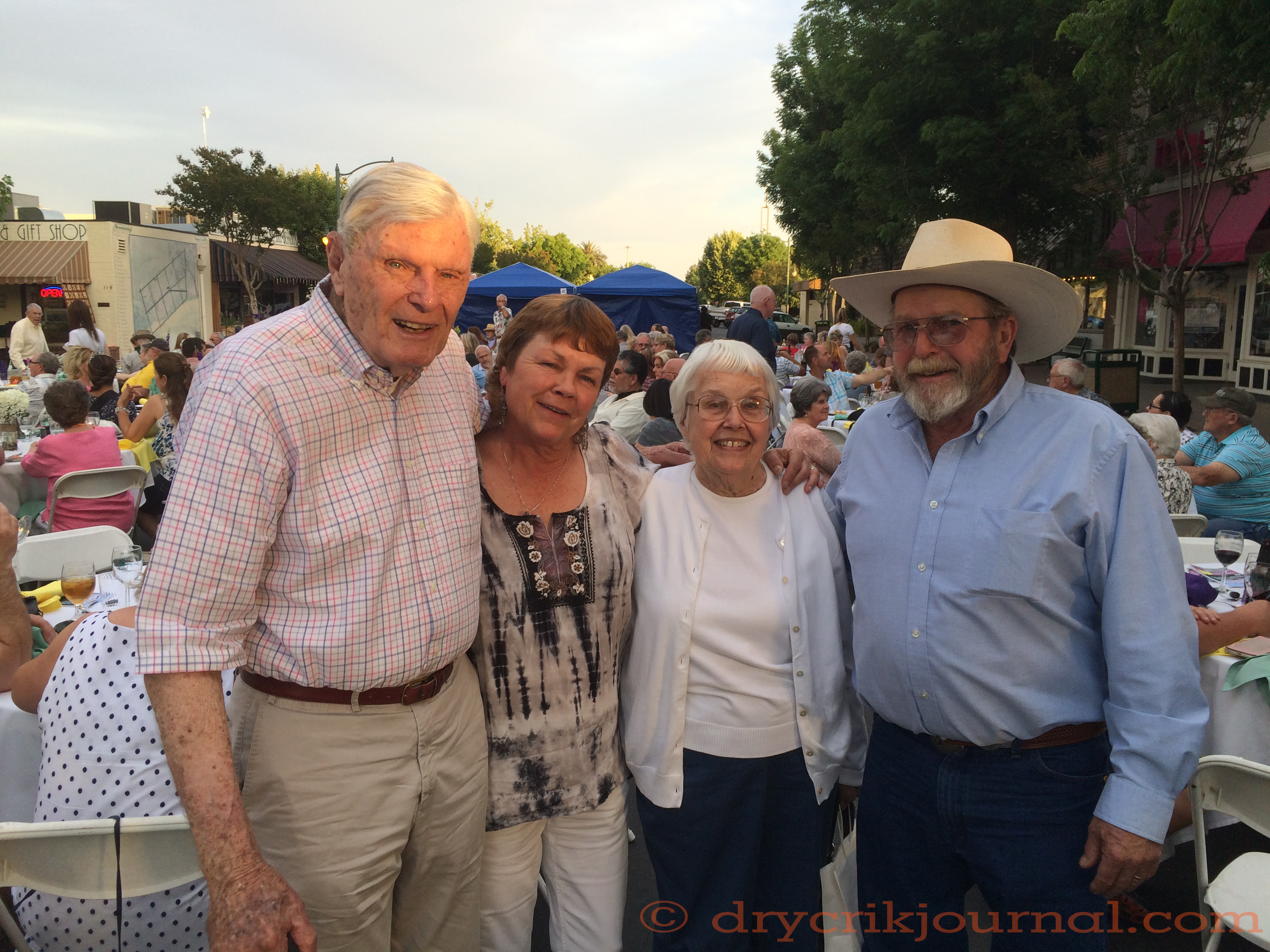
I was humming Ricky Nelson’s “Garden Party” yesterday while working in our own garden, but the song was triggered by the Exeter Garden Party, a fundraiser sponsored by the Exeter Chamber of Commerce, that we were invited to last evening by our Dry Creek neighbors Steve and Jody Fuller. The highlight of the annual event for us is being able to visit with Dick and Pat Jacobsen of Rocky Hill Inc. From long-time pioneer families, both Dick and Pat have a wealth of historical information.
I went to the Lincoln School in Exeter until the fifth grade where Pat (Pogue) Jacobsen first began as a teacher. Last night she reminded me once more that my sister Virginia was the perfect student and that I was an incorrigible little boy. My memory of those days is hazy, but to be among children our age while living out in the country could easily become an adventure.
Dick asked me if I’d read Bill DeCarteret’s “Mountains, Mules and Memories” and told a story about a mule named Dynamite that he and John Crowley had taken on a pack trip. I’d packed the mule myself and swapped the story of a layover day in the High Sierras (unbeknownst to Bill) when a couple of young packers thought they could saddle and ride him. Typical of most mules, Dynamite was willing to endure being packed, but not being rode.
I referred to Dynamite as one of a half-dozen Number Nine mules that Bill DeCarteret had in his string, knowing that the mules had come from the Oregon Ranch that Jim Pogue owned. Pat went on to tell me that “9” branded on their hips was a really a “JP” and that the mules had draft horse mothers that her dad had bred, which accounted for their extraordinary size and endurance.
Exeter hasn’t grown much since I was a boy with a population of about 4,000, today it’s 10,000, but it’s a delightful, well-kept town with many service organizations. A throwback to the old days, it’s always a pleasure to do business in Exeter. It was a delightful evening, but I suspect we were the only ones talking mules.
Posted in Photographs, Ranch Journal
It may be a softening that comes with age, with lots of time among animals reading their thoughts as they try to read mine, my body language not near as brusque as when I was younger, eager to get the job done. Whether palpating cows or processing calves, I’ve always dreaded the rattle and bang of the squeeze chute as the animal strains against the procedure, one after the other like an assembly line until the lead-up is empty.
As a crew, we work well together, find our rhythmic pace as vaccinations, electronic ID tags and dewormers are applied. Having to use an old squeeze chute for half of our Wagyu X calves this year, it was easy to compare it to our relatively new hydraulic squeeze, the latter designed to be much easier on both man and beast.
The animal’s approach to the old chute is usually hard and fast, hitting the head gate abruptly, banging shoulders and brisket before squeezed manually, hooves often thrashing. Though our hydraulic Silencer was considerably more expensive, cattle enter it more quietly before their heads are caught, shoulders against the padded headgate, and they seem comforted, more apt to stand docilely. All these years, it has been the old chutes, the rattle and bang and all that they imply that I have dreaded most—the Silencer is well-named.
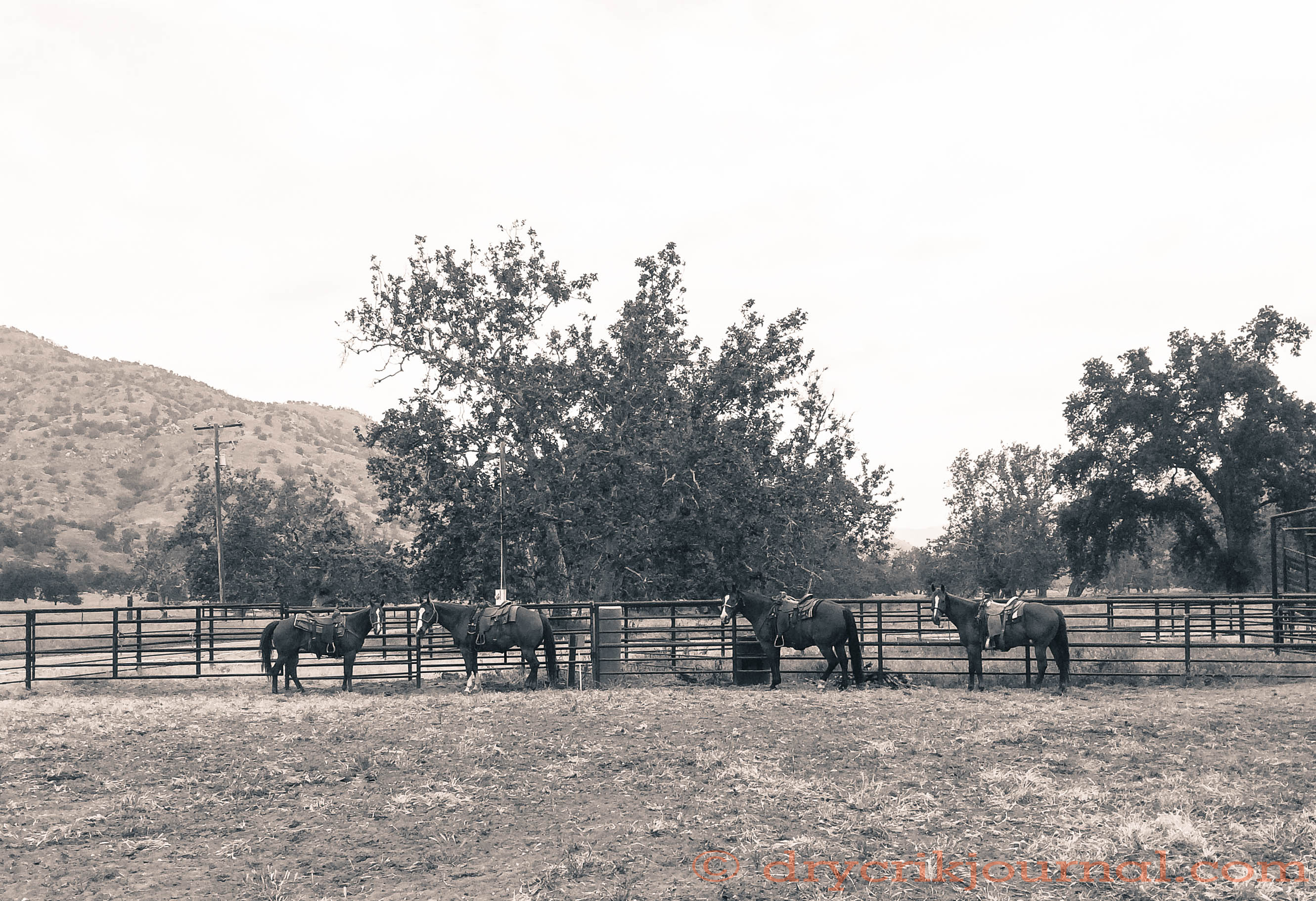
We finished processing our Wagyu X calves yesterday, the first load ready to ship on the 10th. The horses seem to enjoy watching us work, waiting, while we are waiting to give cows and calves time to find one another and relax before turning them out, to head home.
Some born late, but
no leppy calves due
to lack of mothering,
I want to throw
my chest out as if
I was the Wagyu sire
as they wait for shots,
a second-round of vaccinations
and EID tags destined
for more feed, for high-dollar
plates all around the world
pending its politics.
Posted in Photographs, Poems 2018, Ranch Journal
Tagged EID Tags, photography, processing, Silencer, Wagyu X

There is no escape for weeks
looking down on a small world
beneath a thatch of twigs—
no way to hide from sun, storm
or crow until the leaves come
to wait for shadows out of the blue
heavens with or for a meal—
no guarantees that what they see
is good or bad, just real.
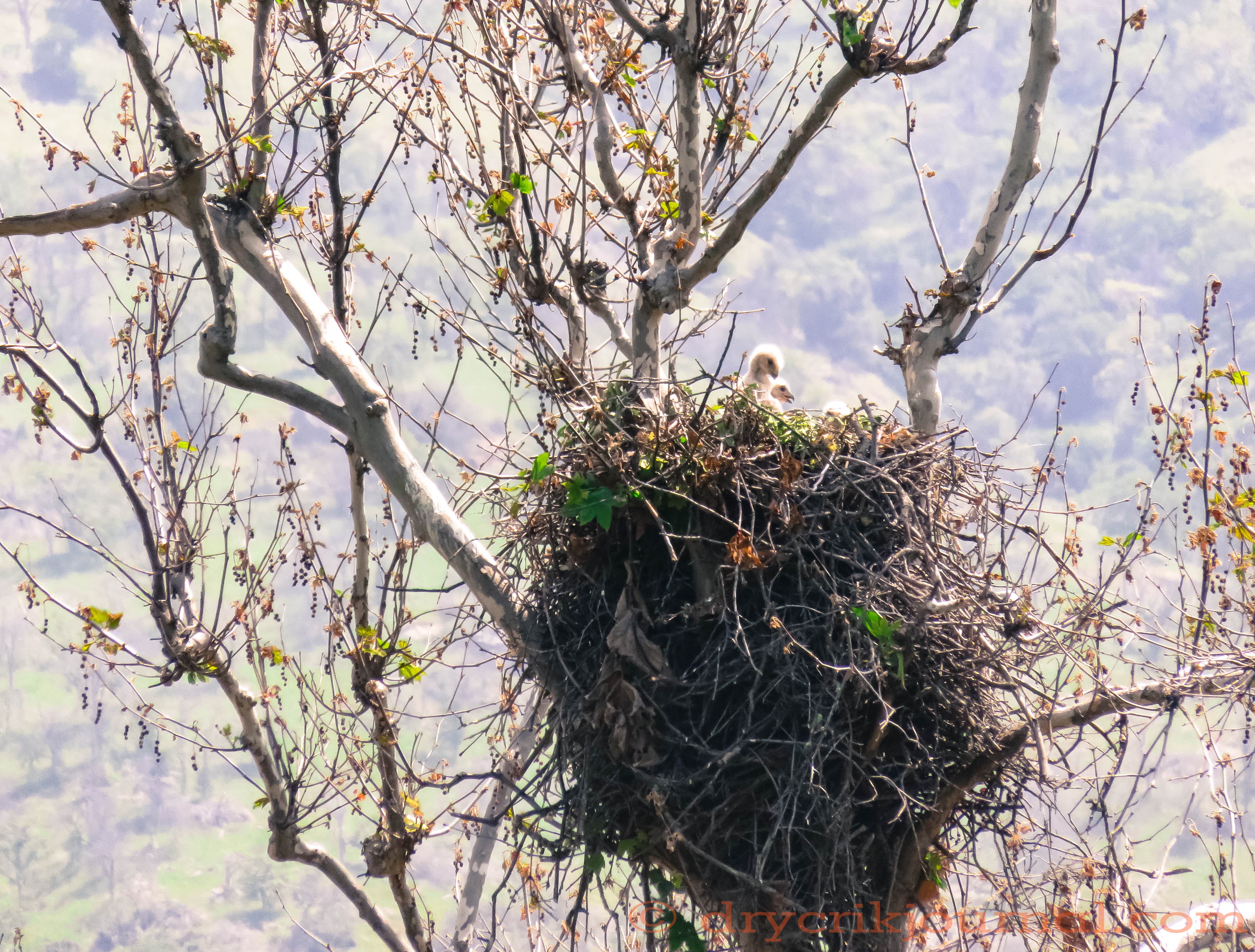
Robbin and I had the luxury of looking at cows and calves in our upper country yesterday when she spotted this Golden Eagles’ nest.
Posted in Photographs, Poems 2018, Ranch Journal
Tagged Golden Eagle, photography, poetry, wildlife

As we approach the end of our grass season, we’ve begun processing our Wagyu X calves before we ship them to Snake River Farms in Idaho around mid-May to be fed and sold as American Kobe beef. Each calf receives a second round of vaccinations and Electronic ID tags consisting of a unique 15-digit number that can be read both visually and electronically, denoting the country of origin and complying with the requirements of disease traceability. Calves destined for the export market must have EID tags.
Born after the first of September, the calves have had a tough start with only 3 inches of rain accumulated by the end of February, but seem to have done remarkably well since our March and April rains. However, I don’t expect them to weigh as much as in past years.
Once the Wagyu X calves are shipped, we will take these cows, mostly second-calf mothers bred to an Angus bull, up into the Greasy watershed as we begin weaning our English calves. With a little luck, we ought to be done weaning by the first of July. With temperatures breaking into the 90s, we’re bracing for our usual summer heat.
Mustard yellow greens
under a blue sky, cows wait
for some direction.

Six bunnies in the driveway as the grandkids and I fed the horses yesterday morning, drab Cottontails, but appropriate symbolism that drew excited squeals, yet underscored with knowing looks about the validity of the Easter Bunny. It was a messy feeding, half the flakes never made the manger, each child covered with alfalfa leaf, but the horses didn’t seem to mind the little strangers. In the Kubota, we prolonged the chore by naming the birds we saw, a covey of quail, a dove pair, a lone killdeer and blackbirds grazing the short-cropped green in the horse pasture.
Hoping to expose them to more wildlife, we took the crew to the corrals in Greasy that we just finished constructing, a project that Earl McKee began a decade or more ago. Even though we kept two of the three board pens intact, the interface with pipe required removing some posts and boards and losing an occasional thirty-penny nail. Each kid got a coffee can and the hunt was on for nails worth two-bits a piece, a practice run for plastic eggs filled with sweet surprises that my daughter was hiding in the dark as I went to bed. HAPPY EASTER!
Not much to do for the past three days but watch it rain, over four inches in the past ten days.
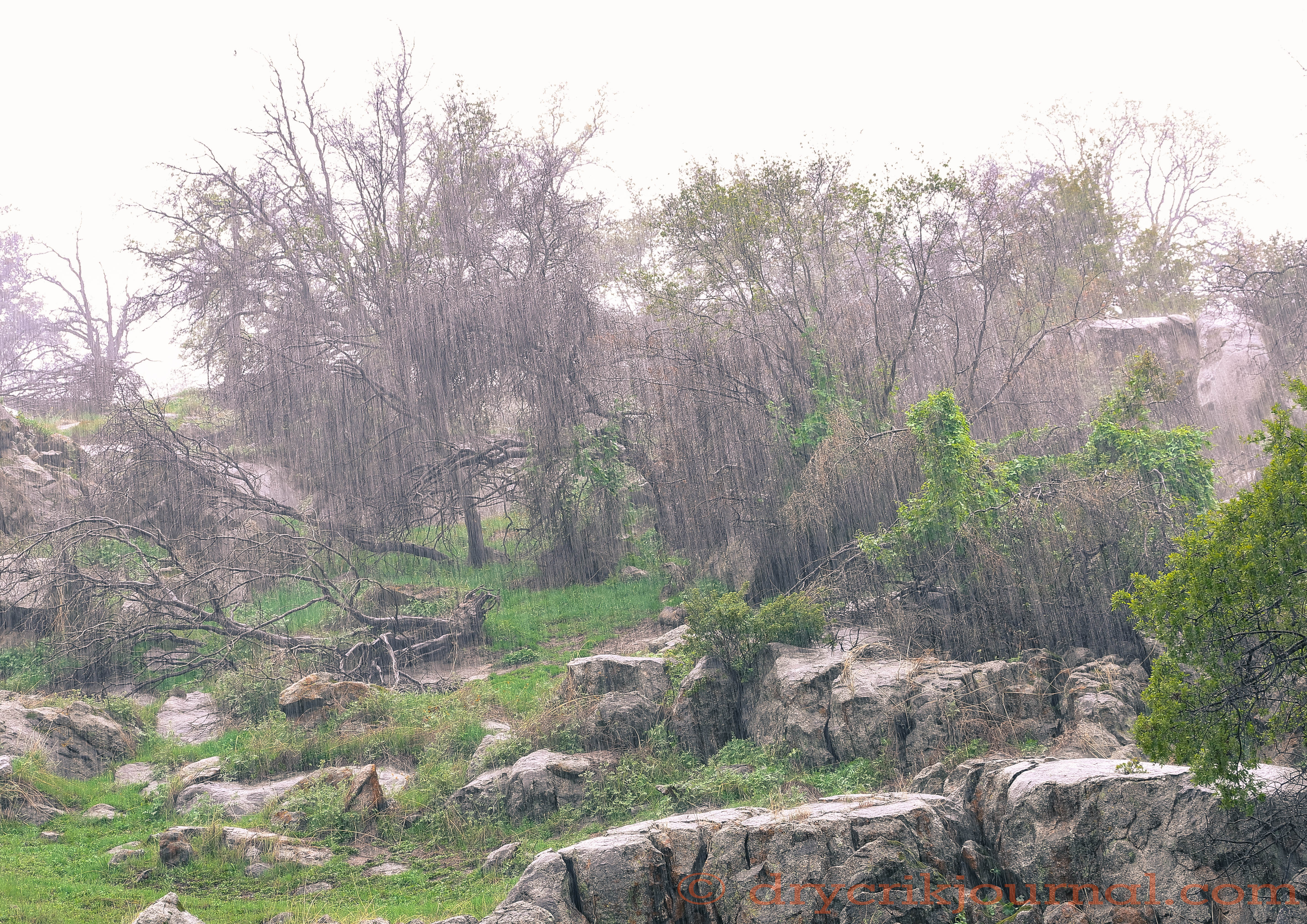
It’s a warm, 67 degrees with another half-inch in the gauge since this morning, bringing our total rainfall to over six inches for the month of March. Prior to February 26th, rainfall was 25% of normal. More due tonight.