Tag Archives: Calves

Hereford Show Calf

20161002-a40a2152


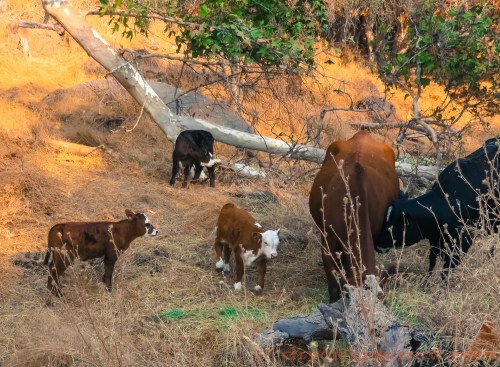
It was chilly this morning when Robbin and I left to look at the calves on the Paregien Ranch, going up Ridenhour Canyon along the way. Though we employ a few select Hereford bulls for heterosis that have added frame, durability and a calmer disposition to our cowherd, we typically don’t have too many straight Hereford calves. At 30 days old, we caught this bull calf posing in the canyon’s early light as if he was aspiring to become an FFA/4H show calf.

Since we posted a photograph with his mother at five days old, I thought it appropriate to include a photo of his father, Ruger 119 from Mrnak Herefords West, ready to go to work for his fifth year on this ranch.

 

20160929-a40a2099


Born Without Fear


20160928-a40a2040


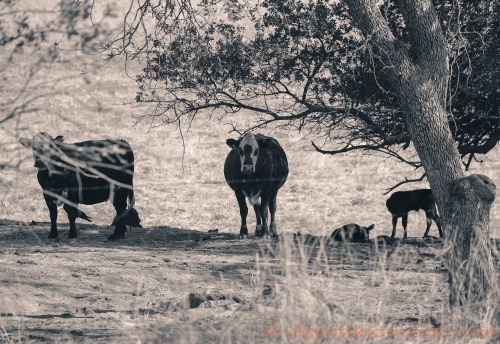
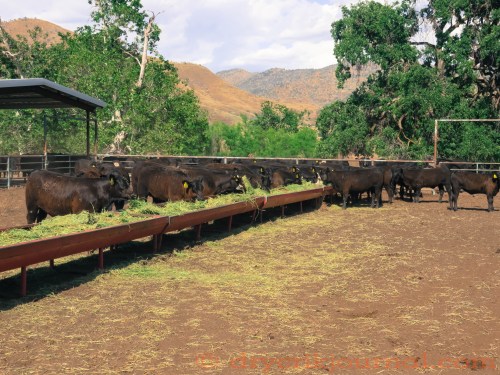
A few days old and separated by 150 yards from his mother among a line of cows feasting on alfalfa, this bull calf returns home, to one of several shady pockets or nurseries where the calves are laid down after nursing. In good shape, we try to limit feeding this bunch of third-calf cows to once a week to reduce the pandemonium when the hay arrives—a new experience for this calf fresh into this pasture. Every cow’s head down, he’d walked the line back and forth, his calls unanswered, hot and frothy when he and another older calf wandered towards me, the older gently guiding, head to neck, the way to the nursery. The older calf immediately claimed the shade he must have risen from when the hay arrived, the younger calf still assessing his place in the world through the twigs of a fallen sycamore.


VISITING FAMILY


20160927-a40a2009


1.
I am lost in a blond pasture
of cows with calves,
lone silhouettes under oaks

stressed by years of drought—
or nurseries: black lumps
around a cow—

the expectant gathered
under sycamores watching
babies steal the show.

2.
Hanging in the leaves,
estrogen
rubs off on me

each pair bonding
differently—
love’s rough tongue

or murmuring song,
some taught to follow
the swing of an udder.

3.
Closer with each visit
we become family
with gesture and tone—

all the poetry
unnecessary
from now on.


Twins


20160925-img_5730


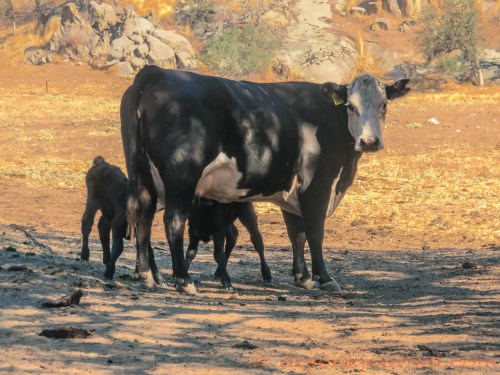
She was not thrilled to have twin Angus calves, but we’ve been watching 3024 since they were born ten days ago, having gone so far as to make arrangements for bottle feeding one of them if necessary. As it turns out, the calf on the left was the one roused by two coyotes in our post of September 17th, when hours old and left in the middle of the pasture. It’s not unusual for a cow with twins to abandon the weakest, but now this cow seems to have acquiesced to her plight, both calves healthy and much stronger than they were. Whether she is keeping better track of them both, or the weaker calf is keeping better track of her is another question. She has plenty of milk and if she can raise them both, she’ll do a better job than we can do.


REFRESHED RELIEF


20160921-img_5727


All this time, decades of learning and relearning
reapplied to new devices designed to save time—
to bank, spend or squander somewhere in the future

with no guarantees made selfish sense, a singular
detachment from the congested urgencies swirling
like autumn’s colored leaves in a quest of rest

and peace. How he craved the storm’s building
energies, the dark electricity thundering rain
to erase time’s tracks, that might freeze the moment

into days and weeks. Old flesh come alive
with the prospect of starting over again, cotyledons
of grass for cows and calves—a refreshed relief.


EQUINOX 2016


Terri Drewry photo

Terri Drewry photo


Long shadows on blond feed tall,
standing skeletons of oaks from drought,
the gray cow caught talking with an iPhone
to her new, silver-belly calf.

No audio, too far to catch the vocabulary
lesson, the inflection of each murmur
into song, the guttural beginnings of all words—
a universal language of basic sounds

with deep meanings that defy time
and cultures, that survive the latest plague
of progress and the genius of science—
no better teacher than a mother cow.


FIRST WAGYU X


20160917-a40a1921


One would think that after 46 years of calving first-calf heifers, we’d be more relaxed about such a natural process where maternal instincts usually insure a successful calf crop. But I confess our anxiety is high this time of year, perhaps in part because we’ve seen all different kinds of failures from coyote kill to breach births to heifers more social than maternal who leave their calves alone too long to gossip with the other girls.

This morning before checking the first-calf heifers bred to Wagyu bulls, I drove up the road to see two coyotes taking turns trying to hamstring a brand new Angus calf belonging to one of the third-calf cows who was nowhere around. My shot that missed sent them off in different directions, but they’ll be back. While checking the calf, its mother showed up, looking to take me as I rolled it over to make sure it was OK.

Not far away, a first-calf heifer across the fence was down in labor, two feet showing when she stood up. I left her to check the rest of the first-calf heifers. About an hour later I returned as 5176 was licking off our first Wagyu X calf of the season.


THIRD CALF


20160904-a40a1837


She knows now,
how to be a mother—
shield innocence

with shadow
and sharp eye,
give meaning

to the soft talk
that reverberates
with familiarity

upon each breath,
the language of cows:
the umbilical stretched

from the warm womb
to grow and graze
a dry and brittle world.

Born in a drought,
she can be a mother
in any kind of weather.


New Year


20160904-a40a1824


Try as we might to push our calving date back two weeks to avoid the first of September heat, the bulls would hear nothing of it, repeatedly visiting our neighbor’s virgin heifers intended for Wagyu bulls. Also, we were under the influence of Big El Niño prognostications, wet weather for the first half of December that could hamper hauling the bulls up the hill to our older cows. With the stars and daylight hours aligned with our bulls’ internal clocks, we opted to let them go to work rather than having to bring them home and fixing fence everyday.

Nine months later, our own internal calendars click to new beginnings as the calves come, a new season and new year as we begin to leave summer behind and wait for the first rains to start the green feed, that unpredictable time of year when we harvest grass with cows to raise another crop of calves. Welcoming the shorter days, we’re saddled-up and ready, looking forward to another wild ride.


20160904-a40a1834


Weaning


20160517-IMG_5521

Gathering our lower country, we’ve begun weaning our calves where they’ll ‘soak’ in two different corrals for a week before the steers go to the auction yard in Visalia. The heifer calves will go to the irrigated pasture, open to plenty of dry feed, until the replacements are sorted in July.

20160517-IMG_5520

This year, after separating the calves from their mothers, we processed all with Inforce 3, a respiratory booster to the vaccination received at branding that is administered nasally. It acts immediately and should relieve any respiratory problems during the stress of weaning. Also, the calves received a topical dose of Cylence for the control of flies. Due to the tall dry feed, we had a number of eye problems, primarily foxtails that we doctored as we processed them.

All of these calves were sired by Vintage Angus bulls and weighed an average of 700 lbs., the heaviest to date from our lower country. We are pleased, of course, with their weights, but happier yet to get started with our weaning. Lots of music in the canyon, cows and calves bawling for one another.