LOOKING DOWN

In spring, we take a deep seat
and watch water run, follow
green up into infinite blue,

trace our ridgelines to walk
among the helpless dead –
talk with family and friends

so bored with their reward
they have come to visit when
heaven rests upon the earth.

But looking down into grass
gone blond with hollow stem,
past light and empty heads,

I find my infinite ignorance
in the dirt where I depend
on living, upon nameless

seed of grass and weed
busy ants save like grain,
that birds regurgitate and

winds take to another place –
like me someday scattered,
just trying to understand.

Scattering the First Calf Heifers

Bob and Zach taking some of our first calf heifers, exposed to the Wagyu bulls and due in August, to water. Beautiful cool/cloudy day after .61″ of last night’s rain – all went well.

Robbin bringing some first calf heifers up the creek.

Bob, Zach & Robbin, with another bunch, at water.

Weaning

6.4.11

Pacing ourselves well, a few of the calves above that we have been weaning the past two weeks. The weather’s been exceptionally cool with a forecast warming into the low 80s until this weekend. We have yet to see a day over ninety with the summer solstice less than three weeks away. .04″ rain this a.m. Extraordinary!!

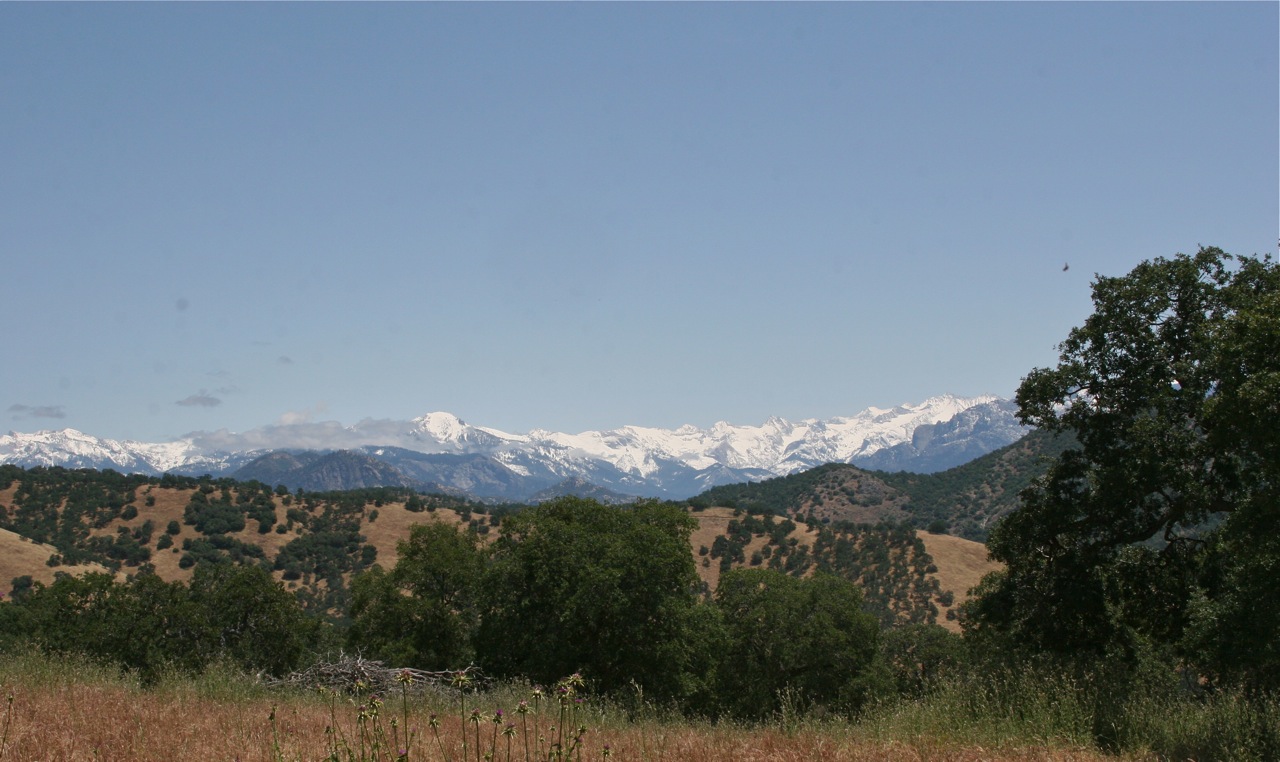
Kaweah Snowpack

May 30, 2011

Sulphur Gather to Wean

SONGWRITERS

Train of days in the luxury of space,
a man lays tracks, wears a path
as seasons change – a woman, too,

rearranges rocks to fit her mood,
saves a place to live among all
the creatures that fly and crawl.

We learn their names. Even those
anchored to this earth remind us
of the grim and grand, the lasting

truth that ‘nothing stays the same’.
So we emulate without knowing,
learn their rhythms we wear as totems,

praise their names. And when the train
stops and the gods come out to sing,
we can join them in a familiar song.

NEA

Thank you Amy Kitchener of the Alliance for California Traditional Arts ACTA in Fresno, an organization she co-founded in 1997, for inviting me to lunch last Tuesday (May 24th) with Rocco Landesman, Chairman of the NEA on his first visit to the Central Valley. The purpose of the lunch meeting, that included twenty or so local traditional artists, was Creative Placemaking, approaches through cultural activities to enhance the character and identity of neighborhoods, cities and regions. In my little canyon most of the time, I was once again surprised to see that the San Joaquin Valley is indeed a melting pot of many cultures. The NEA’s new slogan ‘ART WORKS’ seems an ambitious and sensible approach to enriching all our lives.

Richard Hagopian and his grandson on the drum opened with some traditional Armenian music and Julie Tex and her daughters demonstrated Mono Basketmaking. Mas Masumoto and I read to conclude the lunch in the Coke Hallowell Center at the San Joaquin River Parkway. ACTA Board Member Malcolm Margolin of Heyday was in attendance, bringing a small slice of his Great Valley Books. (His press, releasing a new collection every two weeks, focuses on California.)

Coincidently, I was questioned recently about NEA’s ‘subsidy’ of cowboy poetry, all stemming from the unsubstantiated comments on the Rush Limbaugh radio show last month. I continue to be dismayed that despite the facts, people believe what they want to believe – like gathering acorns, looking to fill their empty baskets.

NEA

Spiny-Sepaled Button-Celery (Coyote Thistle)

Spiny-Sepaled Button-Celery (Coyote Thistle), Dry Creek, 5.7.2011

California Native Plant Society: Inventory of Rare and Endangered Vascular Plants of California (2001)

WEANING

We’ve begun weaning calves, a plaintive chorus at the corrals in Greasy and along Dry Creek, as mothers check-in and locate their babies between grazing. The older cows know the routine, some looking forward to the process. The calves average 600 lbs. or more, no longer dependent on mother’s milk. The separation is mostly emotional, a fence between them for the first time in seven months, but the calves quickly adapt to good alfalfa hay, stay full and quit bawling in a couple of days. The cool weather has been ideal, as we work to control dust in the corrals that can create eye problems and even pneumonia. Our process lasts seven days before we turn the calves out on the irrigated pasture, supplemented with more hay that has skyrocketed this year to over $300/ton.

We’ve also been gathering last year’s heifer calves that were exposed to the Wagyu bulls during the winter months, to make room for the cows we just weaned, to make room for this year’s weaned heifer calves to be bred to the Wagyu. We’ll drive the first-calf heifers up the creek and split the bunch between two pastures around the house so that we can keep an eye on them as they calve this fall – our harvest and preparation for the next crop.

A busy time of year as we also cull some of the older cows that may have difficulty supporting a calf at the colder and higher elevations of the ranch, inserting some of the younger cows in their places, keeping our pastures stocked. We have a plan that can get confusing, at times, as we try to adapt to feed and weather conditions, as well as changing market demands and opportunities – trying to stay flexible and ever aware of our slow cash flow before our annual payday.

Long advocates of small family farms and cattle operations, we see the efficiency of seeing all our cows in the corral this time of year, not having to depend on second-hand assessments and descriptions as we prepare for the next calf crop. Then also, there is the special satisfaction we enjoy as we collect our steer calves that will be sold and shipped around mid-July, guessing what they’ll weigh against their weaning weights. Because we can’t wean them all at once due to the configuration of the ranch, we will be busy for next two or three weeks, so posts may be sporadic. Thankfully the temperature has been cool, making it easier on us all.

Opening the Dry Creek Preserve

Sopac Mulholland, JCD, Scott Spear, Hilary Dustin - photo: Laurie Schwaller

Twenty five years ago, Tulare County issued a Conditional Use Permit to mine rock and gravel here – in 1985, or thereabouts. It was controversial, but it also brought a community together to insist that the operators comply, and that Tulare County enforce, the conditions of that permit.

The Dry Creek Preserve is symbolic, because this is where growth and development has stopped for a moment on Dry Creek, and Nature has taken back over. This is an experiment, an experiment in reclamation, and an experiment in public access, a new land use on Dry Creek that will be managed by Sequoia Riverlands Trust. SRT

I am honored to cut this ribbon on their behalf, on the behalf of my mother and father who understood the forces at work from the beginning – on behalf of this community of families on Dry Creek who were forced to adapt to the drastic changes that rock and gravel mining brought here, and for the many with vision outside this canyon who supported us, offered us hope, direction and their expertise.

We welcome this new beginning.

photo: Laurie Schwaller - art: Matthew Rangel