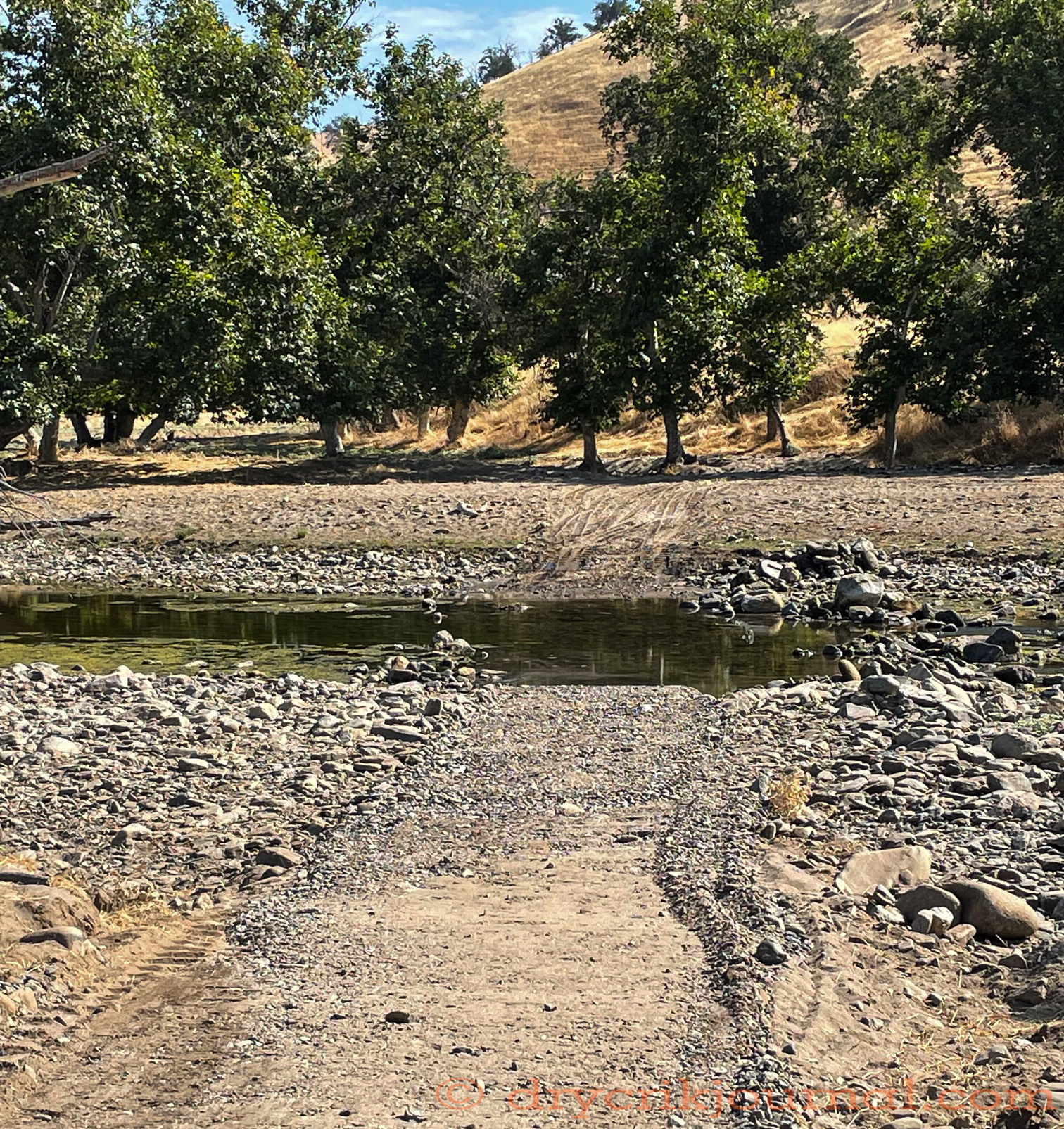
I don’t recall Dry Creek ever flowing into August, as springs continue to feed this morning’s 9 cfs (cubic feet/second). March’s atmospheric river estimated 8,000 cfs, that scoured the channel and undermined the gauging station, left few places to cross the resultant boulder fields and cutbanks. Only now, as our cattle work winds down, do we have time to address some of the impacts of last spring’s rains.
Both for vehicles and cattle, I had to move our crossing downstream. Moving the big rocks was rough work for the skid steer, but I had all the materials I needed in the high water drifts of sand and gravel to smooth the crossing this morning—less than a three hour job. On the way to the corrals, hoof action of our replacement heifers will smooth it a little more.
We’re looking forward to September when the cows begin to calve, another month of a hundred degree weather that often extends into October, but the hot summer days are getting shorter.
Nobody keeps record temperatures in Lemon Cove, but yesterday’s 101° in Fresno broke the high set in 1927. It was 104° on Dry Creek as we hauled gooseneck loads of weaned calves, gathered the 101° day before, off the Paregein Ranch—three two-hour, four-wheel drive round trips off the mountain. In addition to the calves, we hauled 20% of the cows down to go to town as we prepare for summer with little feed. With less than 8” of rain, our rainy season is over until October, capping a second year of drought. With no snowpack or surface water runoff in California, hay prices are already escalating.
The first few days of 100° heat are hard on people and livestock physically, but we all get out a little earlier in the morning and finish what we didn’t get done in the evening. The most noticeable impact of the heat is to our temperaments, not near as pretty as this white geranium, happy as long as it gets water.







 drycrikjournal