Wild Grape, Dry Creek, July 4, 2013

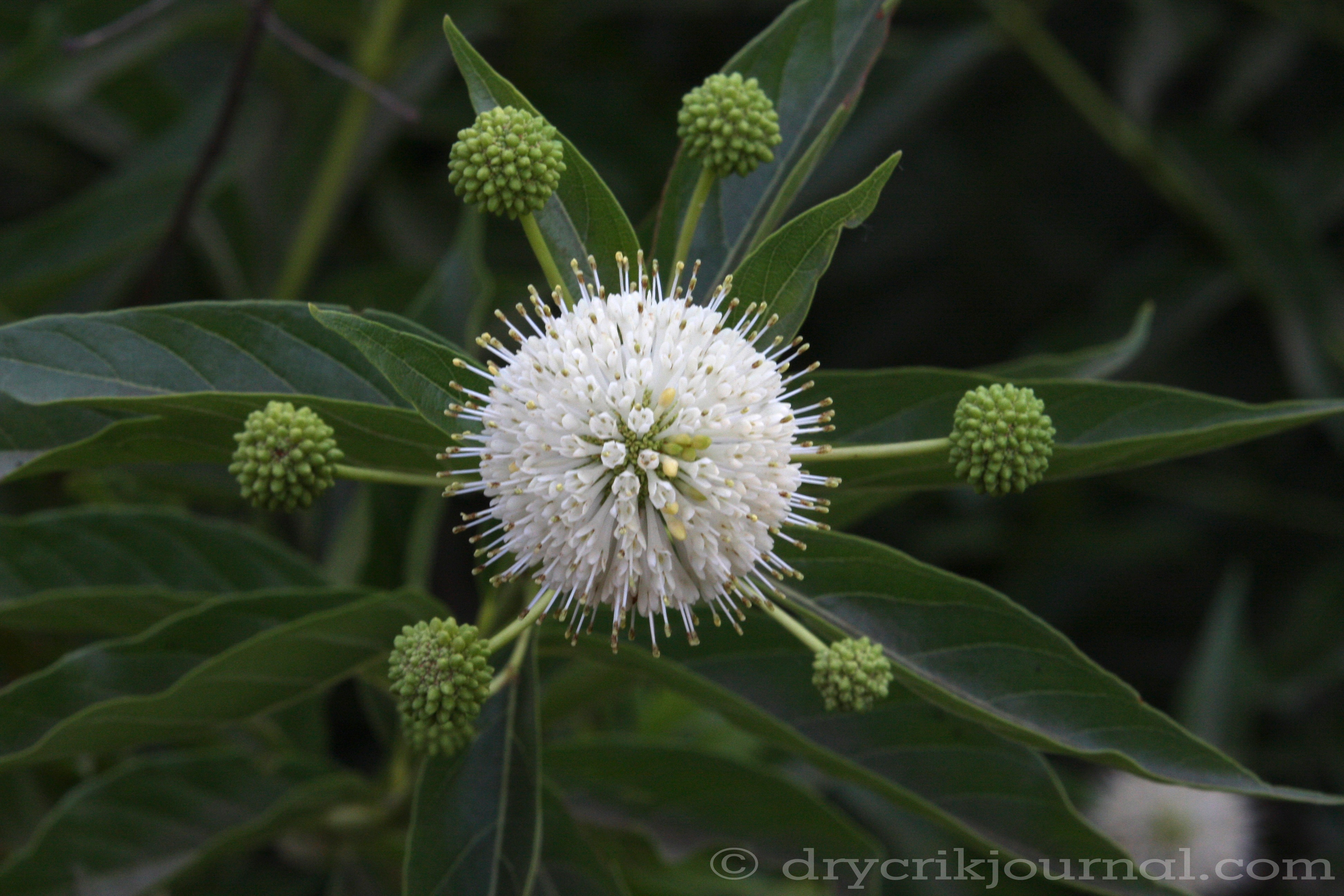
Cephalanthus occidentalis californica

Cephalanthus occidentalis californica
Aaron ‘Slick’ Sweeney spent a lifetime in this country before I came along fresh from college with only a few years of packing mules under my belt. He took me buck hunting for the first time when I was about eleven. He carried a broomstick and I my heavy British Enfield .303. We saw deer, but my eye wasn’t sophisticated enough to distinguish does from bucks on the run at a distance. I never shot.
‘Button willow’ is descriptive enough to know one when you see one, and when he asked me one day in the early ’70s about the ‘button willow spring’ in a certain pasture, I knew exactly where he was talking about. He explained to me at that time that there’s almost always water enough to develop for cattle where there is a button willow tree.
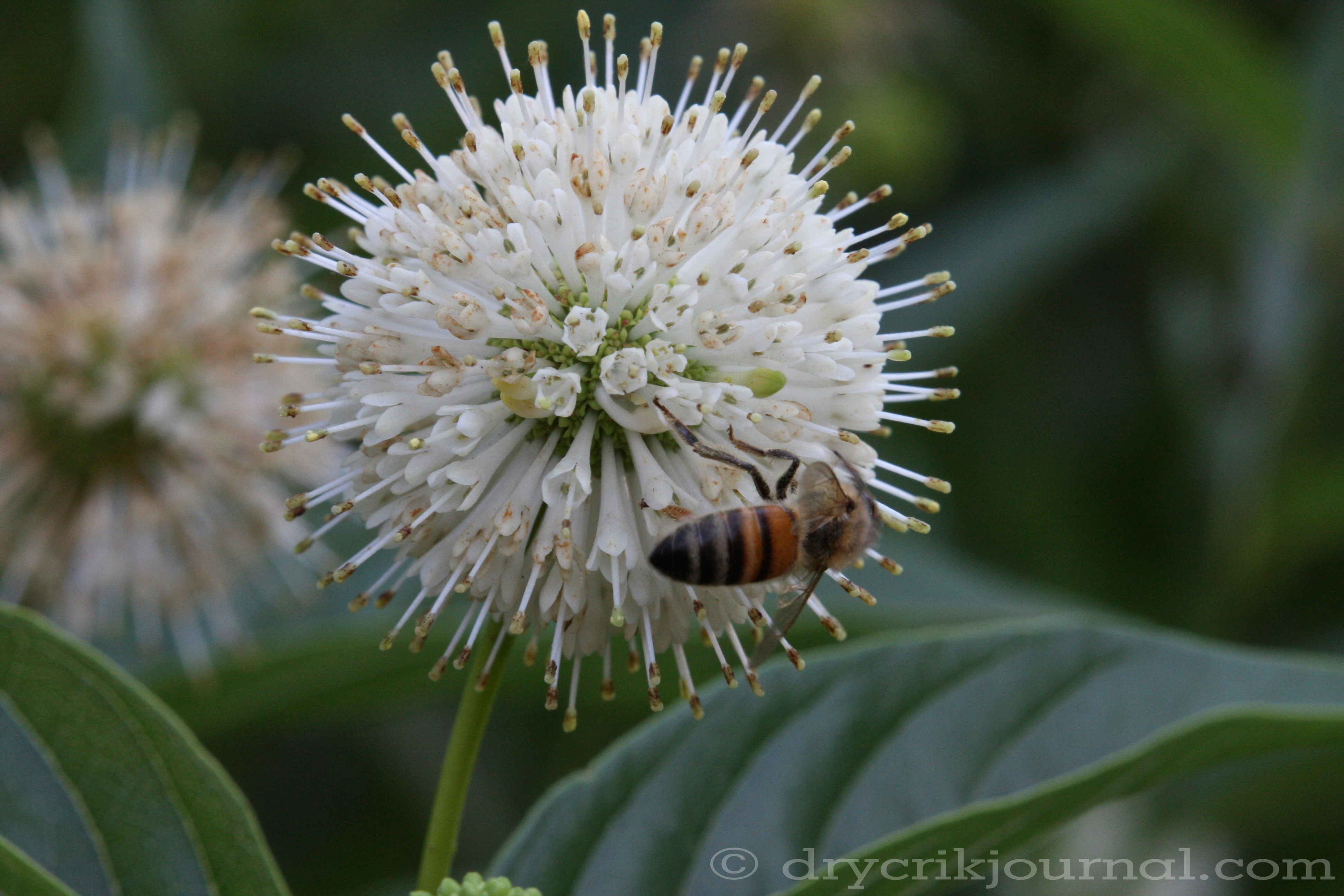
Cephalanthus occidentalis californica
Chorus:
It’s home to your home, wherever you may be,
It’s home to your home, to your own country,
Where the oak and the ash and the button willow tree
And the lark sings gaily in his own country.
– Glenn Ohrlin (“The Button Willow Tree”, 1989)
courtesy: The Mudcat Café
Posted in Photographs
Tagged Button Willow Tree, Glenn Ohrlin, Hellbound Train, Mudcat Cafe, Slick Sweeney, springs, water
Occasional reflection
of a child’s forgotten face
from grammar school
holds for a moment,
finds a name that sounds
like sweet innocence,
like trust and honesty
as it should be—like it
was in the beginning, before
the reasonable temptations—
the good and bad accidents
we shaped like horseshoes
into luck, believing
in something else.
Outside, I am reminded
of myself: red chested
finches on the rail
singing lust songs,
the clutch and tumble
of eagles from clouds
in a spring blue sky—
of that urgency
that consumed me
to pace the barbed wire.
We were told
that animals had no souls
worth saving, could not
think or reason like humans
to resist the lewd downcanyon
winds that were to stir us
like savages around a fire—
yet they have their place
in the front row
of my box of mirrors.
Posted in Poems 2013

Drawn to their delightful morning song a couple of weeks ago, we’ve finally caught the culprits with a camera.


A local crow plucks
woodpecker feathers
from the top rail
by the beak-full,
black and white clumps
shower to the ground—
bare breast exposed
in seconds,
he’s an expert.
Dragon’s teeth like acorns,
acres of oaks unfold
to spill more
into the orchard,
to replace the fallen,
each last gasp still clings
to bark and branch.
Wa-HA-ka, wa-HA-ka, wa-HA-ka
from the distance,
orgies of hilarity
arrive in fours and fives,
dip and coast in awkwardly
to claim these fruit trees—
then party and leave.
Wa-HA-ka, wa-HA-ka, wa-HA-ka.
Myopic sorties, heads full
of the communal, they don’t
seem to know they are targets,
nor recognize the Ca-thunk
of the pellet gun—
new sounds of war that have
the feral cats salivating.

It’s difficult to find much to get excited about with 110+ degrees, day after day, [Weather Journal 2013-14]but Robbin had harvested some vegetables by the time I got back from changing my water and feeding the steers this morning. Like cattle grazing towards the trees at 7:00 a.m., we’re out early and back to shade up before it gets too hot.
They hunt together,
leapfrog one another
in a low, slow glide
to stir a squirrel
out of the grass
early every morning.
Perched on fenceposts
they follow me
with their eyes.
If a man had time,
feed a little in the lean
and gain a bird’s brain
he could become one,
like falconers of old—
even send them
like high-tech drones
to scout ahead,
gather cattle.
Posted in Poems 2013
For tomorrow’s heifers, steers
and bulls: I count bales in the dark,
add them to the flatbed dropped
from the top of the stack—
a vertical, class two-dump
hook over hook ascent, each bite
deep beneath colored hay string,
toeholds loose, inching-up
like a spider to belly over
under rafters coated
with old dust and pigeon shit
in space too tight to stand—
to breathe so far from the ground.
My diamond plate target is dished
between the rectangular tubing
spaced to create shallow lakes
when and if it rains, cross members
too far apart to catch very many
and keep its shape. I need eighteen
to haul and feed, yet envision
two broken and five bales on the ground
before I fall asleep—two trips at least
up and down the barn’s new stack—
inhaling its fresh alfalfa face.
Posted in Poems 2013
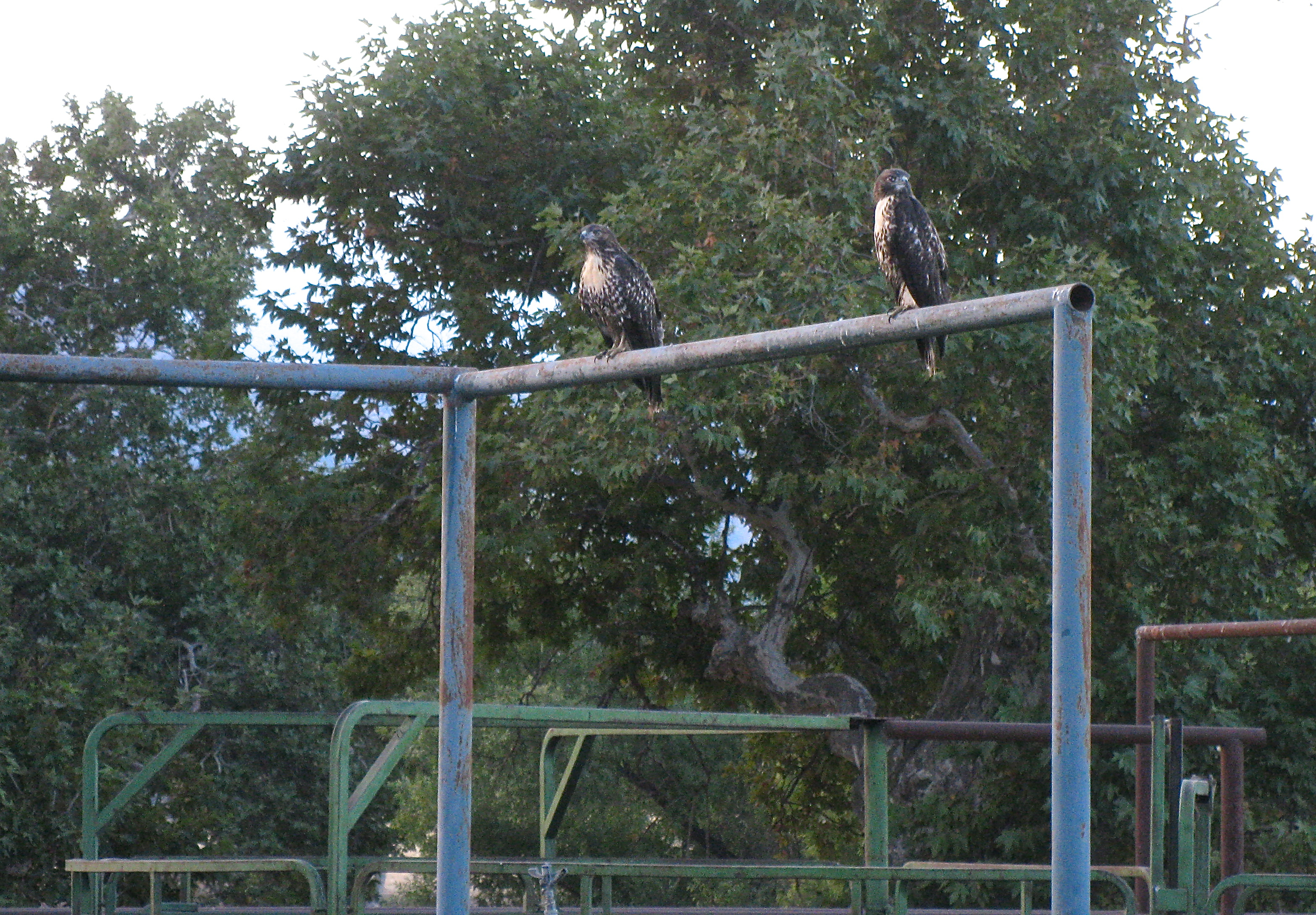
It seems that the juvenile Red Tails become fairly tame and trusting this time of year at the corrals, waiting for young ground squirrels to come out of their burrows at first light. This pair met us Tuesday morning as we arrived to gather and process our steer calves, wondering, I suspect, what kind of entertainment we were bringing as they retreated to a nearby sycamore to watch. They probably would have stayed closer longer if I hadn’t needed the flash on the little camera, but they’ll be back.
Posted in Photographs
It could have been Saturday
when the pump quit,
cattle standing quizzically,
leaves in the garden limp
or a hundred and ten
in the shade with no breeze
to allow your thoughts to ride,
escape to a snowmelt stream
to sit beside instead.
Running water is a luxury
in the middle of all this dry,
a blond and brittle sea of grass
on clay and granite baked
beneath, radiating heat—
each canyon an oven
even the natives left
in the summertime.
So much for progress,
but when we were younger
we all knew how
to prime a pump.
for JEG
Posted in Poems 2013