Category Archives: Ranch Journal

BABY BLUE EYES Nemophila menziesii


20160314-IMG_1811


My mother’s favorite, delicate and bold
among the grasses. Hard to come by
in these times, there is a place

among tall oaks where they thrive
that my father must have known,
that I visit every spring to see

they have survived, like innocence
untouched by humankind. She would ask
if I’d seen them, found them yet.

                                        ~

Baby Blue Eyes Nemophila menziesii
½-1½” diameter
4-12” height
March 14, 2016


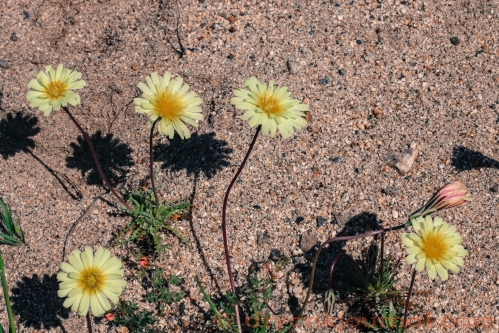
Scalebud Anisocoma acaulis


20160315-IMG_1991


The dramatic changes from bud-to-flower-to-seed make this large dandelion intriguing to photograph. In the sunflower family, their pale yellow flowers range from 2-4” in diameter and stand 1-2’ tall. The scaly bud is about the size of a gopher snake’s head that bursts into reds and yellows as petals develop. Likewise, as the dandelion head explodes into filaments, remnants of the yellow petals retain their color with red accents before turning white, all happening in a matter of days.

I first noticed the wildflower in April 2014 as a pale yellow patch on a south-facing bank of sand in the company of some Yellow Pincushions that were barely noticeable by comparison. Once found and identified, I revisited the same location last year and recorded the sighting with Calflora. At that time, it was the northernmost sighting in the state, as all other sightings were at elevations between 5,000-7,800’ in the Southern Sierras on latitude with Johnsondale, and on either side of the Kern River. However, returning to the website this morning, Calflora indicates another observation in April 1940, now the earliest recorded on Calflora, by Lewis S. Rose, above the town of Three Rivers at 2,000’. The Jepson Manual sets its elevation range between 300-7,800’.

The 1940 observation, east of the Kaweah River above the town of Three Rivers, was prior to the construction of the Terminus Dam. These Scalebud are photographed below Terminus in a highly disturbed area around 500′ that has been subject to the heavy construction of the dam in the early-60s, rock and gravel mining from 1950-1970, as well as the 1955 Flood.

As an amateur photographer and neophyte botanist I find the elevation differences intriguing that such an isolated dandelion family can be dispersed so far apart over such rough terrain into different watersheds. An observation in 1975 by the Consortium of California Herbaria on the Little Kern River may be a clue: Farewell Gap, the common connection between the watersheds. It may be that the Scalebud is more dependent on the unique mineralization of the granite from the Mineral King area than it is on the dispersal of its seed.

None of this matters, of course, and why in the hell would an aging cowman waste what’s left of his time on some dandelion when he could be otherwise occupied with the spectacle of 2016 GOP Presidential Primaries?

Meanwhile, back at the ranch…


IDES OF MARCH, 2016


20160314-IMG_1757


                           that which there is no greater
                                     – “Flying Cowboys”

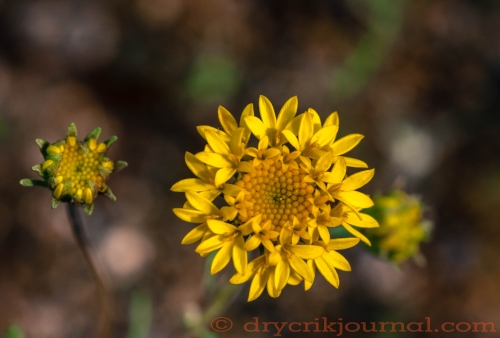
A yellow pincushion dances outside
my macro lens, unsteady gusts
I can’t follow closely, can’t keep up

on my knees. But I know what I want
and hope for something better
than what I see, let the aperture

find bokeh and focus for a fraction
of a second saved for another time
when I need to escape the news—

lose myself, and be this flower
wild and hearty in sandy ground
that grows poor feed for cattle.

Low downcanyon, all shades
of gray after-rain clouds, convoys
of cumulus trailing the storm from west

to east wanting to be thunderheads
as far as I can see of infinity
from the pasture, this close up.

                                                for Jessica

                                   ~

Yellow Pincushion Chaenactis glabriuscula
1-2″ diameter
1-3′ height
March 14, 2016


Pygmy Poppy Eschscholzia minutiflora


20160314-IMG_1847


AKA Colville’s Poppy
1-2″ diameter
2-6″ height
March 14, 2016


RAIN SONGS


20160308-IMG_5281


                                                                                                         and holy
                              days asleep in the calendar wake up and chime.

                                             – William Stafford (“How You Know”)

Tree frogs awake in the dark,
in the rain, a steady wave of chorusing
croaks upon croak—thousands

clear the air in their throats
again and again, prolong moments
no one else seems to want.

I pause in my tracks listening
deep into the wet blackness to a holy
tradition begun before man.


0.88″


WAY OUT WEST, 2016


20160308-IMG_5247


Robbin and I know where we belong, that we have grown old while the world has changed around us. We think of our parents and grandparents, understand their frustrations with progress.

The Academy of Western Artists “seeks to preserve the traditional values associated with the cowboy image despite consolidation in the cattle industry and changes in contemporary society. The group hosts an annual awards show.”

Yesterday, with two of our cattle neighbors, we were headed to Forth Worth to meet my son who had flown in from San Francisco, where I was to receive the Buck Ramsey Cowboy Poet of the Year award and have some fun. This morning we’re on Dry Creek, he’s in Fort Worth.

                                        ~

We know the feeling of corrals
in airports, and prepare ourselves
to be bunched-up, to wait in lines
at every gate—to follow rules

for humans. We should have known
red fire trucks as an omen,
but we loaded-up, anyway,
found our seats and waited.

I was a mountain man in another life
dodging Indians and ole Ephraim,
knew them all and their stories
and started reading. About the time

Hugh Glass met the grizzly’s cubs,
the captain came on the intercom
to say it’ll be a short, or long, wait
to leave for Dallas, to find the trouble

with the engine gauge, maybe just
a loose wire. I am a slow reader,
but by the time they started patching
Hugh Glass’s bloody body up,

we deplaned to rebook our flight—
190 head, three hours in the lead-up
to be processed. No way to get
to Dallas and keep the four of us

together, no other plane to haul
the human cargo—no way to share
awards and ceremony. (They kill
the man
, anyway, Jeffers said.)

Way Out West beyond the claustrophobe,
we should be proud of plans
that we expect—that have to get—
the work done, where we depend

on few, but in the corrals, numb
humans herding humans used to
to corporate calculations failing—
we treat ourselves and cattle better.

                                          for Temple Grandin


Wild Hyacinth Dichelostemma capitatum (Brodiaea pulchella)


20160309-IMG_1732


Even prior to our past four drought years, the number or population of Wild Hyacinth has seemed much less than when I was a boy emulating stories of the local Yokuts by digging the bulb (corm) up to eat, an important source of starch for Native Americans. It is believed that the Wild Hyacinth was cultivated, the corms thinned and separated in the process of harvesting prior to, during and after their period of bloom.

This year, however, due to whatever circumstances and weather conditions, many hillsides and slopes exude a purple haze with their sheer number, more than I’ve ever seen in this area. It may be that the hoof action of our cattle during the dry years with short feed simulated cultivation and separation, and also aerated the ground for our early rains.


A Chance for Spring


20160308-IMG_5249


Ten days ago, I was bemoaning a warm and dry February and the prospect of weaning calves two months early. But within that time we have received over two inches of rain that has rescued our spring grass. Already our south slopes have recovered. To vacillate between the anxiety and dread of another tough year and our current relaxed gratefulness, in such a short time, might be alarming if this canyon didn’t look so good—it’s that overwhelming. And it’s not that we haven’t gotten rain this season, we’re above average, but with over half of the days in February above 70 degrees, the ground was dry and the grass was heading out.

Yesterday we went up to the Paregien Ranch to check the rain gauge, (2.27”), check the cattle and put out salt and mineral supplement, also taking a shovel and chain saw just in case. Cows looking great, it’s hard to believe that these same calves have grown so much since we branded three months ago. The time has flown. With more forecast for the end of the week, it seems El Niño is back on track and we have a chance for spring.


BLACK RAIN


20160301-IMG_5680


No moon, no stars,
she sneaks up canyon
in the dark an hour late

gently whispering
from the black
as if she never left.

A sprinkle kisses the roof
I cannot see, but hear
find its way to earth.

After midnight, my mother
would turn the porch light off,
so no one knew I wasn’t home

when we had neighbors, trails
between cabins in the mountains
I knew by braille

and by the sound
of my young feet, light
upon the night trails.

In the end, no one cares
exactly when it rained—
only that it came.


AT ONCE


20160306-IMG_1692


Canyon gray,
light warm rain,
glass of wine at dusk,

and we enjoy the sound
of small drops
on a metal roof,

tinkling ricochets
in stereo downspouts
that insulate

our momentary sighs,
escaped breath rising
on words overheard

only by the gods
and fickle goddesses
somewhere overhead.

Not the storm predicted,
not the flood
to erase the drought

that won’t release its grip
for years, if ever,
talons sunk in our flesh—

this crease of earth and rock
that’s heard it all before
from generations of oaks

and sycamores, cattle
people and natives,
all sighing at once.