Author Archives: John

ANTI-EROSION


Killdeer spread their wings
over indentations in the crushed
gravel, over four speckled eggs

that look like granite washed
off the mountains and mined
from an ancient alluvium,

then hauled up the canyon
and spread like a blanket
in our driveway to keep

summer’s dust down
or getting stuck in winter’s
mud when it decides to rain.

Sometimes in the spring,
we mark them with a rock
to avoid lest we forget

little puffs on toothpicks
born on the run for bugs
and the cover of the creek.


Exeter Garden Party


I was humming Ricky Nelson’s “Garden Party” yesterday while working in our own garden, but the song was triggered by the Exeter Garden Party, a fundraiser sponsored by the Exeter Chamber of Commerce, that we were invited to last evening by our Dry Creek neighbors Steve and Jody Fuller. The highlight of the annual event for us is being able to visit with Dick and Pat Jacobsen of Rocky Hill Inc. From long-time pioneer families, both Dick and Pat have a wealth of historical information.

I went to the Lincoln School in Exeter until the fifth grade where Pat (Pogue) Jacobsen first began as a teacher. Last night she reminded me once more that my sister Virginia was the perfect student and that I was an incorrigible little boy. My memory of those days is hazy, but to be among children our age while living out in the country could easily become an adventure.

Dick asked me if I’d read Bill DeCarteret’s “Mountains, Mules and Memories” and told a story about a mule named Dynamite that he and John Crowley had taken on a pack trip. I’d packed the mule myself and swapped the story of a layover day in the High Sierras (unbeknownst to Bill) when a couple of young packers thought they could saddle and ride him. Typical of most mules, Dynamite was willing to endure being packed, but not being rode.

I referred to Dynamite as one of a half-dozen Number Nine mules that Bill DeCarteret had in his string, knowing that the mules had come from the Oregon Ranch that Jim Pogue owned. Pat went on to tell me that “9” branded on their hips was a really a “JP” and that the mules had draft horse mothers that her dad had bred, which accounted for their extraordinary size and endurance.

Exeter hasn’t grown much since I was a boy with a population of about 4,000, today it’s 10,000, but it’s a delightful, well-kept town with many service organizations. A throwback to the old days, it’s always a pleasure to do business in Exeter. It was a delightful evening, but I suspect we were the only ones talking mules.


FRIENDS OF THE FARMER


Half-a-dozen Great White Egrets
fly up the creek to light
in a sycamore to plot fishing

a slow pool for frogs and minnows—
pick their stations before
wading in from the cobbled shore.

None here when I was a boy,
they also hunt gophers, stand
like sentinels scattered in the pasture

with the Great Blue Herons
atop tailings from spring cleaning
waiting for movement to impale.

There are no borders south of here
where they come from, no racial
tension with so much else to do.


ORDINARY


                    It begins with your family
                    but soon it comes around to your soul.

                         – Leonard Cohen (“Sisters of Mercy”)

Bring on the sad songs hidden in my belfry,
free muffled desperation’s uncommon tone
to play beneath the trumpet’s discordant blasts

that lack melody or empathy for humanity.
Pilgrim in time, I crave moments with a moan—
minutes to reflect upon what my mind asks.

I need no enemy nor bugle’s call for reveille
to measure muscle, heart or brittle bone—
just a sad song to hum to the ordinary tasks.


HORSES AT THE FENCE


It may be a softening that comes with age, with lots of time among animals reading their thoughts as they try to read mine, my body language not near as brusque as when I was younger, eager to get the job done. Whether palpating cows or processing calves, I’ve always dreaded the rattle and bang of the squeeze chute as the animal strains against the procedure, one after the other like an assembly line until the lead-up is empty.

As a crew, we work well together, find our rhythmic pace as vaccinations, electronic ID tags and dewormers are applied. Having to use an old squeeze chute for half of our Wagyu X calves this year, it was easy to compare it to our relatively new hydraulic squeeze, the latter designed to be much easier on both man and beast.

The animal’s approach to the old chute is usually hard and fast, hitting the head gate abruptly, banging shoulders and brisket before squeezed manually, hooves often thrashing. Though our hydraulic Silencer was considerably more expensive, cattle enter it more quietly before their heads are caught, shoulders against the padded headgate, and they seem comforted, more apt to stand docilely. All these years, it has been the old chutes, the rattle and bang and all that they imply that I have dreaded most—the Silencer is well-named.

We finished processing our Wagyu X calves yesterday, the first load ready to ship on the 10th. The horses seem to enjoy watching us work, waiting, while we are waiting to give cows and calves time to find one another and relax before turning them out, to head home.


Some born late, but
no leppy calves due
to lack of mothering,

I want to throw
my chest out as if
I was the Wagyu sire

as they wait for shots,
a second-round of vaccinations
and EID tags destined

for more feed, for high-dollar
plates all around the world
pending its politics.


INNOCENCE OF DIRT


Like motley soldiers, we lived the dust,
the harvest heat, grape lugs swamped
and in the barn before the storm—gray

curtains looming in the west bringing steam,
mildew, rot and decay to a crop of grapes.
Right after the war, we were born to be bent

to discipline, small army of many hands
like locusts up and down the vine rows,
dollar an hour, until we stripped them clean.

We knew no better, I suspect, of town life,
all the trouble we could find to try,
become forever changed if not careful.

Could we go back having tasted luxuries
of dreams we never had, could we endure
what we have learned about ourselves

since? Clinging to our lungs and flesh,
we will always breathe heroic days
closer to the innocence of dirt.


HORNED GRAY COW


We may be the gods
in a cow’s short life
of few interruptions:

water, shade to grazing
day after day, calf after calf—
we appear when needed

most with hay, a taste
to insure devotion. Horn
in her head, she remembers

the relief, the chute, the saw,
that assuaged the pain.
She prays for our arrival.


WHERE YOUNG EAGLES WAIT


There is no escape for weeks
looking down on a small world
beneath a thatch of twigs—

no way to hide from sun, storm
or crow until the leaves come
to wait for shadows out of the blue

heavens with or for a meal—
no guarantees that what they see
is good or bad, just real.


Robbin and I had the luxury of looking at cows and calves in our upper country yesterday when she spotted this Golden Eagles’ nest.


TO PACK A MULE


I know what it cost, the price in time
it took to learn to pack a mule—
diamond or box hitch, how I envied

the tight cover of canvas matties tucked
beneath low loads on a string of sleek,
quick-stepping animals headed up

switchbacks cut in granite scree,
passes to lakeside meadows,
rainbow trout and starlit nights

as rusty bucket smears leaking
light from another, outside world
that envelops us all. Remember when

we lay naked chasing shade around
the puzzled trunk of a sugar pine,
our Roaring River honeymoon

where the was no phone or clock?
I know what it cost in time
to have everything we needed.


Processing the Wagyu


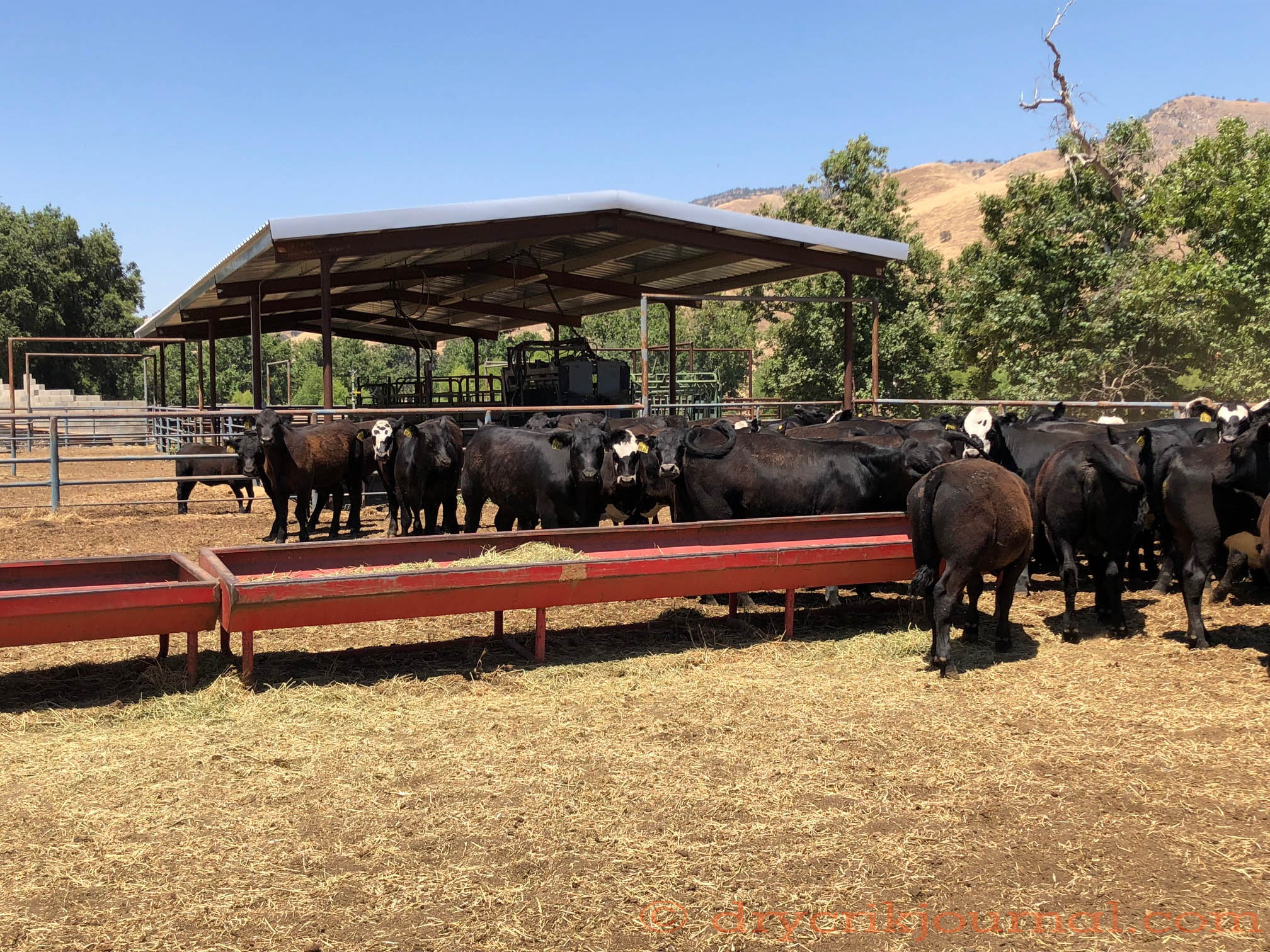
As we approach the end of our grass season, we’ve begun processing our Wagyu X calves before we ship them to Snake River Farms in Idaho around mid-May to be fed and sold as American Kobe beef. Each calf receives a second round of vaccinations and Electronic ID tags consisting of a unique 15-digit number that can be read both visually and electronically, denoting the country of origin and complying with the requirements of disease traceability. Calves destined for the export market must have EID tags.

Born after the first of September, the calves have had a tough start with only 3 inches of rain accumulated by the end of February, but seem to have done remarkably well since our March and April rains. However, I don’t expect them to weigh as much as in past years.

Once the Wagyu X calves are shipped, we will take these cows, mostly second-calf mothers bred to an Angus bull, up into the Greasy watershed as we begin weaning our English calves. With a little luck, we ought to be done weaning by the first of July. With temperatures breaking into the 90s, we’re bracing for our usual summer heat.


Mustard yellow greens
under a blue sky, cows wait
for some direction.