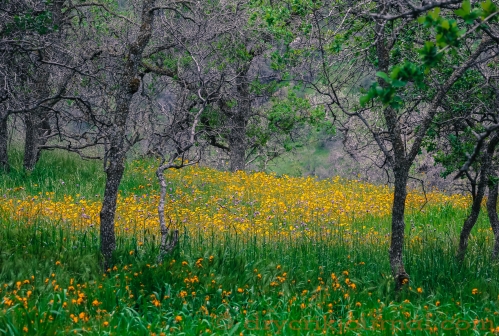
A plodding drawn through hot
and dry, through the seasons
to graze this moment,
this cacophony of light—
of life exploding
beneath our feet.

A plodding drawn through hot
and dry, through the seasons
to graze this moment,
this cacophony of light—
of life exploding
beneath our feet.

More than gold and jewels,
hillsides dressed with hair
reaching for the sky.
More than the wealth of green
slopes, tall feed cured dry
and banked. We are rich
with rain, clear into September—
blinded by this moment spilt
upon the ground in bloom.


I made the circle of Greasy yesterday with a Kubota-load of salt, slipped away to check the cattle with my camera. Warm enough for the snakes to be out, I wasn’t in the mood to wade and lie down in the tall feed for macro shots, and thought instead of broader perspectives that may be more helpful identifying our common wildflowers.
I tend to think of these patches and clusters as families, however not in the botanical sense, and allow myself to personify them, imagining the dispersal of seed, often years worth, just waiting for the right conditions and circumstances to germinate. Every spring is a little different. Some show up where I’ve never seen them before, and some like the Purple Chinese Houses, Agoseris, Chia and Headed Gilia are at the same location every year, sometimes thick and sometimes thin.

So many vying
for your attention, easy
to go unnoticed.
~
Bird’s Eye Gilia Gilia Tricolor
½” diameter
8-15” height
March 15, 2016
Posted in Haiku 2016, Photographs, Ranch Journal
Tagged photography, poetry, wildflowers

My mother’s favorite, delicate and bold
among the grasses. Hard to come by
in these times, there is a place
among tall oaks where they thrive
that my father must have known,
that I visit every spring to see
they have survived, like innocence
untouched by humankind. She would ask
if I’d seen them, found them yet.
~
Baby Blue Eyes Nemophila menziesii
½-1½” diameter
4-12” height
March 14, 2016
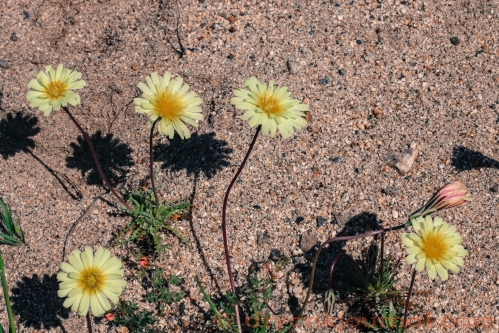
The dramatic changes from bud-to-flower-to-seed make this large dandelion intriguing to photograph. In the sunflower family, their pale yellow flowers range from 2-4” in diameter and stand 1-2’ tall. The scaly bud is about the size of a gopher snake’s head that bursts into reds and yellows as petals develop. Likewise, as the dandelion head explodes into filaments, remnants of the yellow petals retain their color with red accents before turning white, all happening in a matter of days.
I first noticed the wildflower in April 2014 as a pale yellow patch on a south-facing bank of sand in the company of some Yellow Pincushions that were barely noticeable by comparison. Once found and identified, I revisited the same location last year and recorded the sighting with Calflora. At that time, it was the northernmost sighting in the state, as all other sightings were at elevations between 5,000-7,800’ in the Southern Sierras on latitude with Johnsondale, and on either side of the Kern River. However, returning to the website this morning, Calflora indicates another observation in April 1940, now the earliest recorded on Calflora, by Lewis S. Rose, above the town of Three Rivers at 2,000’. The Jepson Manual sets its elevation range between 300-7,800’.
The 1940 observation, east of the Kaweah River above the town of Three Rivers, was prior to the construction of the Terminus Dam. These Scalebud are photographed below Terminus in a highly disturbed area around 500′ that has been subject to the heavy construction of the dam in the early-60s, rock and gravel mining from 1950-1970, as well as the 1955 Flood.
As an amateur photographer and neophyte botanist I find the elevation differences intriguing that such an isolated dandelion family can be dispersed so far apart over such rough terrain into different watersheds. An observation in 1975 by the Consortium of California Herbaria on the Little Kern River may be a clue: Farewell Gap, the common connection between the watersheds. It may be that the Scalebud is more dependent on the unique mineralization of the granite from the Mineral King area than it is on the dispersal of its seed.
None of this matters, of course, and why in the hell would an aging cowman waste what’s left of his time on some dandelion when he could be otherwise occupied with the spectacle of 2016 GOP Presidential Primaries?
Meanwhile, back at the ranch…
Posted in Photographs, Ranch Journal
Tagged 2016 GOP Presidential Primaries, Calflora, Dandelion, Mineral King, photography, wildflowers
that which there is no greater
– “Flying Cowboys”
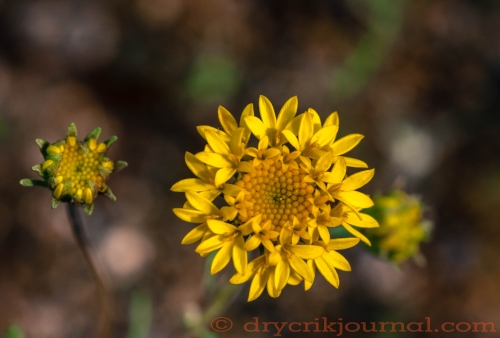
A yellow pincushion dances outside
my macro lens, unsteady gusts
I can’t follow closely, can’t keep up
on my knees. But I know what I want
and hope for something better
than what I see, let the aperture
find bokeh and focus for a fraction
of a second saved for another time
when I need to escape the news—
lose myself, and be this flower
wild and hearty in sandy ground
that grows poor feed for cattle.
Low downcanyon, all shades
of gray after-rain clouds, convoys
of cumulus trailing the storm from west
to east wanting to be thunderheads
as far as I can see of infinity
from the pasture, this close up.
for Jessica
~
Yellow Pincushion Chaenactis glabriuscula
1-2″ diameter
1-3′ height
March 14, 2016
Posted in Photographs, Poems 2016, Ranch Journal
Tagged macro, photography, poetry, wildflowers

AKA Colville’s Poppy
1-2″ diameter
2-6″ height
March 14, 2016

Even prior to our past four drought years, the number or population of Wild Hyacinth has seemed much less than when I was a boy emulating stories of the local Yokuts by digging the bulb (corm) up to eat, an important source of starch for Native Americans. It is believed that the Wild Hyacinth was cultivated, the corms thinned and separated in the process of harvesting prior to, during and after their period of bloom.
This year, however, due to whatever circumstances and weather conditions, many hillsides and slopes exude a purple haze with their sheer number, more than I’ve ever seen in this area. It may be that the hoof action of our cattle during the dry years with short feed simulated cultivation and separation, and also aerated the ground for our early rains.
Posted in Photographs, Ranch Journal
Tagged Blue Dicks, Native Americans, Niggertoes, wildflowers
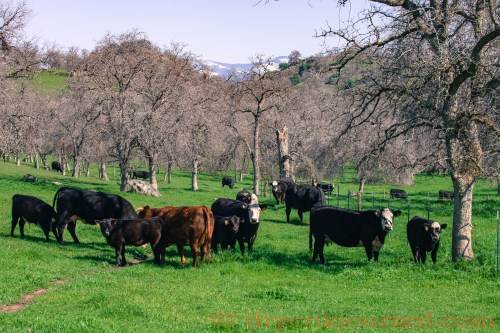
How many years have I
to wait for spring’s deep green,
the damp and dew, tender cotyledons
fresh as nested bird beaks open
drinking sun before they rise
in waves upon a breeze—
and flowers, like bright paint spilled
upon them. Ubiquitous Fiddleneck,
molten brass between the oak trees,
white skiffs of popcorn flowers,
splashes of red wine mallow,
the purple haze of lupine
and wild onion to rise like steam
on the horizons, colonies of poppies
in pockets out of reach to burn
like wildfire blind the eye
at a distance. The pale and delicate
families of Pretty Faces pose
for photographs, petals and stamen
of pink and purple mountain garland
twist in ecstasy before they fade.
Younger, I yearned for everlasting
spring, something almost heavenly—
yet nothing without the dry.
Posted in Photographs, Poems 2016, Ranch Journal
Tagged Paregien Ranch, spring, wildflowers




 drycrikjournal