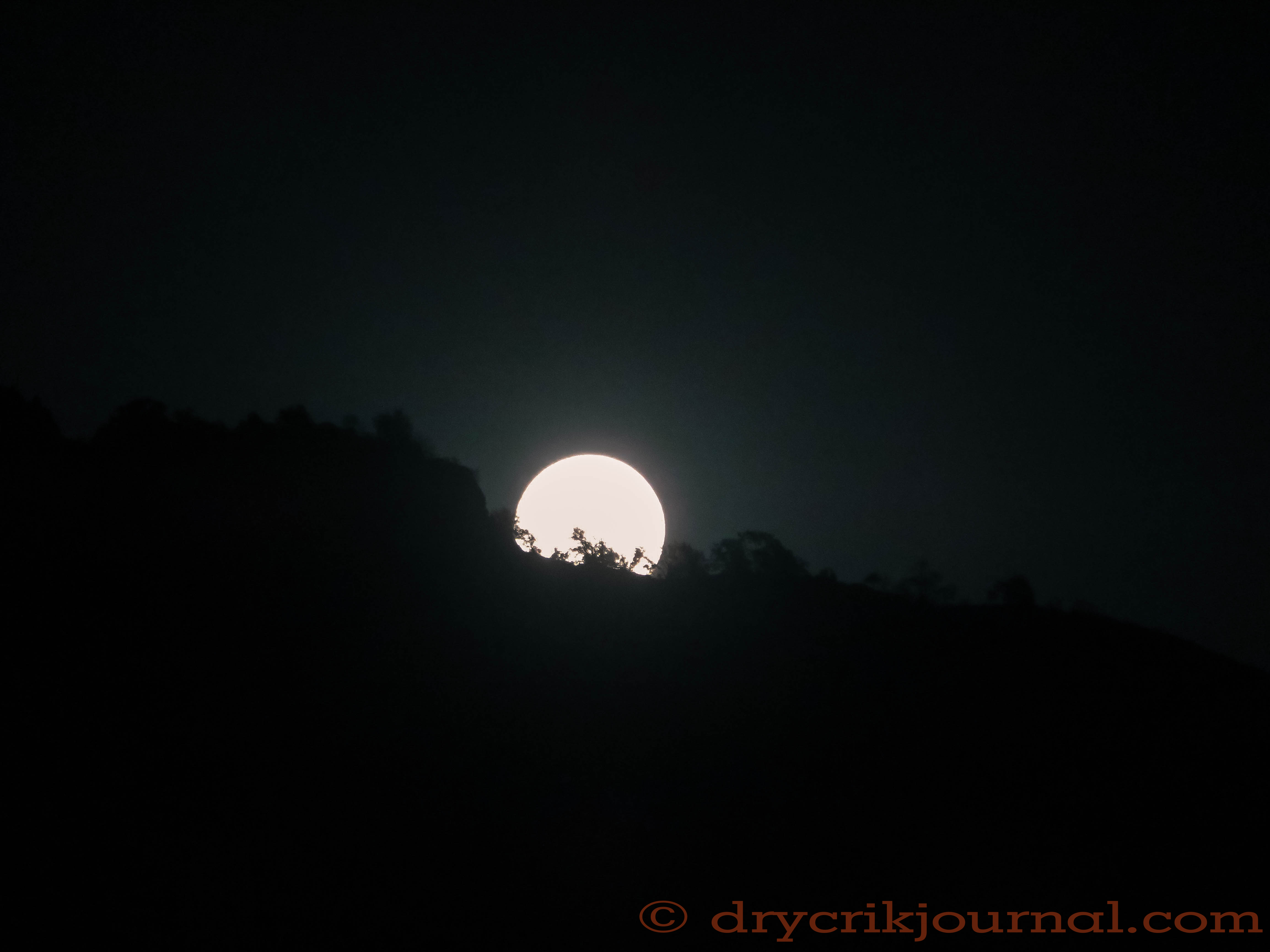
Blueberry moonrise
never in the same place twice—
acorns ripe in oak trees.

Blueberry moonrise
never in the same place twice—
acorns ripe in oak trees.

Had we fish to stupefy
with turkey mullein seeds
the late rains have left
in turquoise waves
above the knees—
we could be native.
Instead we feed
the squirrels beneath
these fuzzy canopies
where shotgun hunters
will wait for mourning dove
to light and leave.
Croton setigerus: a native of the western United States, and found commonly from southern California north to Washington, particularly in the more arid locations away from the coast.
I don’t ever remember Turkey Mullein, or Dove Weed, so tall and thick and claiming such large tracts of dry summer pasture, or its color quite so blue—worth journaling, I think.
Posted in Photographs, Poems 2019, Ranch Journal
Tagged Dove Weed, photography, poetry, Turkey Mullein, wildflowers

When we were children,
we played among the wrecks
of old cars and horse-drawn
wagons with wooden spokes
that hemmed the orchards
that sustained us—families
scattered round distant towns
we could visit
with ripe imaginations.
Bigger now, cities spreading
like amoeba ingesting farms
and one another, like wildfires burning
closer as convenient conflagrations
that have erased the landmarks
where we hung our memories.
It could be creeping senility
that I embrace, a watercolor wash
across pastoral landscapes
rather than the spinning pace
of progress—perpetual motion
like the galaxies of space.

They have begun to circumambulate new slopes to graze
around the house
learning to make their circles between troughs and ponds,
forty-five days away
for the first new mothers to lick a calf up to suck
for the next nine months.
A week off the irrigated green, they’ve overcome the shock
of dry hollow stems
to make a home where we can watch and worry,
as is our custom—
we get know them. About a third will make the herd
for ten years.
With so much time together, we operate by instinct,
you and I,
triggered by well-worn habits, the angle of the sun
and the length of shadows
these young girls already know—a second nature
we had to learn.

© Terri Blanke
Not an easy climb
to rise above the bluster
of the self=righteous.

Out of the black insides of a cow,
the crooked line of dawn’s horizon
reorients my place in the world
as a coyote draws the dogs’ bark—
a constant game without me.
By day, the overflow spills up the road,
herds of top-packed SUVs
following cops on a pot bust,
military-style: well-spaced, single file
like prairie schooners. Old eyes
search the darkness for the familiar
ground that has yet to change.

After the recent wildfires in 2017 and 2018, PG&E, the utility company that has been found responsible for 17 of the blazes and facing liability for as much as $30 billion is likely to file Chapter 11. Since 2017, Southern California Edison, SCE, one of the other California electrical utility companies, has been extremely busy replacing poles, transformers and placing spacers between their high voltage transmission lines so as not to spark a fire during high wind conditions. Furthermore, SCE has placed a weather station on Dry Creek to report temperature, humidity and wind conditions. Though it seems unclear what the guidelines are if these conditions prove too risky, SCE has the power (no pun intended) to shut the transmission lines down.
Our practice over the years has been to blade a two-mile firebreak between our dry feed, barns and houses and Dry Creek Road. Most arson fires are ignited from the road and the SCE transmission lines that serve our pumps and houses follow the same road. Also, our barns and houses are inspected annually by Calfire prior to each fire season. About half of the fire incidents over the past 50 years have been subdued or contained by our ranching neighbors, but without electricity we are unable to pump water, hence our effectiveness to fight fire would be substantially reduced.
My neighbor a mile up the road just had the insurance policy on his house canceled because he lives in a ‘high-risk’ fire area based of a draft of the new maps that have painted about half of the State of California in red. Rumors that insurance companies are using the fire maps to cancel homeowners’ insurance taste a little like a conspiracy when other insurance companies assume the risk with increased premiums of 200-300%—all of this, it’s assumed, to partially offset their losses and legal costs of the 2018 fire season in Northern California. More to come, I’m sure.

Add to the wildfire risk recent California legislation, AB 711, a total ban on hunting with lead ammunition that went into effect on July 1, 2019. Recent tests indicate that copper jacketed lead core bullets have the lowest probability of igniting fires (almost nil). Bullet substitutes like solid copper, steel core and steel jacked, lead core and steel jacketed and steel core copper jacketed have a much higher probability of starting fires. The stage is now set for hunting season.

The crows know what time
the maids come to clean—
leave their cart of sheets and towels,
TP and soap, coffee and especially
creamers unattended.
They wait on the roof.
Black fledglings watch the plastic peal,
peck when they can to help,
nothing’s spilt.
It’s part of the price
to stay on the coast
where no one seems to notice.

Daytime buzzards circle gunshots
and the dogs bark at three in the morning
when the pups arrive to consume
my pruning of a bumper crop
of ground squirrels, squads that raid
garden and orchard to harvest fruit
before it’s ripe, leaving nothing to glean.
In sixty days, the heifers will be calving
for the first time, confused and alone
licking a wobbly, wet calf clean
of the scent that draws the coyotes
who watch and know the habits
of all of us in a world
without crimes or rules.
I’ve heard stories I don’t remember
embellished into local myths
no longer true, no longer claimed
as I age, as memory fades
as it should from the far context
of most outdoor youths.
Oh, how we howled like a pack
of coyotes in these canyons—
louder yet in towns avoided now.
But a man learns not to dwell
on guilt, what can’t be helped
to please the righteous—
evolutions of imperfection
honed into an existence
we’ll soon live without.