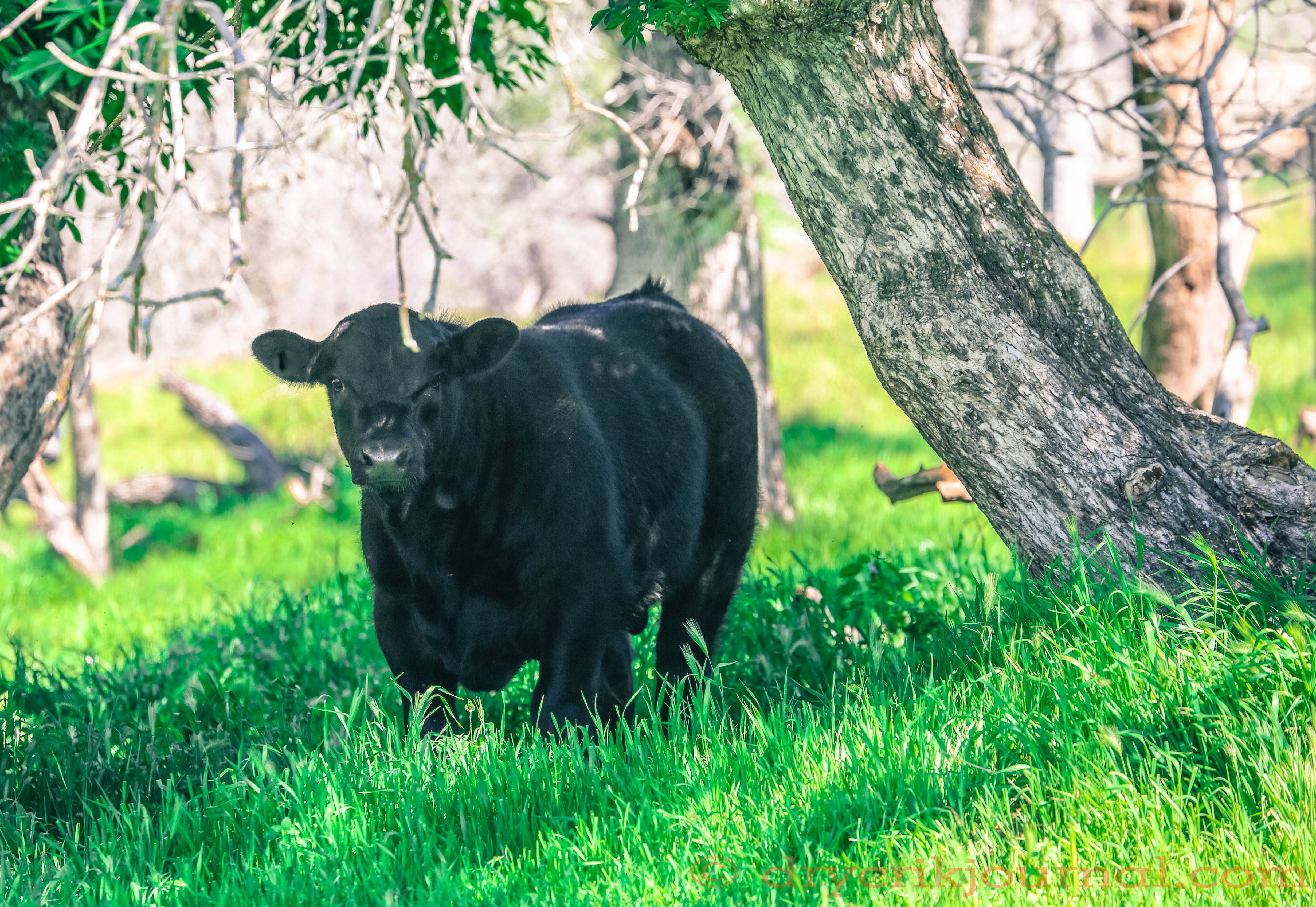
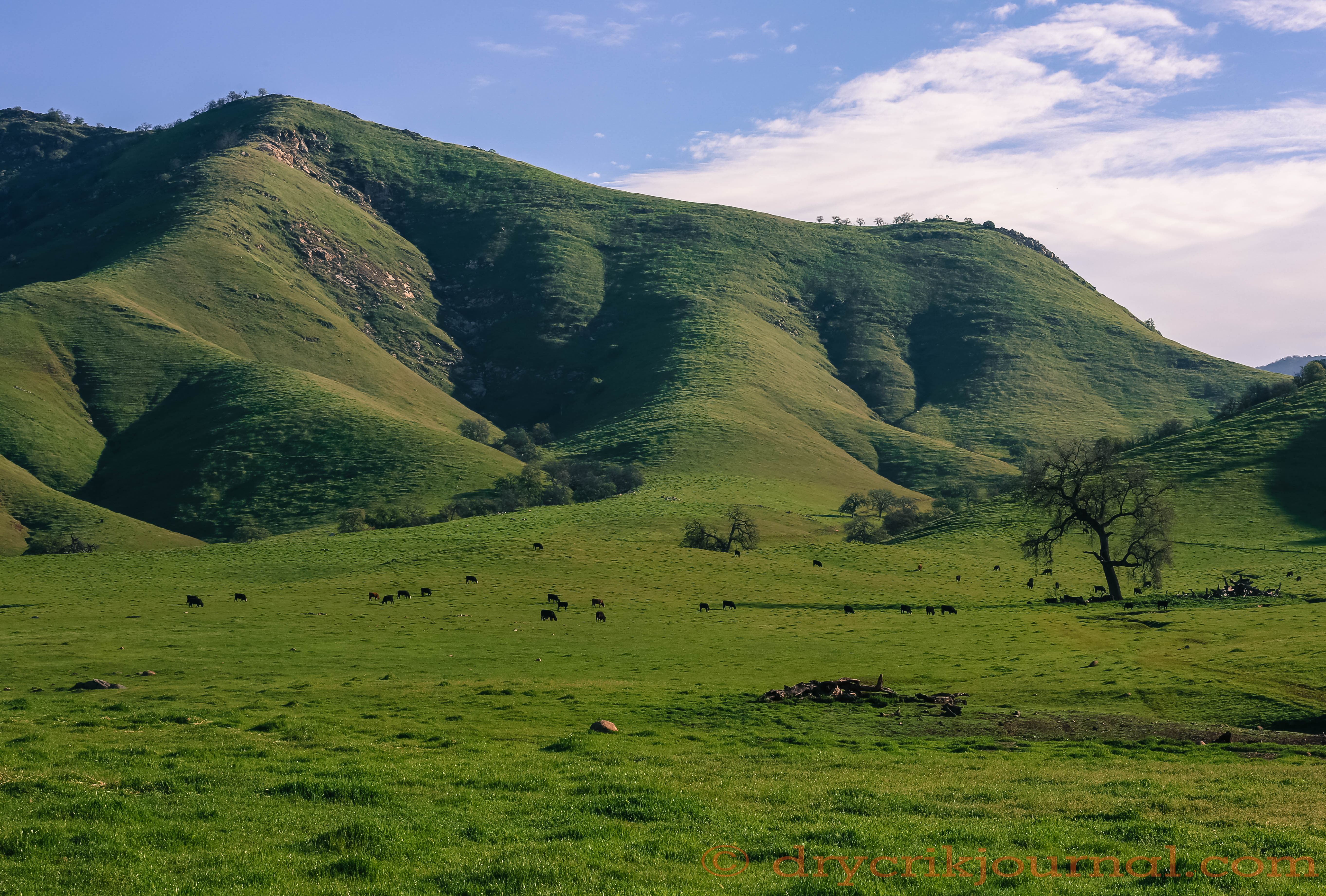
My sister and I circled the mountain pasture behind the house in the Kubota after opening the gates to the flat below for the first-calf heifers and their Wagyu X calves before we drive the bunch to our scales and processing corrals next week. The calves need to be revaccinated before we ship them in May to Snake River Farms to be finished as American Kobe Beef. Not quite the same as gathering a horseback, she managed to see a lot of country where the cattle had been before we finally found them—a steep, rough ride nonetheless.
Gentle and Kubota-broke, our cows spend their first three years in our low country before graduating up the hill, and managing to gather them all was not a surprise, but offered an up-close look at the cows and calves for my city sister to see. Also, part of our purpose for gathering them a little early was to begin grazing the tall ripe feed around the house that will become a fire hazard this summer, despite the firebreak I’ve bladed with the skid steer.
Within a couple of hours, as if invited to Easter dinner, some of the cattle had gathered below our ‘sip ‘n’ dip’ for a visit.
With a few exceptions, I tend to lump all the little birds together, especially in the spring. The constant flittering that seems to begin with the house finches courting on the railing, the rosy chests of crooning males that seem to intensify in the process, followed by a period of squabbling with neighbors while claiming space along the beam with a steady rain of dry materials from construction and deconstruction overhead. With space enough for half-a-dozen households, it’s entertaining, but messy.
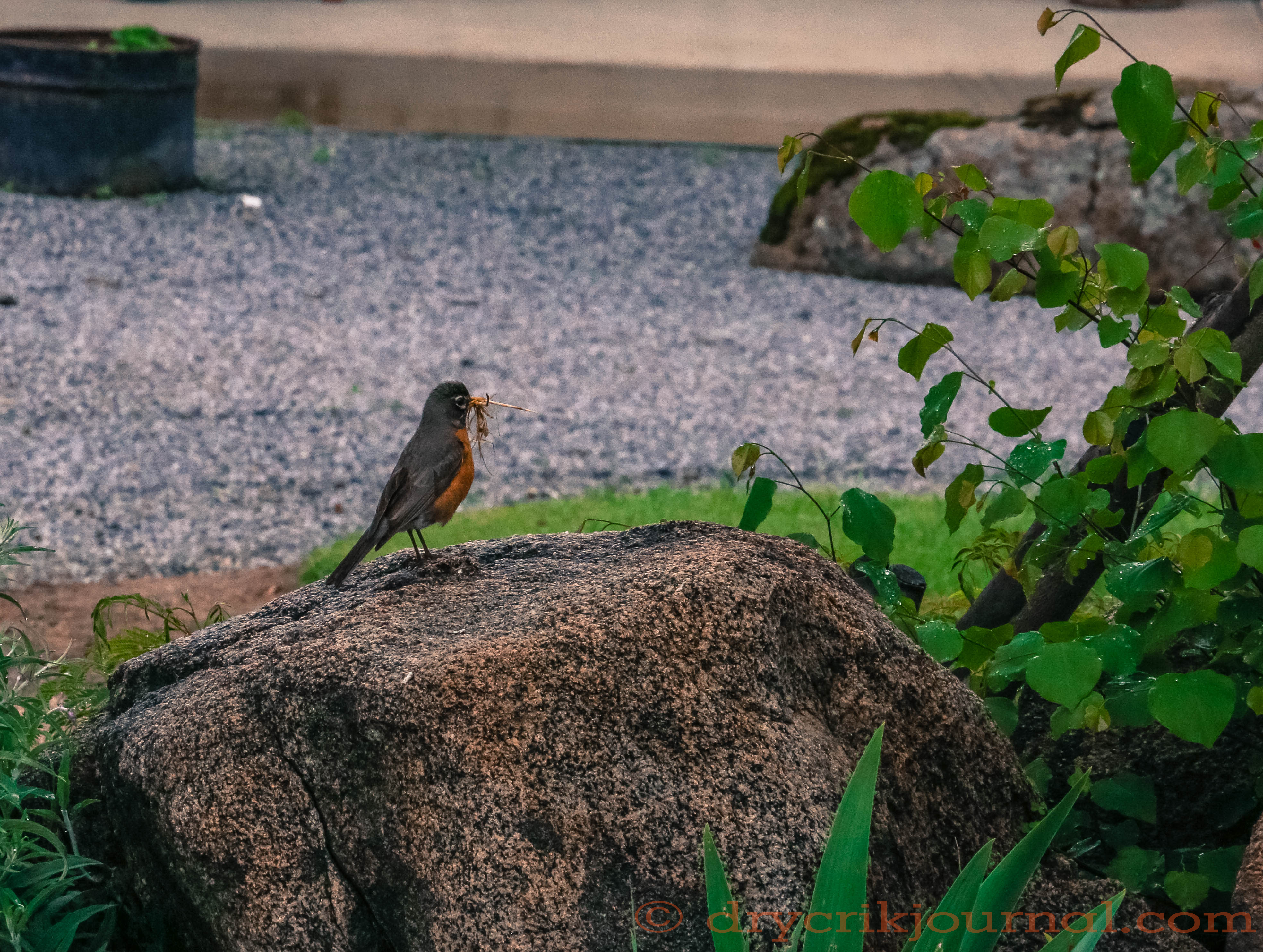
My sister, who was visiting from the Bay Area, was impressed with all the avian activity when Robbin and I both noticed a bird we hadn’t seen before, bigger than a finch, but smaller than the clan of blackbirds, who’ve taken residence in two coastal redwoods, strutting across the lawn between unabashed breedings. To add more birds for our entertainment, Robbin filled the bird feeders for the first time in months that drew the stranger in, along with a pair of Bullock Orioles. Even noting the distinguished details of the stranger with binoculars, I couldn’t identify it online or within the several bird books on hand.
So taking a page out of my wildflower identification experience, I photographed it last evening on the feeder. Only in the photograph did I really see its ‘large’ beak, then went online this morning: I think it’s a Black-headed Grosbeak!
There are boulders even
in dry creek beds, obstacles
for water to flow around – make
the sounds that soothe us so.
Easily identified, some are bolted down
like the mountains with sharpened edges
eerily singing new refrains each night.
We know them. Sometimes we curse them.
We even pray to God to remove them
from our channeled way of going, yet
not believing the music we cherish most
comes from rubbing against them.
Noting repeated references to ‘granite’ in my poetry, a dear friend emailed an audio link of Thobar Phadraig reading his poem “Stone” that reminded me of “Stone Poems” by Douglas Skrief published by Starhaven (London, 2009), who also published my “Poems from Dry Creek” in 2008. Relating this ‘granite’ thread to Robbin last evening, she remembered my poem “Obstacles” and the circumstances that spawned it.
The Poem Notes from that book: Written while haggling over the language of a conservation easement intended to preserve the ranch, this simple poem was, and continues to be, a solid touchstone for difficult times. After approximately three years of emotional discussions, we abandoned the concept to concentrate our energies on improving the ranch and our cowherd – tending to the business we know best. Included in “Still in the Mountains,” 2004.
Our notion of a good poem is not dated, so we have decided to post some of my earlier poetry here from time to time.










 drycrikjournal