Category Archives: Photographs

Changing Totems

IMG_3170

IMG_3159

I have mentioned that Wy-lee, the Roadrunner with droopy wing that essentially lived in our garden this summer, disappeared about the time the Cooper’s Hawk arrived, inferring that Cooper’s Hawk ate Wy-lee. We don’t know, but Wy-lee has been replaced by another Roadrunner, though not near as tame. In any case, the Cooper’s Hawk, a female I believe, has taken center stage on an evening when we are sprinkling the lawn, after a daytime high of 103°.

Autopilot

IMG_6426a

It’s a fairly common practice when feeding alone to put the pickup in gear, preferably low-low range 4×4, climb on the back and begin flaking the alfalfa off in pieces small enough so that all the cattle get equal chances at the hay. The first prerequisite is flat ground, occasionally looking up to see where you’re heading, conscious of rocks, holes and trees. The ‘on and off’ the back of truck gets trickier with age, flatbeds much safer than pickup boxes, in my estimation.

Just out of college, I was feeding out of the back of a standard pickup in ‘autopilot’ on rough ground. Hit a bump and fell over the wheel well, but fortunately my boot toes were stuck under the remaining hay bales with my heels wedged against the inside fenders, leaving me upside down, head hanging inches from the ground and no way to get loose. Arms flailing and bouncing towards rougher terrain and the creek, I managed one great sit up to get upright, get off and get the pickup stopped.

A man takes pride in the damnedest things: I like to have my flakes well-spaced and even in size with no gaps in the design that they and the cattle make on the ground. Though I aim the truck initially, no two designs come out the same. Then quickly disappear.

Image

Near Wuknaw

IMG_6378

Waiting on Water

IMG_6416

IMG_6405

We had to install a new water trough Tuesday on the Paregien Ranch. Fortunately it’s a good spring and the trough filled overnight despite pressure from the cows. The overflow fills three other troughs that were recovering Wednesday by noon, after the cows had watered for the day.

Image

Tarweed

IMG_1170

UC Davis

Image

H2O

IMG_6371

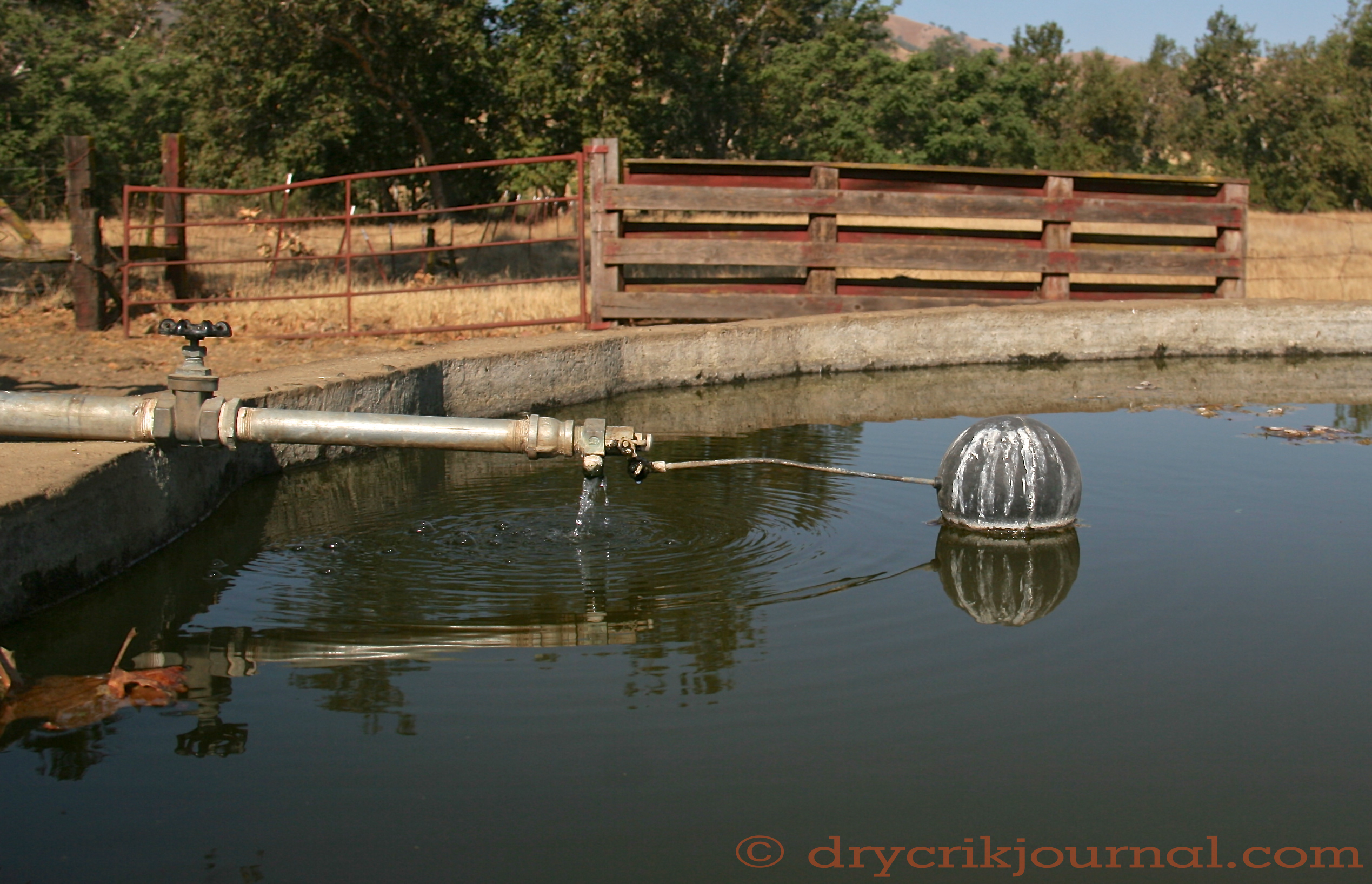
Probably nothing more important in the month of August than water, especially in a dry year when native springs are the least productive, if producing water at all. With no water in Dry Creek for eight miles upstream, we have to pump water for livestock at several locations. The concrete trough above was poured by my father during the drought of 1947 and has become a mecca for native birds and ground squirrels.

‘Spic & Span’ Grazing the Gloaming

IMG_3133

Evenings thus far in August have been delightful, days noticeably shorter, about 30 minutes at both ends. It’s also 10 degrees cooler, hovering in the mid-90s with gusty breezes up and down canyon, especially at dusk. Atop the knoll where native women came to heal themselves without men, Rags and Bart (a.k.a. ‘Spic & Span’), raised at the Fairlea Ranch farther up Dry Creek Road and trained by Clarence Holdbrooks, are part of the family, part of the evening’s entertainment—though never sure who’s entertaining who. Our pair of crows usually roost atop the dead snag, an over-two hundred year old Live Oak that I imagine offered shade when the native women came.

Feeding Woodpeckers

IMG_3087

Kittens are cute, but I’m not a great lover of cats. Between the barn and our log house, their function here is to help keep the rodent population, field mice, gophers and ground squirrels, down, as well as alerting us when a rattlesnake is in the yard. In exchange, we maintain a community bowl of food between the barn and shop. We lost our strain of Manx cats several years ago when two bobcats picked them all off, one at a time. Great hunters with kittens easy to give away, the Manx reestablished themselves with renewed heterosis among the McKee clan in Elderwood, a few miles as the crow flies over a couple of ridges.

IMG_3108

The two white puffballs were deposited in the haystack inside the horse barn with ample rations. Robbin confirmed their survival the next evening with binoculars, but by the second evening only one could be seen. Next morning, both (a.k.a.‘The McKees’) had found the house, mewing incessantly, dashing any immediate hopes that the barn would become their headquarters.

Concurrently, we have declared war on the woodpeckers that prematurely picked all of our cherries, apples, apricots and peaches. Their population has exploded on the ranch and we have resorted to pellet guns to hollow out a no fly zone around the house. All of which is to say, Virginia: the kittens are still alive!

IMG_3113

Image

Hay on the Ground

IMG_6360

August 2013—Weather

August 3, 2013

August 3, 2013

For the past week or so, we have been enjoying light gusty winds along the foothills influenced by monsoonal patterns out of the Southwest with a few light clouds leaking over the Sierra Nevadas. Temperatures still remain close to the century mark, but high temperatures are relatively short in duration as compared to last month when we experienced one of the longest strings of 100-degree days that I can remember. July Temperatures

A carryover from the days that my father raised Emperor Grapes, August is our indicator month for the fall if it is confirmed in September. Though there are but only a few small Emperor vineyards remaining, nearby Exeter advertised itself as the Emperor Capital of the World when I was a boy. Harvested from mid-September through October, it was important to know when and if a rain would spoil the harvest or the crop.

More than a two or three day hiccup, our current weather change seems prolonged. If confirmed, we could have substantial cooling, and hopefully some rain in early October. Current forecasts indicate another week of the same. Consensus among Robbin, Clarence and I is that it feels a little like fall already, despite the heat. Guarded against too much wishful thinking, I must admit it seemed a lot like fall yesterday as I made the rounds in Greasy, gustier and breezier than the lower elevations of the creek. It smelled like fall.

Though the cows look good, our dry feed is short and stockwater dried-up or under pressure in many places. The first calves should begin arriving within thirty days as we look forward to shorter days and another chance for decent rains and a good grass season.