Category Archives: Photographs

Good Day @ Ragle Springs


20150819-IMG_4214

To complete our documentation of last week’s efforts to improve the availability of water for cattle, Terri Blanke stands beside the upper concrete box last Wednesday, one of many constructed by Earl McKee, Sr. and Lee Maloy in the 1930s when they packed cement and sand on mules from the Kaweah River, five miles and 2,500 feet in elevation away.

From the bottom, the upper box was plumbed to the lower box with 1½“ steel pipe too rusty and leaky to repair, rendering the lower box useless. In the 1990s, Earl McKee, Jr. and Chuck Fry constructed the pond below with dozers to collect all the leaks plus seasonal runoff. Dirt tank dry by the end of June for past two years, I installed the little galvanized trough last year to provide clean water by utilizing a hole in the side of the upper box.

While David Langton was mucking out the pond at Grapevine last Saturday, I plumbed the second concrete tank to the overflow of the little galvanized trough with 1 ¼“ PVC and galvanized riser. On Monday, while David was covering the PVC, he bumped the rock beside the galvanized trough with his backhoe’s outrigger, which moved the empty trough and snapped my PVC fill pipe. We plugged the flow from the upper box with a plastic bag and I went for hose at the corrals a mile below to syphon water into the galvanized trough rather than lose it, giving me time (2½ hours) to get to town for galvanized pipe replacements.

There wasn’t enough water stored in the little galvanized trough for the fourteen head of cows living at Ragle Springs, yet the little trough filled and overflowed at night. Assuming the lower box doesn’t leak as it fills, we will have enough water stored for the fourteen cows—a good day for all.


TWO POEMS


20150817-IMG_4202


RAISING HELL

We don’t talk about
the drought, anymore:
four years dry,

we have adapted
and survived our fears—
scratched for water,

sold half our cows—
but ready for storms
to raise some more.


WIND SONG

Perhaps we are cursed
to stay busy, put our shoulders
to the rock, embrace it—

move the planet
with small accomplishments,
little marks never permanent

that become our joy:
like new fence
guitar string tight

keeps neighbors strong,
picked by the wind
to play its song.


Rough Fire


20150818-IMG_4209


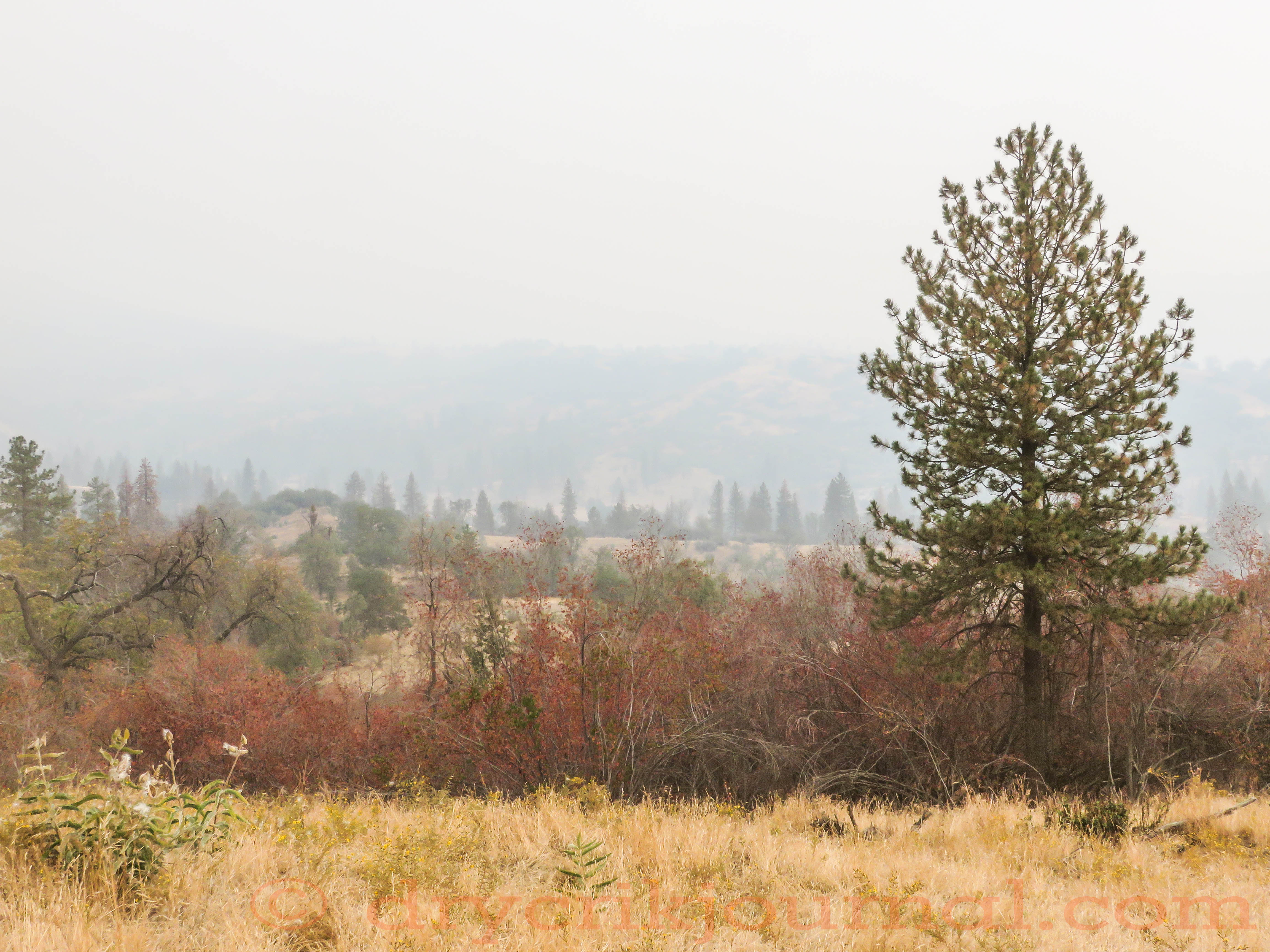
Smoke at dawn from the Rough Fire after jumping Highway 180 in Kings River Canyon (next watershed north) on Tuesday, August 18th. Currently over 30,000 acres and headed towards Hume Lake.


Grapevine Spring


20150814-IMG_0517

We began mucking out the silt and sediment at Grapevine in the afternoon of August 14th, after breaking loose new water at Railroad Spring.


20150817-IMG_4183

On the 15th, after spending the morning at Railroad constructing a spring box and plumbing pipeline to the troughs, David continued at Grapevine after some accumulation of water overnight, also digging about ten feet deep at the south end of the pond .


20150819-IMG_4218

Photo of Grapevine while checking our stock water and cows in Greasy on the 19th. The flow from beside the rock on the north end of the pond appears to be running 1/2 to 3/4 gallons per minute. At the south end, where the Gill cowboys rode in with shovels in 1939 to find water for the their cattle, David dug as deep as he could reach on the 17th where substantial water had seeped in overnight.

Even poetry cannot express my relief knowing we’ll have enough water for our cows, already ranging farther out to graze now sure of places to drink.


WONDERMENT


20150712-IMG_0251


My other voice just beneath the skin,
its echoes muffled by convention
and chained from reason’s reach

to speak only to me, quickly and quietly—
my unholy voice of blatant honesty
I can neither temper nor ignore,

telling more than I truly comprehend,
amazes me: a brief non-sequitur
with a keen edge, blade like a mirror.

I have grown deaf to crowds chanting
simple mantras as demigods tremble—
I’ll keep my counsel with my wonderment.


Water @ Railroad


20150817-IMG_4176

Hauled by four-wheel drive to Railroad Spring in the early 70s, before we built a road there, I am gratified to see they are still level and don’t leak, but more that we were able to redevelop enough water on Friday and Saturday to fill them. US Army Surplus tank transmission cases, these serve us well as water troughs with a combined capacity of about 750 gallons.


20150817-IMG_4180

Lid for the spring box I fashioned from scraps on Sunday with three coats of Superdeck Heart Redwood stain, leftover from a another project, for added life.


MID-AUGUST 2015


20150816-IMG_0576


Too early to know
what the day brings—
plans mixed with dreams.

Ridgelines stay the same
except rooted trees
lose their leaves

or dress in early spring
with iridescent greens
hard to imagine from August.

But the errant clouds help,
forecasting change
beginning each day.


IDES OF AUGUST, 2015


20150816-IMG_0563


The hills black,
faint pink cloud
over Sulphur

in first light cool.
Nights grows longer
with the shadows

when we dream
of winter storms,
four years dry.

We feed our future hay
until the time comes
we have nothing else to do.


Spring Box @ Railroad


20150815-IMG_0526


There are several different ways to install a spring box depending on the water source and materials at hand. With backhoe and shovel work, David and I uncovered about two square feet of a hard flat rock with a horizontal crack that was leaking the water. We scrubbed the rock with a brush to remove all the mud so the mortar mix would stick, then built a small dam of smaller rock around our 1½” PVC pipe until the water pooled behind it to rise and exit the pipe. We leveled the dam and sides until the discharge pipe was secure, the ran about 80 feet of pipe down the trench to the troughs and backfilled it before placing larger rocks around our spring box to keep the loose dirt and debris out.

Our placement was about three feet deeper and five feet away from the original spring box, also constructed of rock, which enclosed a seep in native soil that had to be dug out regularly to free the water to rise into a pipe. I’m guessing the original spring box was installed in the 20s or 30s with only a shovel.

The inside dimensions of our box at the top are approximately 7” x 14” and about 18” to the hard rock bottom, making it fairly easy to clean for any silt or sediment that might accumulate over time. I’ll be back Monday with some short 2 x 6s and screws to fashion a lid to keep leaves and small critters out, but for now, the disc blade covers that space.

While I went to Ragle Springs to install a new overflow pipe to utilize a 6’ x 6’ concrete trough built by Earl McKee, Sr. and Lee Maloy in the 30s, having packed the sand and cement on mules from the Kaweah River some four miles and 2,000 feet below, David continued to clean out the pond at Grapevine Spring that had accumulated a substantial amount of water overnight and several thousand gallons by the time we came off the hill late afternoon. Wahoo!

We will return Monday morning to finish up at Grapevine and cover my overflow pipe at Ragle Springs with a dirt pad for a new trough, should the old concrete trough leak.


Dirt Works @ Railroad Spring


20150814-IMG_0509


We’ve been on David Langton’s list for well over a month as he moves ranch to ranch with his four-wheel drive backhoe improving stock water. Railroad Spring has been nearly dry for two years, with not enough water in the spring box to reach the pipe. Hand dug and constructed of concrete and rock with a disc blade lid, it’s provided good water since well-before my time with the exception of the droughts of 1938-39 (anecdotal) and 1976-77.

(Heavy equipment working at the 2,400-foot elevation 4-5 miles from the asphalt is always a clash of sensibilities for me.) In the photo, David has dug about three feet below the original spring box and gotten to a flowing crack in the hard rock, nearly an impossible task to reach with a pick and shovel. He’s trenching the pipeline we will install this morning to the troughs in the background, which will presumably overflow in a normal year to the dirt tank beyond them.

When the trench was completed, we measured the flow at 1½ gallons/minute, that if sustainable would amount to well over 4,000 gallons/day, however, as so often is the case, the flow subsided to about ¾ gallons/minute after about five hours. We intend to work around the original spring box some more before installing our new spring box and pipe. Meanwhile, we broke a little water loose at the Grapevine spring a 1/4 mile away, and mucked out enough silt to form a basin where the cows can water, previously preferring to drink the fresher water pooled in their hoof prints than the warm stale remnants at Railroad Pond. Open to two other pastures with water, my count at Railroad was 24 head of cows getting ready to calve.