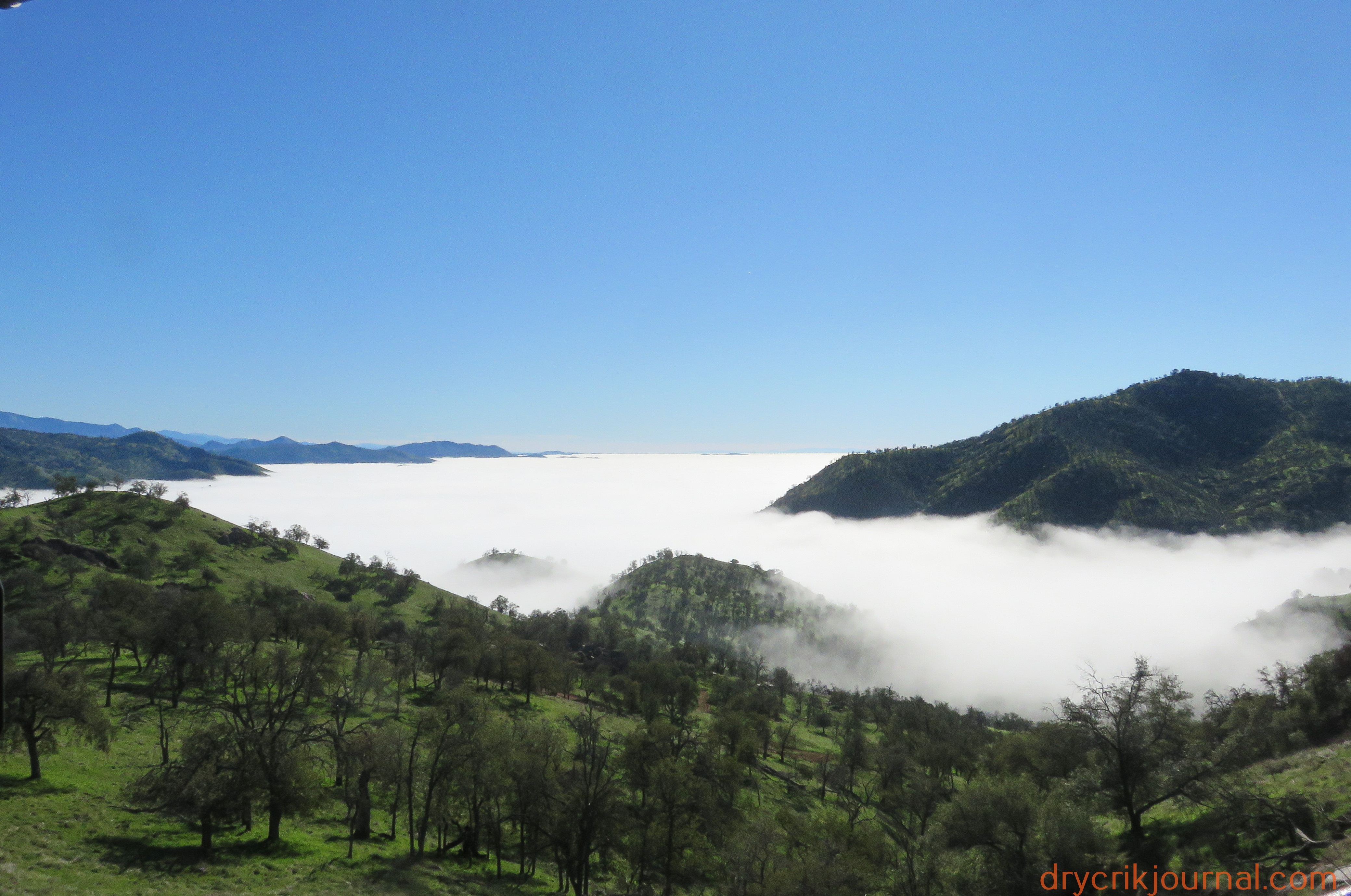
How nice it was to see the sun above the fog topping out at 1,800 feet, temperature in the high 70s. Down on Dry Creek this a.m. it was 35 degrees.
We went up to the Paregien Ranch to make some repairs to the corrals and cut some dead trees out of our dirt roads and off the fences. The oaks that died during the 2012-2016 drought are really tipping over now. A joy to work in the sunshine before we brand calves next week.
It hasn’t come “on little cat’s feet” (Carl Sandburg), instead a blanket hanging for 10 days straight, a “radiation fog” as it’s now named, 44 degrees high yesterday, 38 degrees this a.m.
Of course, nothing compared to the snow storms elsewhere, but our grass needs sunshine. Other places in the San Joaquin Valley have experienced zero visibility, and often here the low lying fog spills over the ridge clear down to the creek. Perhaps tomorrow we’ll get some sun.
Around Christmas, I’d wake to my father asleep on the floor facing the fireplace of the old Coffelt house with high gray ceilings, his brown sweater reeking of #2 diesel and I’d lay beside him as he snored.
He’d been up and down all night checking temperatures, lighting smudge pot sentries whose flaming helmets surrounded his father’s orchards of oranges to turn back a freeze, or climbing towers with spinning turrets to start the flathead Ford’s twin prop wind machines.
I begged to go with him block to block passing Ike Clark’s lean-to of old scrap boards catching fire from two lit smudge pots and bottled heat with him asleep on gunny sacks of straw. Dad pulled him free as we watched the shelter disappear.
My mother suffered most the suet that leaked inside the house from the black cloud that hung over Exeter’s crop of gold. to ship East and the new dress she bought for a Christmas party in Visalia she never got to wear because the freezing weather claimed my Dad. She never forgave him.
We’ve let the commentators have their say as if they understand the price of beef. We’ve let politicians have their day pontificating plans that create grief among both cowmen and folks in town trying to overhaul how the market works when demand is more and supply is down due to drought and the rising costs that hurts us all. We let them talk, let them repeat to show what they don’t know when numbers shout that we have more mouths to fill with red meat with fewer cows and cowmen due to drought. We pray for rain and to be left alone with a little meat still left on the bone.
Lots of commentary on the cattle business lately with a focus on the price of beef. But relative to inflation, $20 will buy a cheeseburger, fries and a soda or a USDA Choice New York steak at Costco. What a deal!
Our 4-year drought (2012-2016) doesn’t seem that long ago when we had to cull some older bred cows for slaughter in order to feed the rest of our herd expensive hay. A good part of the reason why producing cow numbers are at a 75 year low. Though the media has its red meat theories, nobody mentions that the US population has more than doubled since 1951. This is simple to understand: supply and demand.
KEEPING SECRETS
How do they know, these old fat cows that read a baggy sadness in my walk among them checking irons as they pull
alfalfa stems apart to tongue green leaf in the corral? The gates are set, waiting for the truck to town. There is nothing
right about the moment, that they know— little consolation in my voice, they eye me suspiciously searching for details
in my muted gestures. If I told them all I know of town, of auction rings and rails, they would all revolt
for the brushy hills, lay fences down to take their chances without water through the summer—that I know.
-JCD (“Best of the Dry Years, 2012-2016”)
The three variables for the cattle business are weather, price and politics, any one which can reduce our once-a-year paycheck to a loss, but two or more can be an economic disaster—none of which have we, nor the government, any control over.
In the photo above, Robbin and I fed a few replacement heifers before the forecast Atmospheric River. The grass geminated last month has become short and spotty and we have to keep them in shape to cycle and breed when we turn the bulls out in two weeks—just part of the business.