Monthly Archives: August 2012

IDES OF AUGUST, 2012

The heat on, set over 100 degrees,
cottontails lounge in the dust,
share shade with squirrels and quail

beneath the gooseneck. No talk
of politics, healthcare or guns, no
plan hatched to overthrow the sun.

Woodpeckers wait in line to cling
to leaky faucets, sip a drop at a time.
Roadrunners multiply before our eyes.

Veterinary Drugs and Photo-Allergies

For the past year, I’ve been dealing with a perpetually peeling face, that at its worst would burn and peel in three to four-day cycles, shedding skin in sheets, stay red, itch and continually sting with the heat and exposure to the sun. At its best, the cycle might take as long as a week or ten days to complete, but could occur all times of the year. Until recently, I’ve had no relief.

With dramatic improvement this past week, I’m fairly confident that we’ve finally found the cause(s) and share my odyssey in this journal with the chance that it may offer clues for some who, like I did, might search the Internet to identify and thereby find some insight. But perhaps more importantly, I’ve loosely documented my experience as information for those who make their livings in the livestock industry.

My problems began in the summer of 2010 after processing our yearling calves during weaning that included the application of the fly control product Cylence with a leaky applicator gun on an especially hot day. Using my bandana to wipe perspiration from my face and glasses half-a-dozen times during the process, I was unintentionally applying the concentrate to my face. An hour or so after, my face was on fire. I flushed it in a cold shower for fifteen minutes to gain slight relief. The burning lasted for several days and seemed to dissipate completely in a week or ten days.

However, after any long exposure to the sun, similar, but less intense symptoms would return. I addressed this with the sunscreen Vanicream 60 SPF and bumped along the following season with occasional flare-ups and minor discomfort. My complexion is light, always susceptible to sunburn as a child at the beginning of every summer. About ten or twelve years ago, I had to exclusively wear long-sleeved shirts, because when working in a T-shirt, my arms began to swell and itch.

During the processing of our calves in the summer of 2011, I was applying Cylence once again, but with a new applicator gun, trying to keep my hands clean and much more careful with the product. We are a tough bunch, survivors of the old days and ways and not ones to wear latex gloves or other such protection. Though we’ve never had to do this in the past, today’s chemical products are much more sophisticated and complex as they address ever-adapting livestock pests.

After another burning red face, cold shower and returning symptoms, I went to the drug store to buy the highest SPF sunscreen I could find. It didn’t help my face that began to burn, peel and itch regularly. Furthermore, my hands began to itch and peel as well. I searched the Internet for some information on what might be happening to me and finally went to the doctor in December 2011 who prescribed Silver sulfadiazine for my face and Fluocinocide 0.05% ointment for my hands while referring me to a dermatologist.

With no improvement in February 2012, the dermatologist suggested discontinuing the Silver sulfadiazine and prescribed Hydrocortisone butyrate for my face, Clobetasol Propionate 0.05% for my hands and gave me a sample of Aveeno Baby 30 SPF sunscreen, explaining that it was all I needed. After exhausting the sample and unable to find Aveeno’s Baby sunscreen at the pharmacy, I purchased a tube of Aveeno Continuous Protection 30 SPF sunscreen instead. I continued my normal ranch activities with a little improvement to my hands as my face got worse. At the end of July, my dermatologist conducted a patch test as we looked for the standard allergic reactions to grass and weeds, including alfalfa. None.

On August 7, 2012, a biopsy was conducted. Results pointed to a photo allergic reaction to some topical agent. Sunscreens were at the top of the list, Aveeno Continuous Protection 30 SPF sunscreen containing three of the chemical compounds on the list. Furthermore, the antimicrobials used in veterinary medicine were also included as common photo allergic agents, such as Chlorhexidine found in the disinfectant Nolvasan, and Fenticlor found in liniments for horses. The list also included the hexachlorophenes found in Dial soap and Phiso-hex, but more importantly in the Acaricides we commonly use for dewormers and fly control, namely Permethrin, Pyrethrin, Clyfluthrin found in pour-on products like Ivermectrin and Cylence.

My conclusion, at this juncture, substantially better but not completely free of the symptoms, is that the initial culprit was the pour-on Cylence, exacerbated by Aveeno Continuous Protection 30 SPF sunscreen. Be careful with pour-ons and to avoid photo allergic reactions to sunscreen, use products with only Titanium Oxide and/or Zinc Oxide in their ingredients or consult a dermatologist.

As my father often said, ‘most people learn the hard way, but only a few from the mistakes of others.’ I truly hope you might learn from mine.

STAYERS

Almost every morning, we bump-up against
the old days over cigarettes and coffee cups
to bore the be-Jesus out of whichever young buck
happens to politely listen to yesteryear. All the men
and horses with big hearts tough to get along with,
that walked this ground when it was hard, harder than
Billy Hell without a 4WD and RTV. We start our days
amazed how far we’ve come to this perspective,
surviving floods and drought and them with
bigger calves, better corrals and goosenecks.

How envious they must be, looking down in disbelief
—quick pause to nod ‘tween ridge and dawn—
we go on and on, and tell a couple twice before
we remember what triggered the tale: something
out there come alive in our collective mind
before we join them. When I was seven,
you were my first cowboy hero at sixteen,
and now we laugh at the last-half century
without regret, without one ounce of lament,
glad to have a job to do and tickled with life.

                                                                        for Clarence

WHERE THE STARS ARE MANY

The old oaks spoke patiently,
listening to each confusion
                    press for direction—
but I followed the churn
                    of rivers narrow
                    beyond the timber
                    in the granite
where the stars are many.

A man is almost nothing
                    in the mountains—
                    small creature
set apart in time for awe.

The other world of men
exfoliates and settles for
                    the clutch of gravity
and growth decomposing
                    in the bottoms—
                    here weather wears
                    the worn away
where the stars are many.

No need for money
                    in the mountains—
                    unless to start a fire
to keep the cold at bay.

STARGAZING

Black silence beneath a waning moonrise:
a golden crescent, Venus trailing. Too hot
for night life, coyotes and raccoons are still

tossing in yesterday’s shade, rewriting
the same line half-a-dozen different ways—
a circular prowling they can’t get beyond

as the sun loops back into a blaze of day.
The night sky is ripe for gazing into the infinite
soul of the universe we can never see clearly,

for homemade theories stirred with myths
and illuminated meteors escaping somewhere—
for calming my delirium with blank paper.

Wagyu #2

#1094 – August 11, 2012

#1094 – August 11, 2012

OUT OF THE FOREST

A man steps out of the forest, a close family
of oaks in the shade of one another. Nothing
is as it was. Dry channels of rivers crumble

in a desert where green, ripe heads once bent
heavy with the breeze, in a lifetime’s flash
of time past and time to come—one moment

without beginning or end—a continual wash
of colors nevermore the same. The dull sacrilege
of leather-skinned mountain men felling the first

bountiful oak before native eyes bled into brown
forts that became settlements, before the gray
railroad towns and blond dry-land farming,

before the irrigated ground was planted to houses
surrounding bright cities run on more of the same.
And she gave-in and continued giving as she has

and will again, for time is nothing, just the passing
of a brush stroke on an endless panorama of ever-
changing colors that we are washed within.

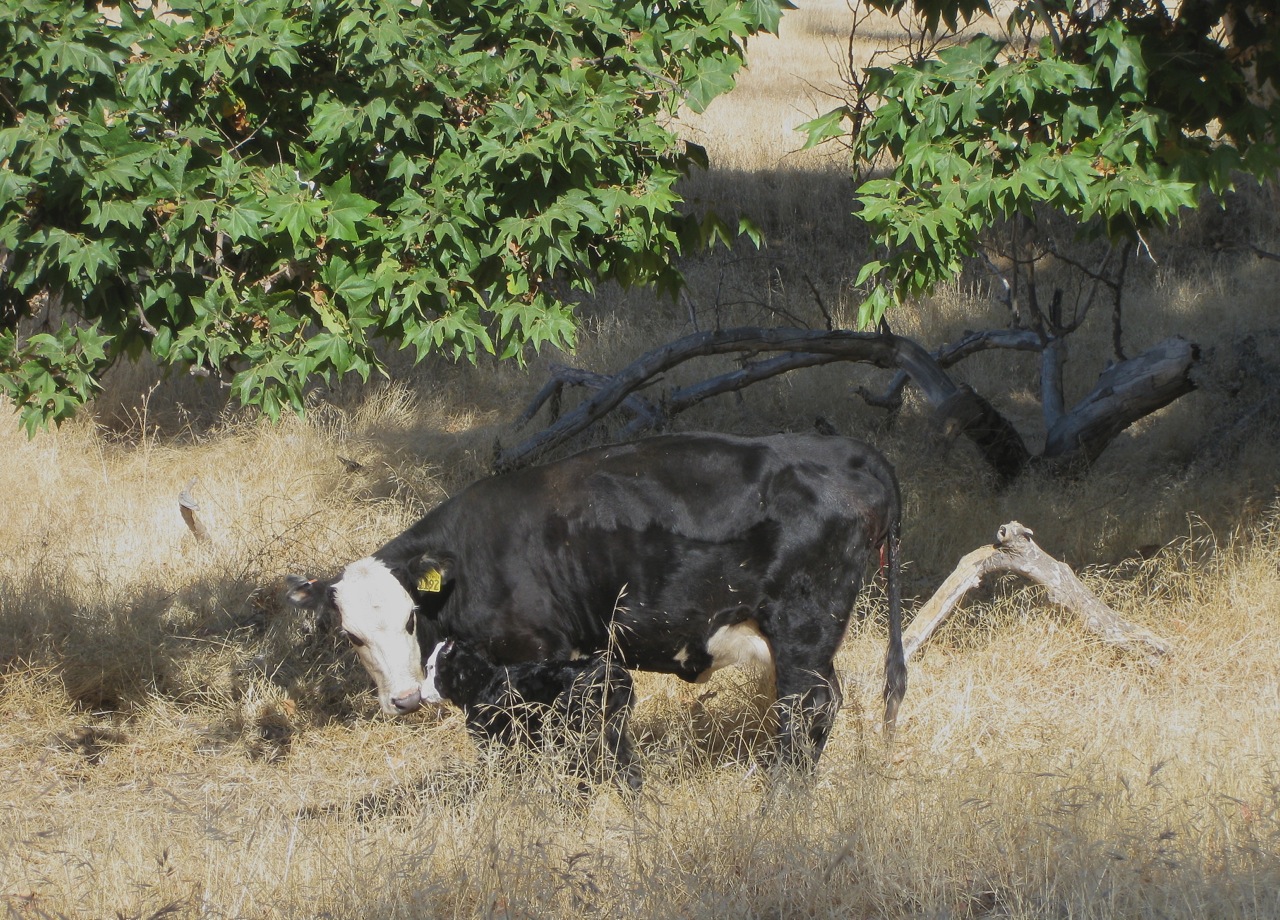
First Wagyu Calf 2012

#1192 – August 9, 2012

Having just opened the gates last week to let our two bunches of first-calf heifers off the hills into the pasture along the creek and the other around our house, I found this fresh calf, less than an hour old, this morning. As part of our Age and Source Verification program with Snake River Farms, this journal serves to record when the first Wagyu calf is born. We put the Wagyu bulls out November 14, 2011. With over 100 to check regularly, we have at least a half-dozen either side of the road that look to calve within the week. But with first-calf heifers, you never really know for sure, some can look close-up for a month. Here we go!

#1192 – August 9, 2012

THEIR TONGUE

The hoots in the dark grow closer
to sounding similar, a conversation
from ground to tree, a rustling of leaves.

Muffling a weak calf into the hollow
of my hand, she turns, looks back
and finds what she has hidden in the grass.

You nicker with him when he’s done well,
let gentle whinnies roll into your laughter.
Howling with coyotes since children,

we become them, feel each tone wash
through our flesh. You never forget
what the words mean, if you’re listening

—for sound and motion of the universal dance—
for the truth in heart and mind. When Mountain
Lion gathered the animals at Wuknaw,

at the head of Antelope Valley, each perched
in a circle of rocks that yet remain, they agreed
to create another creature to speak their tongue.

Nature’s Garbageman