WRANGLER AND STRAUS

                                        ‘Too poor to pay,
                                        too rich to quit.’

                                             – Velvet Clark, (“Gunsight Ridge”, 1957)

With an extra hour gained between Daylight
and Standard time, my body’s clock rings early
to find the black and white ethics of yesteryear

still resonate in both sides of my brain.
Left-handed gun, a piano-playing miner
measures himself with wealth despite

his gentle talent, and so it went in those years,
rebuilding after the war with Joel McRae.
Dinner up the road with pre-teen, twin town boys

revisiting ranch repairs and guns, dubbed
‘Wrangler’ and ‘Straus’, one left and one right-handed
when they shoot, serve drinks to us all

as the fire licks fresh vegetables and swordfish
from the coast. Both love to eat, but lefty
writes poetry, listening to every word I say.

BACKCOUNTRY WAY

                               We were following a long river into the mountains.
                                                  – Gary Snyder (“Journeys”)

On the outskirts of the backcountry,
the foothill hem of the Great
                                                            Western Divide
we head upstream, drifting closer to
                                                            the Kaweahs
where the Big Arroyo falls to the other side.

Ko said, “Now we have come to where we die.”

                    How many aged, hip shot horses finally look up
                    from dreams, asleep on their feet, not wanting
                    to wake into our fenced realities, recalled
                    to mountain meadows fed by Sierra lakes
                    and snowmelt? We saved her once, fallen
                    off the High Sierra Trail, but Jane escaped
                    and stayed the winter on the Big Arroyo
                    with only scattered bones to show.

We become the animals that have taught us
how to forage and gather for the future,
the fang and claw of predator and prey—
we relearn the language and how to think.
We hold no fear of death.

Two young black cows, calves trailing
a long steep bluff of trees and rock
to the sound of my Kubota with alfalfa,
a flat spot in a short canyon cove I own
where I’ve never fed before. Here
I am the interloper without a history.
A gray Prairie Falcon glides low
overhead, treads air to inspect me
in his territory, falls to perch on a clod
for another perspective as the cows eat,
then returns to the top of his oak tree.

When I was a boy, I might have shot him
for a closer look, like Audubon inspecting
the feathers of his handlebar moustache.

                    But now he is my totem,
                    both on journeys upstream—
                    “This is the way
                    to the backcountry.”

                                                  For Sylvia and Matthew

TRICKY TRADEOFFS AT HALLOWEEN

The earth sinks at the middle spring,
at the fairly flat and brushy head
of Ridenhour Canyon, huge Blue Oaks
and gooseberries covering forgotten
gossip rocks. I think of Effie riding
her white horse, string of ‘wolves’
beside her cattle following at a walk—

me on the Kubota, salt and mineral,
backtracking for my lost hay hook hung
on the flatbed rail to disengage Spencer’s
trailer backed beneath the pickup hitch
to transfer bales he borrowed for
his daughter’s party—lighter trailer rising
as the loaded feed truck bears down.

Gulf War veteran, he’s had a key since
he was sixteen, goes where he wants,
grins with canine teeth as he talks coyotes,
calls them in for instant death. A silhouette
at rest in the shade of gray chemise,
the bunch behind me, rises in my scope.
Mangy old dog down, forever relieved.

As they regard him crossways in their track,
a tall Brangus turns to search the manzanita,
ears flicking, another leaving I never see
though I comb hillsides clear to the corrals.
Ahead, bawling cows tuck two more tails, chase
chuckling tongues over year-old shoulders.
One down, but one slips off before I head to

Effie’s cabin, cows and calves come to salt,
hope for hay, survey and study another
nosing leaves beneath an oak on Wuknaw ridge,
animals’ rock circle—Yokuts Creation Place.
Three for three, cow dogs living with cattle,
waiting for the mother of the latest calf
to go to water. Haven’t found my hay hook, yet.

RURAL ARCHITECTURE

With a little luck, we become
a third person consumed with
plugging holes with acorns—

all sizes, an art perfected
in the fall, each picked ripe
from the tree. Of course,

there’s bickering for the prize,
flapping feathers in the oak—
but come the winter’s wet and cold,

who’s to say who filled the hole
in the post that holds the gate,
that keeps the barn upright?

Doe and Fawn

I ran up into Paregien’s yesterday to put mineral and salt out to the cows, plus look for the hay hook I lost somewhere the day before. Found these two instead along the road.

The coyotes are with the cows almost everywhere I went, waiting to catch a newborn calf alone. The cows told me where two of the three less were.

MAKE IT RICH

                    I arrived by air, by the light
                    of a million stars.

                                        – Quinton Duval (“The Aviator”)

Outside the day begins with dependable shoes,
a mental checklist wider now with lower heel
to meet uneven ground—each day another chance

to see a world surviving with damn few
humans in it. Perhaps a reverie at work, yet
unfurling, with so many eyes to see through.

‘Make it rich,’ Hal Spear said, early-on, each
moment open and elastic to fill the emptiness,
to jettison useless cargo. It works like a dream.

JUDGE JUDY

Our slice of earth, cobalt blue
beneath a dawning, loose clouds
pink as my mother’s nightgown.

Quiet in the canyon, calves
impressed in beds against
thin maternal dreams of hay.

It will not rain soon, but
it’s beautiful and cool
before we stir our dust—

hooves and wheels, a boiling
shroud for blatant bawling
deep within the turmoil,

big-eyed and insistent,
they plead not guilty.
Who is responsible

for feeding the world
what it needs, who cannot
go back to sleep?

The camera crews are ready.
Judge Judy has arrived.
All the cows are in their pews.

NEARBY, PETROGLYPHS

Certain rocks draw the eye
and speak a single word
we never learned—too far
removed from survival,
too addicted to science
searching to soothe us,
to accept as truth—
we have convenient homes
furnished in our minds.

Not far, a young boy sweats
behind deer skins hung
from a granite cave
where two boulders rest,
ceiling black with soot—
left to his naked self
in these rocks,
beneath this sky,
that speak.

I remember the first time
it caught in my throat—
a gasp, up close, looming
above me—white-faced
cows and calves winding by.
I am yet not old enough
to stay and stare too long,
to learn another language.

October

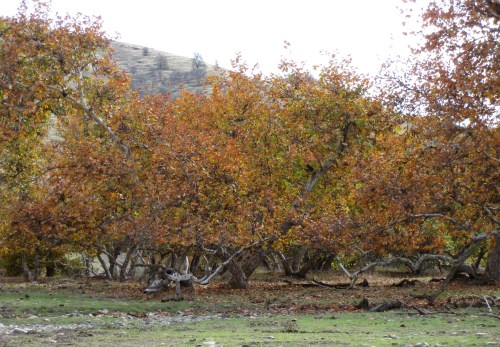
With the increasingly lower angle of the sun, October brings fiery color to the foothills, longer shadows crisp with contrast as well as a welcome relief from the summer heat, persisting, this year, with 90+° into its first week. As the angle of the sun also drops below the brim of my hat, I notice renewed impacts to my face.

But aesthetically, it’s one of the loveliest months of the year, and psychologically positive as it precedes our rainy season and the beginning of green grass through winter and spring. With rains too early, the new green fades with the heat before the next rain arrives. Typically, the first of November is ideal for our first rain, and our best chance this year, based on the Farmer’s Almanac and my own forecasting methods, looks to be the 11th or 12th of November.

But October is a tough month on cows, two-thirds of which have calved in the last sixty days. The flat ground, where we watch and keep our first-calf heifers is short, but with access to ample dry feed at the higher elevations. Supporting calves for sixty days draws the heifers down despite supplementing with alfalfa regularly. Even in our upper pastures, both young and old cows tend to be thin. Furthermore, everyone and everything is on the acorns including deer, bear, feral hogs, woodpeckers, turkeys, Mallards, Wood Ducks and quail, a diet that keeps cows thin, and changing, I suspect, the pH in their digestive system to make efficient conversion of the dry feed more difficult. Moreover, the acorns seem to have an addictive quality. Bottom line, October is not a month to show off your cows.

October is a month of tough choices, also. Whether to feed more hay, or not, as we make our rounds in the upper pastures, will require more physical work, more time and money, more fuel, and wear and tear on the 4-wheel drive. But supplementing after the cows have gotten thin is often too late, especially if the rains don’t arrive on time, so we watch the weather patterns closely. Anxiety can be high, but not near the panic level as in November and December without a start to our new feed.

October is a transition month in the Southern Sierras, and we are there.

Light Dusting

Alta Peak & Morro Rock- October 25, 2012

Just enough snow to see the elephant on Alta Peak (11,208′) with Moro Rock (6,735′) in the foreground, redwoods of Sequoia between them, from the Top in the Greasy Creek watershed @ approx. 2,000′.