August 18, 2012
Our days noticeably shorter, we’ve lost about an hour’s daylight in the morning since the Summer Solstice. This photo @ 6:24 a.m. Our high temperatures, still above 100°, but we’ve enjoyed the break from 110°.

August 18, 2012
Our days noticeably shorter, we’ve lost about an hour’s daylight in the morning since the Summer Solstice. This photo @ 6:24 a.m. Our high temperatures, still above 100°, but we’ve enjoyed the break from 110°.
Posted in Photographs
For the past year, I’ve been dealing with a perpetually peeling face, that at its worst would burn and peel in three to four-day cycles, shedding skin in sheets, stay red, itch and continually sting with the heat and exposure to the sun. At its best, the cycle might take as long as a week or ten days to complete, but could occur all times of the year. Until recently, I’ve had no relief.
With dramatic improvement this past week, I’m fairly confident that we’ve finally found the cause(s) and share my odyssey in this journal with the chance that it may offer clues for some who, like I did, might search the Internet to identify and thereby find some insight. But perhaps more importantly, I’ve loosely documented my experience as information for those who make their livings in the livestock industry.
My problems began in the summer of 2010 after processing our yearling calves during weaning that included the application of the fly control product Cylence with a leaky applicator gun on an especially hot day. Using my bandana to wipe perspiration from my face and glasses half-a-dozen times during the process, I was unintentionally applying the concentrate to my face. An hour or so after, my face was on fire. I flushed it in a cold shower for fifteen minutes to gain slight relief. The burning lasted for several days and seemed to dissipate completely in a week or ten days.
However, after any long exposure to the sun, similar, but less intense symptoms would return. I addressed this with the sunscreen Vanicream 60 SPF and bumped along the following season with occasional flare-ups and minor discomfort. My complexion is light, always susceptible to sunburn as a child at the beginning of every summer. About ten or twelve years ago, I had to exclusively wear long-sleeved shirts, because when working in a T-shirt, my arms began to swell and itch.
During the processing of our calves in the summer of 2011, I was applying Cylence once again, but with a new applicator gun, trying to keep my hands clean and much more careful with the product. We are a tough bunch, survivors of the old days and ways and not ones to wear latex gloves or other such protection. Though we’ve never had to do this in the past, today’s chemical products are much more sophisticated and complex as they address ever-adapting livestock pests.
After another burning red face, cold shower and returning symptoms, I went to the drug store to buy the highest SPF sunscreen I could find. It didn’t help my face that began to burn, peel and itch regularly. Furthermore, my hands began to itch and peel as well. I searched the Internet for some information on what might be happening to me and finally went to the doctor in December 2011 who prescribed Silver sulfadiazine for my face and Fluocinocide 0.05% ointment for my hands while referring me to a dermatologist.
With no improvement in February 2012, the dermatologist suggested discontinuing the Silver sulfadiazine and prescribed Hydrocortisone butyrate for my face, Clobetasol Propionate 0.05% for my hands and gave me a sample of Aveeno Baby 30 SPF sunscreen, explaining that it was all I needed. After exhausting the sample and unable to find Aveeno’s Baby sunscreen at the pharmacy, I purchased a tube of Aveeno Continuous Protection 30 SPF sunscreen instead. I continued my normal ranch activities with a little improvement to my hands as my face got worse. At the end of July, my dermatologist conducted a patch test as we looked for the standard allergic reactions to grass and weeds, including alfalfa. None.
On August 7, 2012, a biopsy was conducted. Results pointed to a photo allergic reaction to some topical agent. Sunscreens were at the top of the list, Aveeno Continuous Protection 30 SPF sunscreen containing three of the chemical compounds on the list. Furthermore, the antimicrobials used in veterinary medicine were also included as common photo allergic agents, such as Chlorhexidine found in the disinfectant Nolvasan, and Fenticlor found in liniments for horses. The list also included the hexachlorophenes found in Dial soap and Phiso-hex, but more importantly in the Acaricides we commonly use for dewormers and fly control, namely Permethrin, Pyrethrin, Clyfluthrin found in pour-on products like Ivermectrin and Cylence.
My conclusion, at this juncture, substantially better but not completely free of the symptoms, is that the initial culprit was the pour-on Cylence, exacerbated by Aveeno Continuous Protection 30 SPF sunscreen. Be careful with pour-ons and to avoid photo allergic reactions to sunscreen, use products with only Titanium Oxide and/or Zinc Oxide in their ingredients or consult a dermatologist.
As my father often said, ‘most people learn the hard way, but only a few from the mistakes of others.’ I truly hope you might learn from mine.

#1094 – August 11, 2012

#1094 – August 11, 2012

#1192 – August 9, 2012
Having just opened the gates last week to let our two bunches of first-calf heifers off the hills into the pasture along the creek and the other around our house, I found this fresh calf, less than an hour old, this morning. As part of our Age and Source Verification program with Snake River Farms, this journal serves to record when the first Wagyu calf is born. We put the Wagyu bulls out November 14, 2011. With over 100 to check regularly, we have at least a half-dozen either side of the road that look to calve within the week. But with first-calf heifers, you never really know for sure, some can look close-up for a month. Here we go!
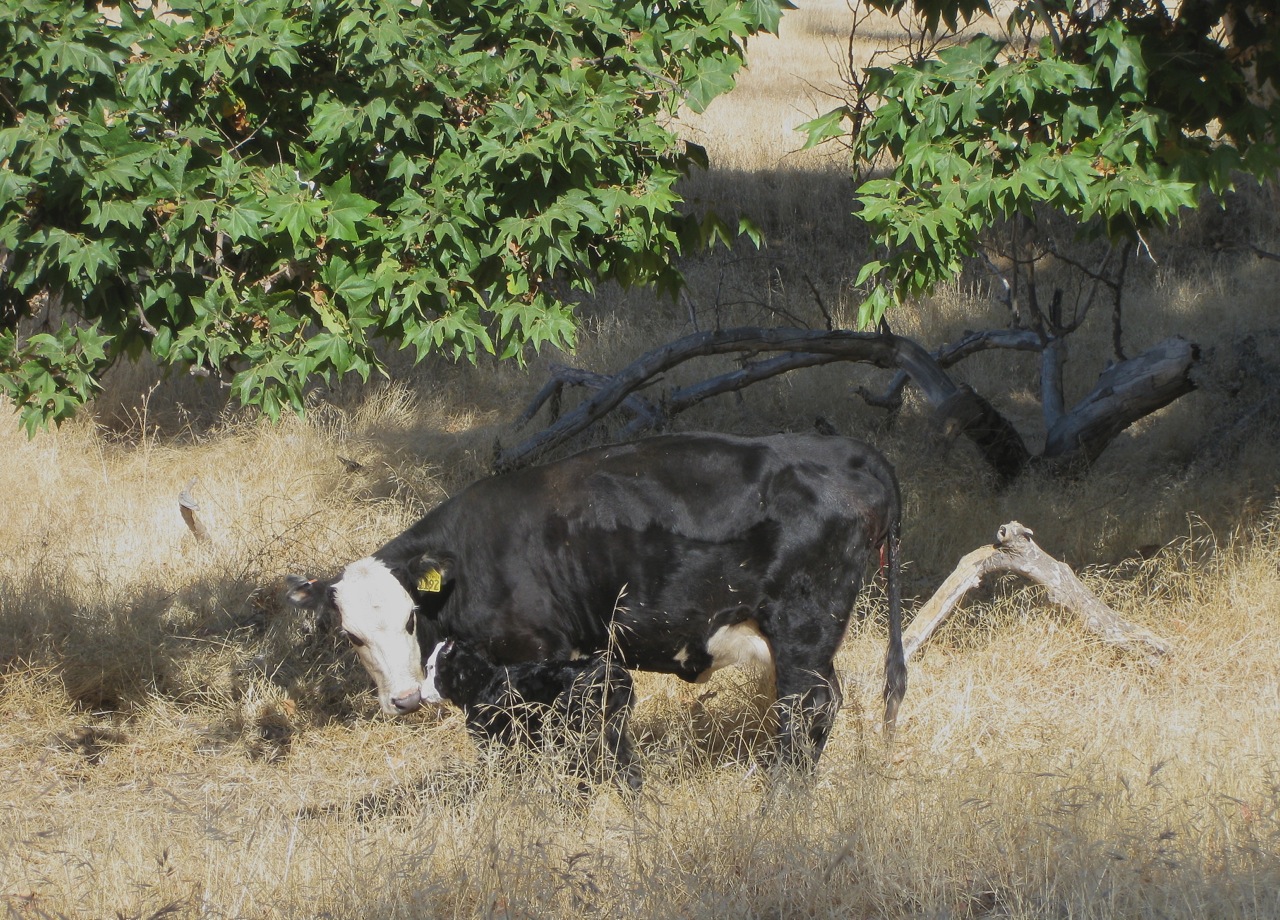
#1192 – August 9, 2012

Sycamores are greedy,
take all the water they can,
believe in unlimited growth
they can’t support, lose limbs
with the crack of a rifle shot:
leave wilting proof
of gravity
upon fences
along the road
over and over again.
They never learn.
(“July Outside”)
Posted in Photographs
I bought my first gun when I was 12 by saving my summer wages swamping lug boxes of Red Malaga grapes out of my father’s and uncle’s vineyards. A few weeks before the opening of Dove Season, I sent a $109.95 money-order to Sears and Roebuck for a 20 gauge Model 12 Winchester shotgun. The box came addressed to me in the mail.
Before that, I hunted dove and quail with Stevens .410 single-shot and roamed the foothills on cow trails shooting ground squirrels with a used, J C Higgins single-shot .22 rifle that my mother’s cousin, Stanley Dickover, had given me for Christmas when I was 10. Different days and times, my parents would likely have been thrown in jail today for turning a youngster loose with a gun. But I loved it—not the killing as much as the hunting and exploring.
In those days, finding a place to hunt was not difficult. For me, there was always the ranch. But most all of my teenage friends had permission from local landowners to fish and hunt whatever was in season. Poaching happened, but was seldom an issue in this small community where everyone knew everyone else, when a young man built his reputation early in life.
In the mid-60s with the advent of affordable air conditioning, the local population began to explode, and with more people, less places to hunt. Trespass and poaching became serious problems for landowners who lost livestock, had water troughs shot full of holes and experienced a general increase in vandalism that impacted their operations. Then again, the clash of cultures after the Vietnam War when many Hmong refugees, used to living off the land, were relocated to the Central Valley.
Today, the prices of guns and ammunition, as well as license and tag fees to the California Fish and Game, continue to increase while places to hunt have decreased dramatically. It’s not surprising that poaching has become a problem, and in some instances, a business where deer, feral hogs and livestock are butchered in backyards and the meat sold locally. While budgetary restraints have wardens stretched thinly, the problem of poaching falls precariously on landowners more than ever before. Rather than to have to sort the good guys from the bad, we are inclined not give anyone permission to hunt.
Today’s poachers seem to believe that if they have a gun, they have a right to hunt anywhere they want, indignant when caught, and blame the landowner when prosecuted. Our latest incident on July 22, 2012, a slam-dunk case for the Fish and Game and D.A.’s office with indisputable photographic evidence, has to be pursued if we expect help and support from local wardens in the future.
I’ve never been an advocate of stricter gun laws, but if the common belief that the purchase of a gun increases one’s rights while diminishing the rights of others, then something has to change.
Posted in Photographs

Though high temperatures have dropped into the 90s, I’m trying get out and around early to keep the sun off my face. My back is taped with a battery of patches to give my dermatologist a clue as to what I’ve become allergic to that has triggered my immune system to keep producing new skin on my face to burn, peel and itch continuously. After feeding our replacement heifers, then starting my irrigation water, I caught these geese at the pond at dawn. Quite tame and never flew while I open the gate to let water into the pipeline.

A tough shot into the sun, the dragonflies of all colors and shapes have begun to show, and sparkled this morning.
Posted in Photographs