
 Clarence & Robbin
 enlarge
 enlarge
-
Recent Posts
-
-
NATIVE HARMONIES: ranch poems
-

“Best of the Dry Years: 2012-2016”

‘STREAMS OF THOUGHT’ — Spoken Poetry 2013

‘PROCLAIMING SPACE’ — Wrangler Award 2012

‘POEMS FROM DRY CREEK’ — Wrangler Award 2009

Categories
Archives
- March 2026
- February 2026
- January 2026
- December 2025
- November 2025
- October 2025
- September 2025
- August 2025
- July 2025
- June 2025
- May 2025
- April 2025
- March 2025
- February 2025
- January 2025
- December 2024
- November 2024
- October 2024
- September 2024
- August 2024
- July 2024
- June 2024
- May 2024
- April 2024
- March 2024
- February 2024
- January 2024
- December 2023
- November 2023
- October 2023
- September 2023
- August 2023
- July 2023
- May 2023
- April 2023
- March 2023
- February 2023
- January 2023
- December 2022
- November 2022
- October 2022
- September 2022
- August 2022
- July 2022
- June 2022
- May 2022
- April 2022
- March 2022
- February 2022
- January 2022
- December 2021
- November 2021
- October 2021
- September 2021
- August 2021
- July 2021
- June 2021
- May 2021
- April 2021
- March 2021
- February 2021
- January 2021
- December 2020
- November 2020
- October 2020
- September 2020
- August 2020
- July 2020
- June 2020
- May 2020
- April 2020
- March 2020
- February 2020
- January 2020
- December 2019
- November 2019
- October 2019
- September 2019
- August 2019
- July 2019
- June 2019
- May 2019
- April 2019
- March 2019
- February 2019
- January 2019
- December 2018
- November 2018
- October 2018
- September 2018
- August 2018
- July 2018
- June 2018
- May 2018
- April 2018
- March 2018
- February 2018
- January 2018
- December 2017
- November 2017
- October 2017
- September 2017
- August 2017
- July 2017
- June 2017
- May 2017
- April 2017
- March 2017
- February 2017
- January 2017
- December 2016
- November 2016
- October 2016
- September 2016
- August 2016
- July 2016
- June 2016
- May 2016
- April 2016
- March 2016
- February 2016
- January 2016
- December 2015
- November 2015
- October 2015
- September 2015
- August 2015
- July 2015
- June 2015
- May 2015
- April 2015
- March 2015
- February 2015
- January 2015
- December 2014
- November 2014
- October 2014
- September 2014
- August 2014
- July 2014
- June 2014
- May 2014
- April 2014
- March 2014
- February 2014
- January 2014
- December 2013
- November 2013
- October 2013
- September 2013
- August 2013
- July 2013
- June 2013
- May 2013
- April 2013
- March 2013
- February 2013
- January 2013
- December 2012
- November 2012
- October 2012
- September 2012
- August 2012
- July 2012
- June 2012
- May 2012
- April 2012
- March 2012
- February 2012
- January 2012
- December 2011
- November 2011
- October 2011
- September 2011
- August 2011
- July 2011
- June 2011
- May 2011
- April 2011
- March 2011
- February 2011
- January 2011
- December 2010
Author Archives: John
Still Cowboys
Having missed three heifers, one with a fresh calf, across the creek when I fed, Robbin & I jumped in the Kubota to see if we could find them yesterday afternoon, eyes peeled for coyotes. We found the pair, but also our neighbor’s heifer across the fence, down with legs up, looking dead at a distance, but trying to have her calf.
We went for him and the calf pullers, parts that have outlasted their canvas bag, big jug of water, lubricant, disinfectant and penicillin. As an afterthought, I grabbed a stiff lariat rope someone had left at the shop. Clarence beat us to his first-calf heifer, on his knees with some hay string in the shade and surrounded by the heifer’s mates, his Kawasaki Mule running when we arrived. We assembled the pullers after slipping the OB chains around the calf’s front feet, connecting the OB chains to the big chain from the jack with a quarter-inch bolt and nut, the original S hooks long-straightened and lost.
She was a big heifer with small pelvis in obvious pain as we applied pressure and lubricant. The calf’s feet were big and he was alive. Just as we were making progress, she jumped up, Clarence with a hold on the OB chains, me with the breeching, pole and jack, scattering the channel locks we used for a jack handle, cross-country. It was a fairly even pull to begin with, and I thought she was wearing down when the pole I was holding disassembled, leaving Clarence with a grip on the chains. Approaching 73, his legs couldn’t keep up with his grip, and out across the pasture she trotted, dragging breeching and jack, swinging from the chains connected to the calf’s front feet.
We had the rope—a 7/16th x 30-foot cable I tied to the axel of his Mule. We drove towards her. I needed a big loop, already loosing 5 feet of length from the bowline on the axel to the passenger’s seat, leaving me only a coil and a half in the hand I held-on with as I swung with the other, not sure whether to jump clear when I caught or duck under my slack as it got tight. What ran through my head without resolution became academic after several misses, and having to unwind their slack from around the axel. From the shade of our original oak tree, Robbin said it was pretty good watching. A one point, the heifer was turning in a tight circles left, the centrifugal force of which, as Clarence kept up, made standing and staying aboard my full-time job.
The chase brought us closer to the corrals and an ancient, Linton squeeze. I got the gate afoot, Robbin fell in behind her on the Kubota, and Clarence turned her through the gate on the Mule. Long story short, we saved the heifer, but lost a huge calf.
Over drinks as shadows crept across the canyon, we replayed the afternoon. My first cowboy hero, Clarence ran this ranch for my Dad and Granddad when he was 16, and I had to ask him, “How old do you think those pullers are? They were still in their canvas bag when I got here out of college in 1970.”
“Sometime in the Fifities, I guess.” He replied.
“Do you think Dad would throw too big a fit if I wasted money on some new ones?”
Posted in Photographs
Big Dog Back
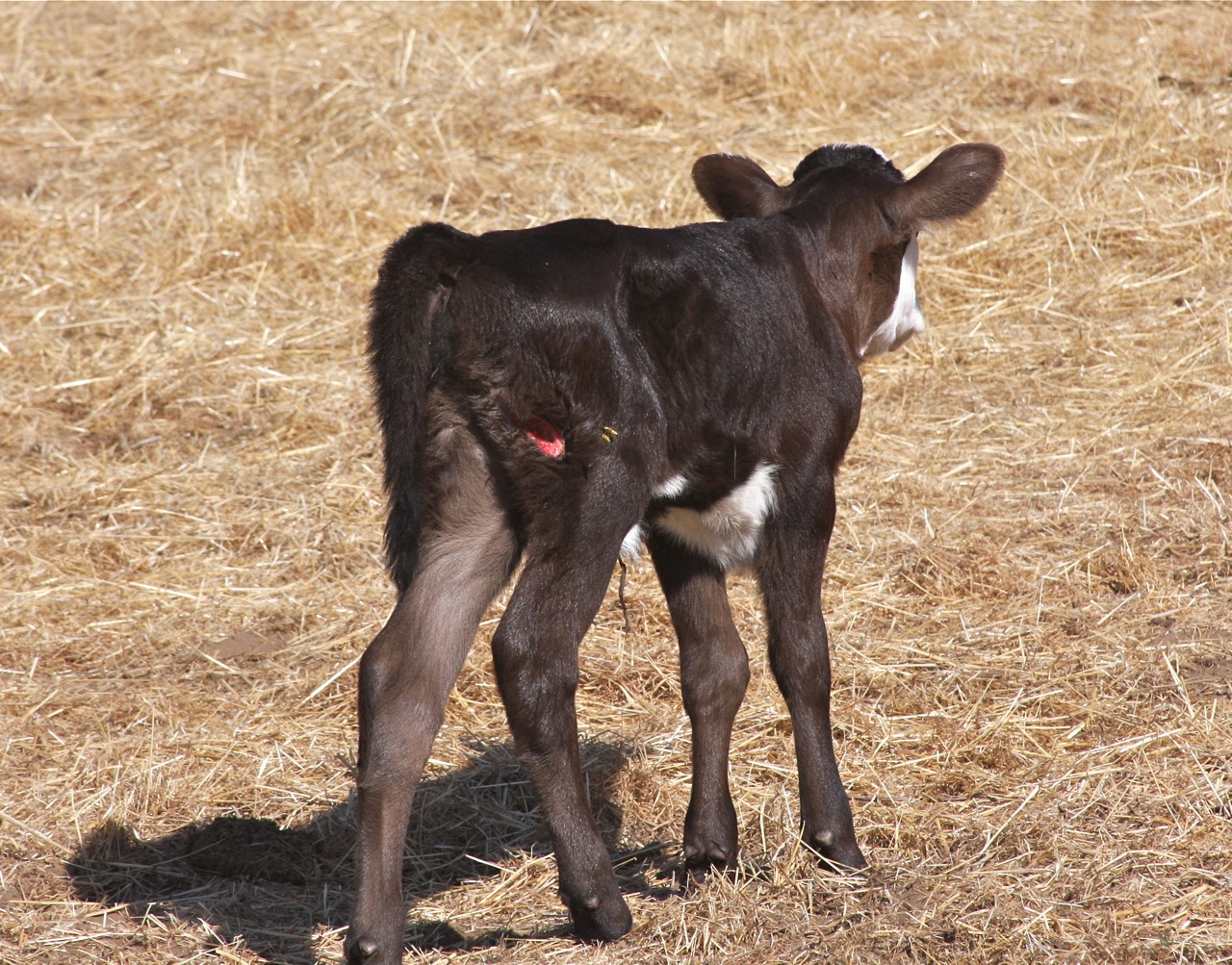
Since my early a.m.post, I’ve fed the 1st-calf heifers, finding the lucky calf above. Coyotes go for the hamstring. The calf must have bawled and the young cows ran him off. The girls were understandably nervous this morning. My coyote with a ‘taste for veal’ is obviously still around.
Addendum: A Taste for Veal
I try to leave the coyotes alone except for calving time, not liking the killing of anything anymore, believing that too much pressure on the local population will only produce bigger litters and more fertile females in the future. Though inconsistent, I think my process becomes more seasonal and individually selective.
Since posting ‘A Taste for Veal’, I haven’t seen a coyote. Somehow, the word is out. I do see a few tracks padded overnight, over the Kubota’s on my rounds, but none of the inquisitiveness of pups drawn to the scent of afterbirth. Assuming the rifle shots have been associated with the sound of the Kubota, they’ve kept their distance the past three days. Even nighttime serenades have decreased from choruses to duets and trios.
With some perspective, perhaps the coyote’s boldness or its lack of respect for humans spawned my lasting anger. I am these heifers’ provider, protector and midwife, if need be. Perhaps with better timing I might have saved the calf. But it is what it is: a less than attentive mother who’ll not make the cowherd—pretty as she is. But she’s not alone, some didn’t breed, a few aborted or produced stillborn calves. Around the first of December when we brand, we’ll make a sort for town, not wanting to perpetuate these genetics. It’s why we keep so many heifers, knowing we’ll always have some to help pay the pasture rent.
My attitude and behavior towards coyotes evolves a little each fall during calving time, when they’re all fair game in my crosshairs. Some die and some understand to move on to less risky places. With plenty of ground squirrels, rodents and crippled game from hunters and poachers, they are not starving, not forced to kill calves. I want the ones that have a taste for veal.
STAYING WARM
…and all that we have
to love may be what’s near
in the cold, even then.
– William Stafford (“So Long”)
So much for fleeting fantasies and retouched dreams
that seldom see canvas, that cannot feel the cold
nor help you walk the uneven ground of shadows
and circumstance, anymore than unravel chance designs
of lichen on speckled granite rock. No perfect world,
no perfect perception left to rise from the herd,
the human press, to warm the soul. We wander off,
letting go of this and that we thought we would become—
we bought or thought we stood for when it mattered.
Even now in this instant, we are not the same, yet
near at hand is the tool and the template, the axe
and handle, everything we touch at the level of love.
Posted in Poems 2011
A Taste for Veal
Nostrils full of Hoppes #9, I am surprised when Robbin closes me into the office. I can’t smell anything else, not its combined scent with WD 40 and 3-in-1 Oil wafting throughout the house. Too long postponed, I’m cleaning rifles, still angry over the Wagyu calf we lost yesterday.
Zach & I fed the heifers about 8:30, short in a suspect count on the east side of the creek. We fed the bulls and replacement heifers down the road, then got back to the house about 11:00. I left in the Kubota to get another count and to check on the heifer with new calf at the north end of the pasture, having spotted a young coyote nearby when we fed. Though open to the hillsides, the heifers are calving along a mile and a half stretch of the creek.
There were four pairs nursing across from the house when I left the driveway to check on the heifer and calf. Getting a count on my way back, I approached where the pairs had been, when a big coyote jumped up from the creek ahead of me, running across the flat towards the steep slope. I rationalized that my two misses from dirty barrel and dusty scope, long shots half-way up the hillside, were at the least, fair-warning and educational. I finished my count and was driving home when I spotted the motionless form of a calf on the green bank, head downhill, across the creek. I whistled twice. Nothing.
Within the thirty minutes I was up the road, the 1st calf heifers had finished nursing and left to clean-up the last stems of alfalfa hay, about a 100 yards away. Without a babysitter, without a sound, the coyote killed a week-old calf. I inspected it, a hole for a hindquarter as the meat bees swarmed. No mother around.
A few hours later on my way back from errands in Exeter, I identified the heifer standing vigil over the carcass. I recorded her tag number and went to the house, angrier. Certainly not our first calf lost to coyotes, I could picture the thick-bodied male in the scope, broadside, head high, cocky and aloof on the hillside. I began imagining, piecing together what went down, giving him human attributes—I hated the SOB and wanted retribution. No clever trickster, just a bold thief stealing what might have been an $850-calf next May.
Initially, I was going to haul the carcass up the canyon, but as she continued to bawl beside the calf into evening, I left it, hoping all the new mothers on both sides of the road might hear her complaint all night and pay closer attention to their calves. But I thought it strange when shortly after dark, her bawling was moving farther away.
This morning the carcass was gone. After several circles, I found no drag marks in the dry grass within a hundred yards, no bones, no hide. Whatever packed it off, picked it up. Even the feral hogs would have left something. The second suspect in this grizzly caper: a small bear that has been working up and down the creek these past few weeks.
THE THIEF
He falls out of canyons cut between the steep
hills to the dry-grass shadows of sycamores
to watch the new calves nurse and play
themselves to sleep on short-cropped green
along the creek, waiting until first-time mothers
leave to graze. All the world is good to fresh
pastoral dreams, as the big dog meanders
among them, touches noses, tears a hamstring
holds and muffles a short cry in its throat.
Half-way up the hill, he looks back, full
of himself and the heavy half-a-hip in his belly
as the dirt flies, as a swarm of yellow meat bees
takeover before the heifer returns. She stands
vigil, trying to bawl her baby back to life
and follows as he drags it off into the night.
TODAY
Unlike any other, the day waits
under dark covers and doesn’t care
if you are there, or not,
to see her details, to watch her
dress—always changing
into something new.
Posted in Poems 2011
Calves & Kids
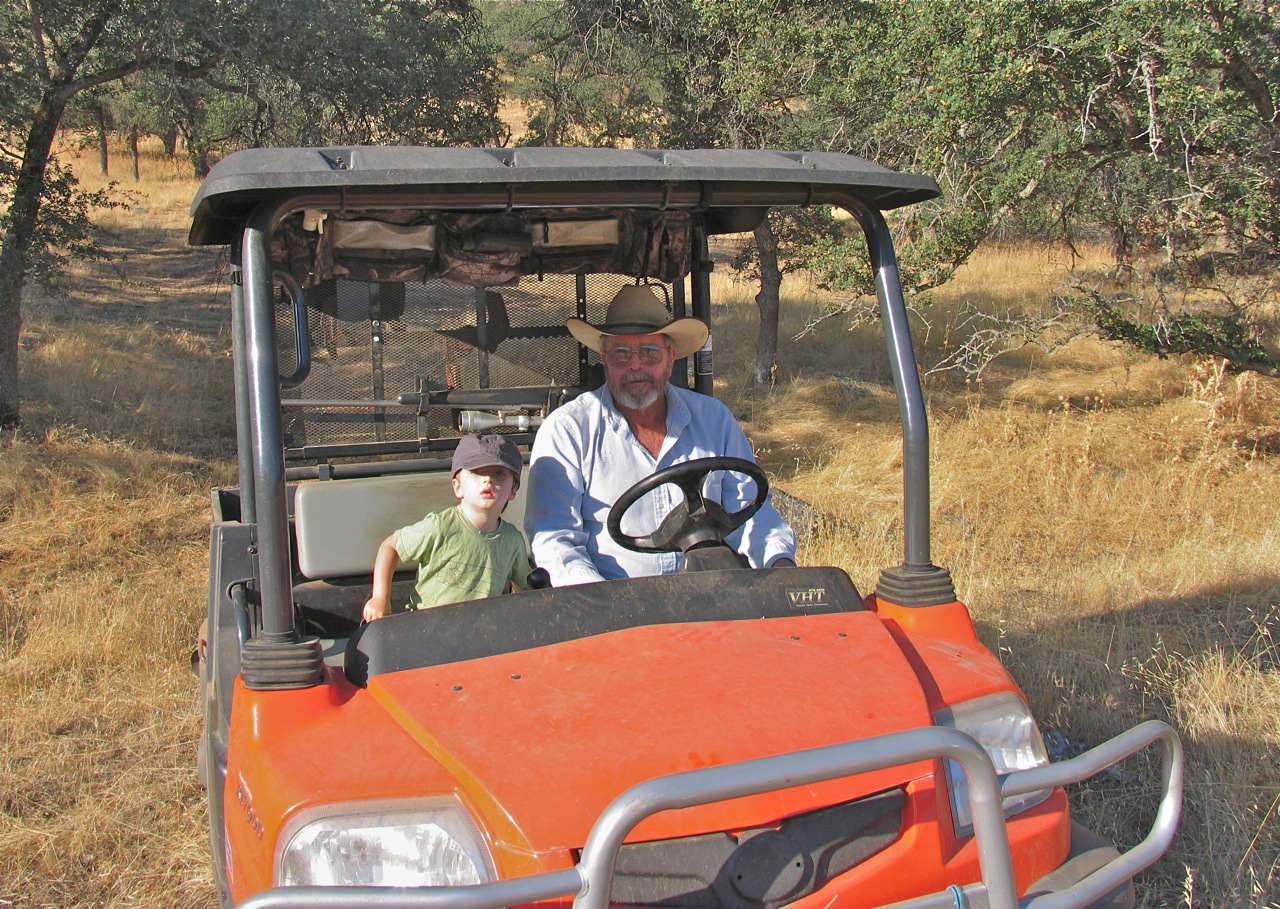
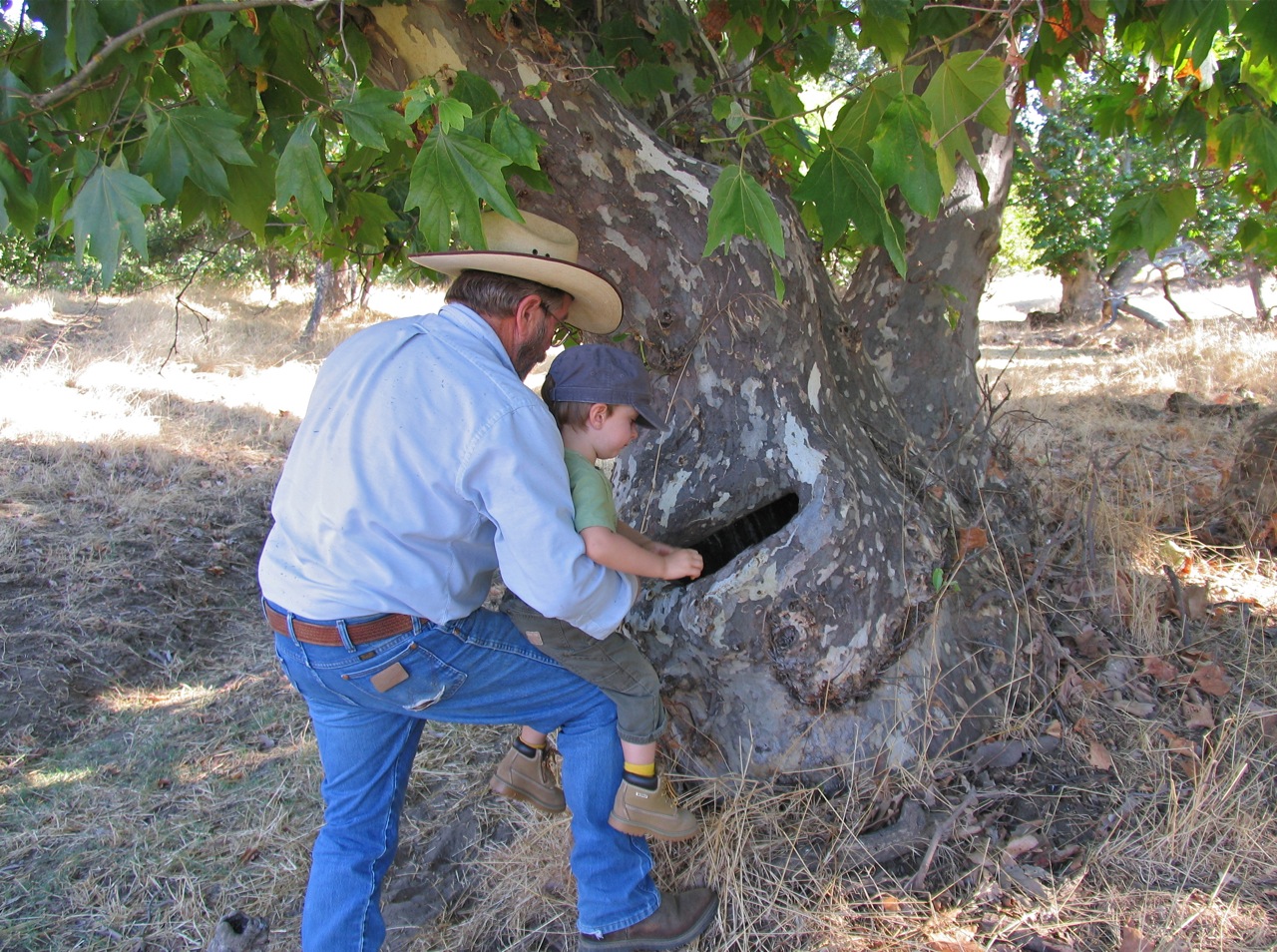
I have the keys to the Kubota, to the skid-steer, to all things mechanical, and hence a hero when my grandson Cutler comes—my second chance to emphasize what I might have missed with my own kids, or a chance to share what has only become richer with time. I have that obligation as a parent, as a grandparent, to expose him to this larger, fairly foreign world of huge and cute creatures in tangled spaces. He’s three.
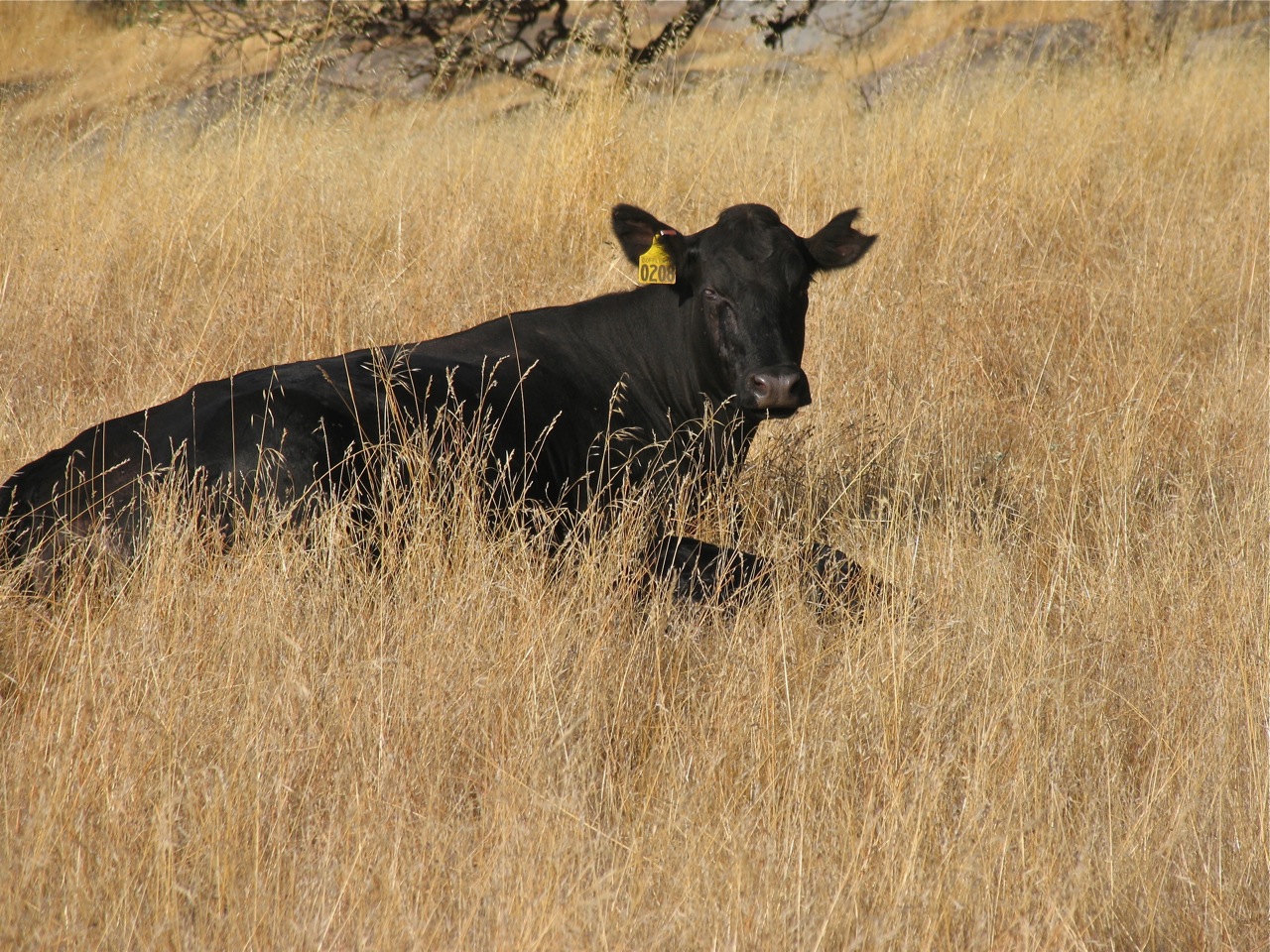
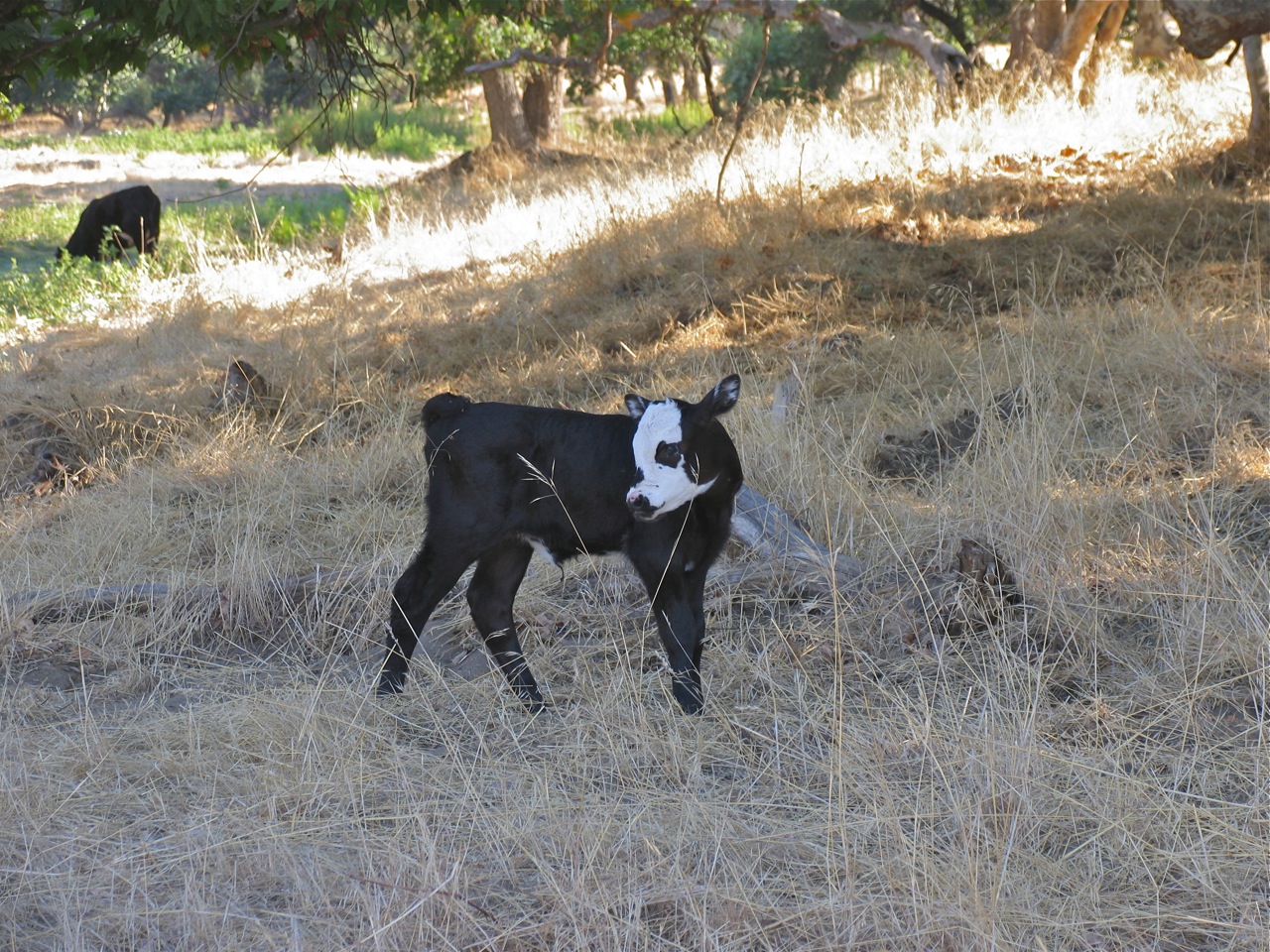
Robbin and I are essentially babysitting for a few hours while checking the 1st calf heifers, getting a count to see who’s missing, then locating her to see if she’s had her calf or not. The heifers have set-up their nurseries, his mother runs a day care center—these pastures full of maternity.


IN YOUR HANDS
Knowledge will cure them. But
not all at once. It will take time.
– William Stafford (“Waiting In Line”)
The cows have watched, seen me stumble
feeding hay, blade clenched in my teeth,
held their breath each time I climbed
the moving flat bed, wondering. And yes,
in town we step aside for one another,
open doors, lock eyes and nod for all
we have survived and seen, wondering.
We work the shallows near the bank
and stay from the faceless current, trying
to find an eddy in the coming rush of youth,
before another dam is built, or river loosed
to flood. It will take time to accumulate
credentials, or to have the luck to get lost
in the sun’s goodbye, or slow approach
to the day—and to save enough experience
to endure our last rainy day. No shortcuts,
it will take time to get to where we began,
to fill-in the blanks, take pride in your hands.
Posted in Poems 2011



 drycrikjournal