
Author Archives: John

WONDERMENT


20150712-IMG_0251


My other voice just beneath the skin,
its echoes muffled by convention
and chained from reason’s reach

to speak only to me, quickly and quietly—
my unholy voice of blatant honesty
I can neither temper nor ignore,

telling more than I truly comprehend,
amazes me: a brief non-sequitur
with a keen edge, blade like a mirror.

I have grown deaf to crowds chanting
simple mantras as demigods tremble—
I’ll keep my counsel with my wonderment.


Water @ Railroad


20150817-IMG_4176

Hauled by four-wheel drive to Railroad Spring in the early 70s, before we built a road there, I am gratified to see they are still level and don’t leak, but more that we were able to redevelop enough water on Friday and Saturday to fill them. US Army Surplus tank transmission cases, these serve us well as water troughs with a combined capacity of about 750 gallons.


20150817-IMG_4180

Lid for the spring box I fashioned from scraps on Sunday with three coats of Superdeck Heart Redwood stain, leftover from a another project, for added life.


MID-AUGUST 2015


20150816-IMG_0576


Too early to know
what the day brings—
plans mixed with dreams.

Ridgelines stay the same
except rooted trees
lose their leaves

or dress in early spring
with iridescent greens
hard to imagine from August.

But the errant clouds help,
forecasting change
beginning each day.


IDES OF AUGUST, 2015


20150816-IMG_0563


The hills black,
faint pink cloud
over Sulphur

in first light cool.
Nights grows longer
with the shadows

when we dream
of winter storms,
four years dry.

We feed our future hay
until the time comes
we have nothing else to do.


Spring Box @ Railroad


20150815-IMG_0526


There are several different ways to install a spring box depending on the water source and materials at hand. With backhoe and shovel work, David and I uncovered about two square feet of a hard flat rock with a horizontal crack that was leaking the water. We scrubbed the rock with a brush to remove all the mud so the mortar mix would stick, then built a small dam of smaller rock around our 1½” PVC pipe until the water pooled behind it to rise and exit the pipe. We leveled the dam and sides until the discharge pipe was secure, the ran about 80 feet of pipe down the trench to the troughs and backfilled it before placing larger rocks around our spring box to keep the loose dirt and debris out.

Our placement was about three feet deeper and five feet away from the original spring box, also constructed of rock, which enclosed a seep in native soil that had to be dug out regularly to free the water to rise into a pipe. I’m guessing the original spring box was installed in the 20s or 30s with only a shovel.

The inside dimensions of our box at the top are approximately 7” x 14” and about 18” to the hard rock bottom, making it fairly easy to clean for any silt or sediment that might accumulate over time. I’ll be back Monday with some short 2 x 6s and screws to fashion a lid to keep leaves and small critters out, but for now, the disc blade covers that space.

While I went to Ragle Springs to install a new overflow pipe to utilize a 6’ x 6’ concrete trough built by Earl McKee, Sr. and Lee Maloy in the 30s, having packed the sand and cement on mules from the Kaweah River some four miles and 2,000 feet below, David continued to clean out the pond at Grapevine Spring that had accumulated a substantial amount of water overnight and several thousand gallons by the time we came off the hill late afternoon. Wahoo!

We will return Monday morning to finish up at Grapevine and cover my overflow pipe at Ragle Springs with a dirt pad for a new trough, should the old concrete trough leak.


Dirt Works @ Railroad Spring


20150814-IMG_0509


We’ve been on David Langton’s list for well over a month as he moves ranch to ranch with his four-wheel drive backhoe improving stock water. Railroad Spring has been nearly dry for two years, with not enough water in the spring box to reach the pipe. Hand dug and constructed of concrete and rock with a disc blade lid, it’s provided good water since well-before my time with the exception of the droughts of 1938-39 (anecdotal) and 1976-77.

(Heavy equipment working at the 2,400-foot elevation 4-5 miles from the asphalt is always a clash of sensibilities for me.) In the photo, David has dug about three feet below the original spring box and gotten to a flowing crack in the hard rock, nearly an impossible task to reach with a pick and shovel. He’s trenching the pipeline we will install this morning to the troughs in the background, which will presumably overflow in a normal year to the dirt tank beyond them.

When the trench was completed, we measured the flow at 1½ gallons/minute, that if sustainable would amount to well over 4,000 gallons/day, however, as so often is the case, the flow subsided to about ¾ gallons/minute after about five hours. We intend to work around the original spring box some more before installing our new spring box and pipe. Meanwhile, we broke a little water loose at the Grapevine spring a 1/4 mile away, and mucked out enough silt to form a basin where the cows can water, previously preferring to drink the fresher water pooled in their hoof prints than the warm stale remnants at Railroad Pond. Open to two other pastures with water, my count at Railroad was 24 head of cows getting ready to calve.


GODZILLA HAIKUS


20150807-IMG_0428-2


Any day now—soon,
any day, the pundits say
we might wash away.

We dig for water,
bring David and the backhoe’s
hydraulic muscle:

big jaws and steel teeth—
hope and pray to break some loose
to water cattle.

California’s map
in flames, burning inside out
to greet El Niño.


ABOUT THE GIRLS


20150801-IMG_0355


It’s always been about the girls
on this landscape, grass and water
notwithstanding: the basic elements

of endless awe as maternal blooms
before our eyes with faint reflection
from whence we came.

We have lent all we know, watched
generations grow into mothers—
it’s always been about the girls.


Still in Velvet


20150811-IMG_0482


While checking our stock water, we’re also feeding hay to our cows at the higher elevations, now three weeks away from beginning to calve. We culled heavy in May when we weaned our last year’s calves knowing that our stock water would be limited, especially on Top. We’ve opened those cows into two other pastures with springs that are struggling to maintain a flow into troughs. While feeding yesterday, we ran into this young buck, still with a little velvet, at the salt, reminding us that deer season opens soon, bringing us a little closer to the end of summer, shorter days and a chance of rain. We closed the ranch to deer hunting last year because of drought, feed conditions and lack of cover, and will again this year, allowing this buck a better chance to grow up.


Surprise


20150809-IMG_0451


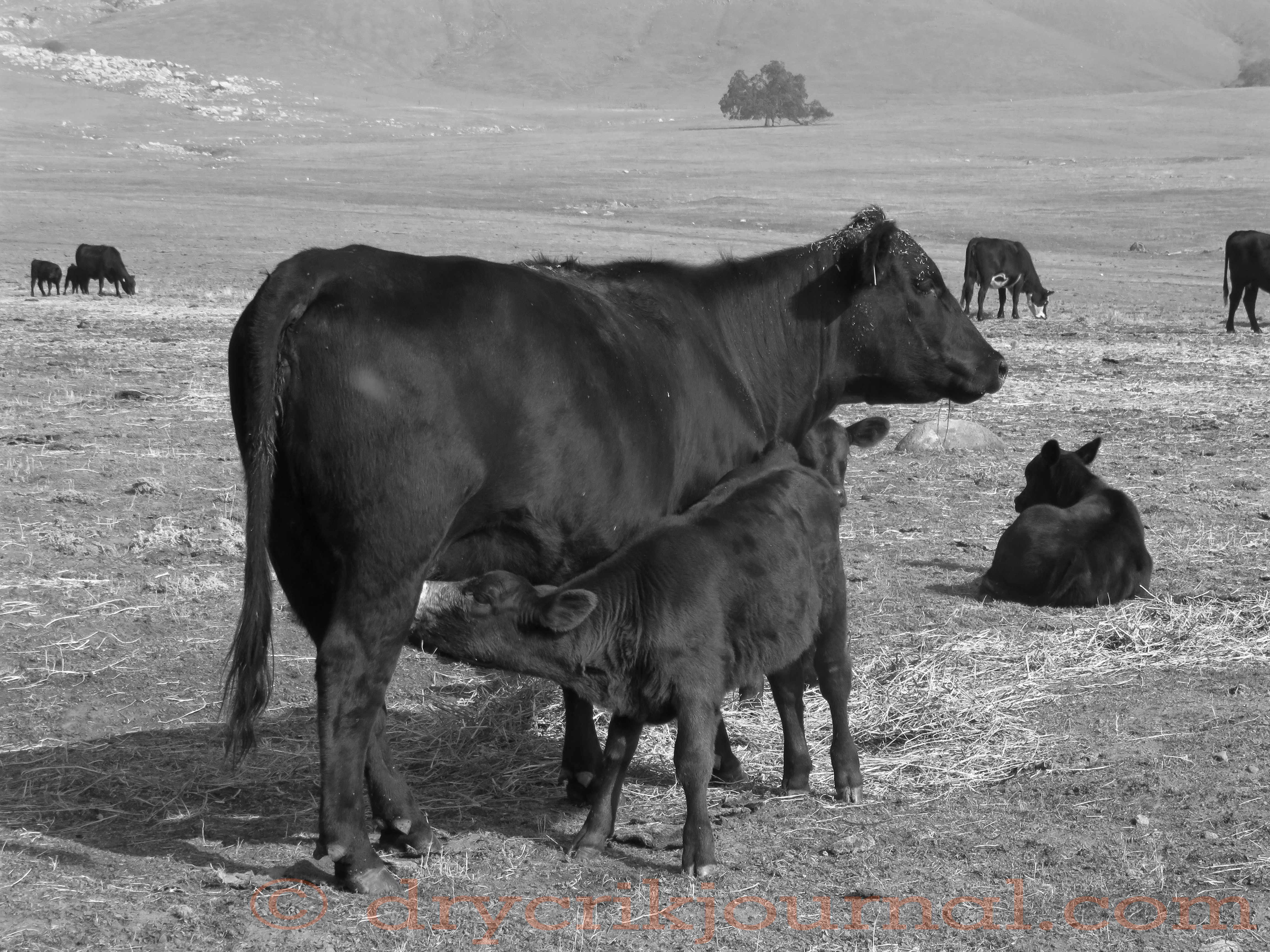
One of four calves born a month early. A quick review of our records indicate that a bull fight occurred last October 26th when two bulls gained entry into the pasture of the second-calf heifers. Fence fixed and bulls out the next morning. But we’ll take a rain or a calf anytime.