Who are these people
who can’t see beyond their bills
stirring up sand flies?
A last minute decision, we slipped off to Cambria for the three nights, leaving the ranch in good hands. We haven’t gotten away since the Elko Gathering last January, Robbin all but threatening to go without me. We never missed a meal, two which were at the The Sea Chest. Yesterday, we followed a little rainstorm home.
We watch people like cattle
from different pastures and places
walk and jog upon the boardwalk
housing ground squirrels
that beg for popcorn and nuts
from anyone who stops to sit
and stare at the ocean.
On the beach, a seagull
will claim you with his space
as streams of pelicans ride waves
and sandpipers drill moonstones.
Young and old walk polite dogs
on leashes, all in their own
thoughts. It is a dance with
few collisions, all these tourists,
we among them. With no one
to direct us, everyone
seems to get along.
Posted in Photographs
The coincidence is just too much to ignore. A few days ago on my daughter’s blog ‘for the archives’, she demonstrated how her husband raises worms and collects their castings by utilizing the scraps and trash as an example of a very ‘artful function’ that is inspiring.
Wednesday morning, Robbin went to our container garden to see if her broccoli, cauliflower and lettuce seeds had germinated yet. Our drip system has been set for longer days and 100+ degrees, and one container received too much water bringing hundreds of baby worms to the surface. Now if we just could figure a way to ship them to Kauai.
While calving, our cows are well aware of the recent influx of bears, displaced in part by the 150,000 acre Rough Fire in Kings Canyon, but primarily due to the drought and the lack of anything to eat at the higher elevations. Furthermore, there’s not much here to eat either, as only one in three or four hundred oak trees has any acorns and the percentage of oak trees that have died because of the lack of rainfall the past four years continues to increase and probably approaches 40% now. The remainder have lost most of their leaves, but there’s bear sign everywhere we go.
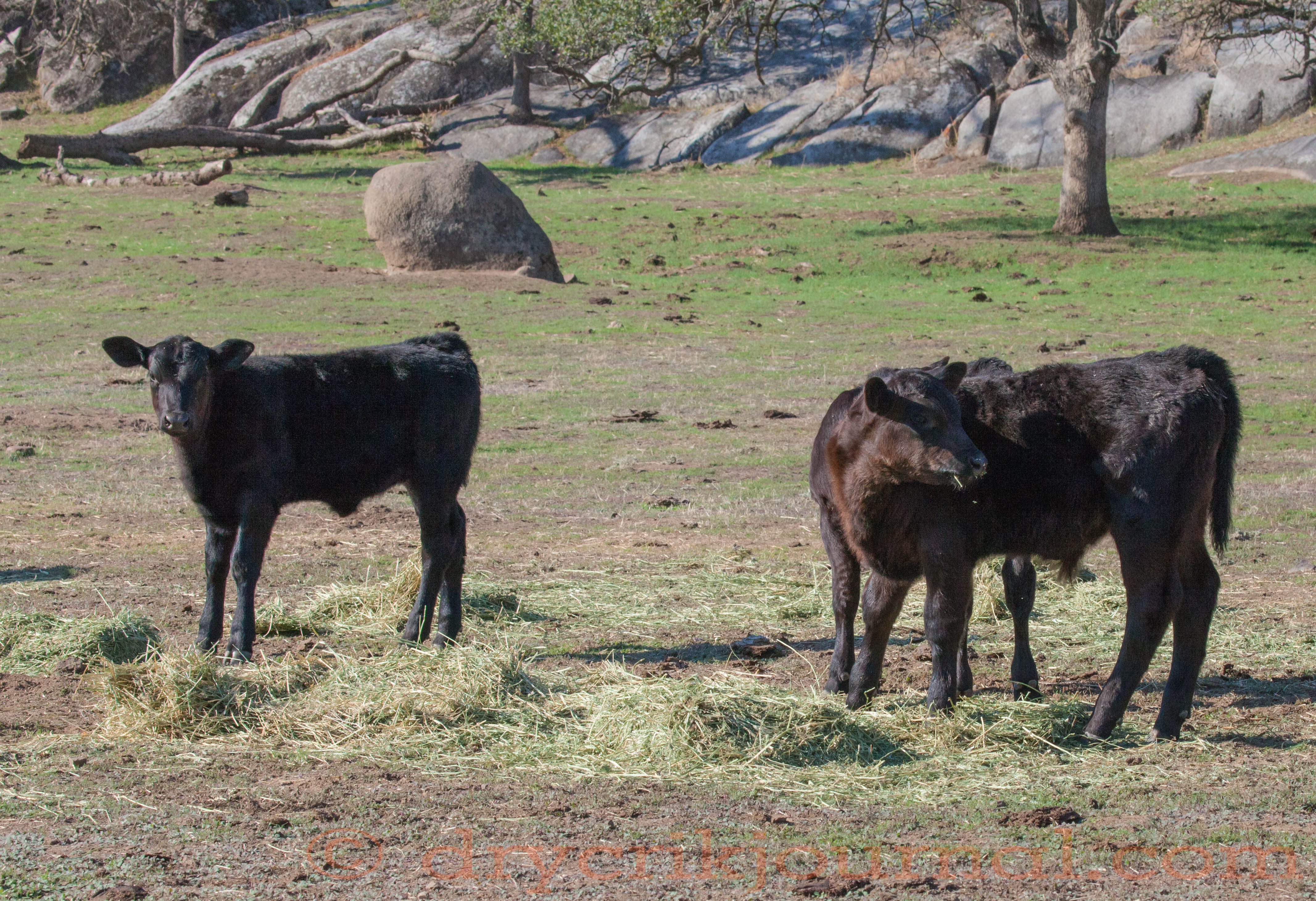
On Monday on my way to pump water at the Paregien Ranch, I found the mothers of these two calves high in Ridenhour Canyon, taking turns going to water while the other babysat. Though I didn’t see the calves on the way up, I knew the cows had been sucked. When I came down a few hours later, I found the cows and calves had moved to the top of a ridge. Both were well hidden and only a day or so old.
Most cows sort themselves before calving, as the ones close to calving begin running together apart from the bunch as they prepare their nurseries ahead of time. We’ve lost calves to bears in the past, but usually those of first-calf mothers. Older cows, or cows together, can bluff most bears, but with so little to eat in the middle of calving there are no guarantees. Bears will eat anything, and older bears unable to rummage for food begin to acquire a taste for veal.
Yesterday, on my way up to work on a trough, I found the same two cows together higher yet in the pasture, making their steep round trip to water to close to a mile. Once again, I didn’t see the two calves until I came off the mountain.
Posted in Photographs, Ranch Journal
Tagged Acorns, bears, Calves, cows, Drought, nursuries, oaks
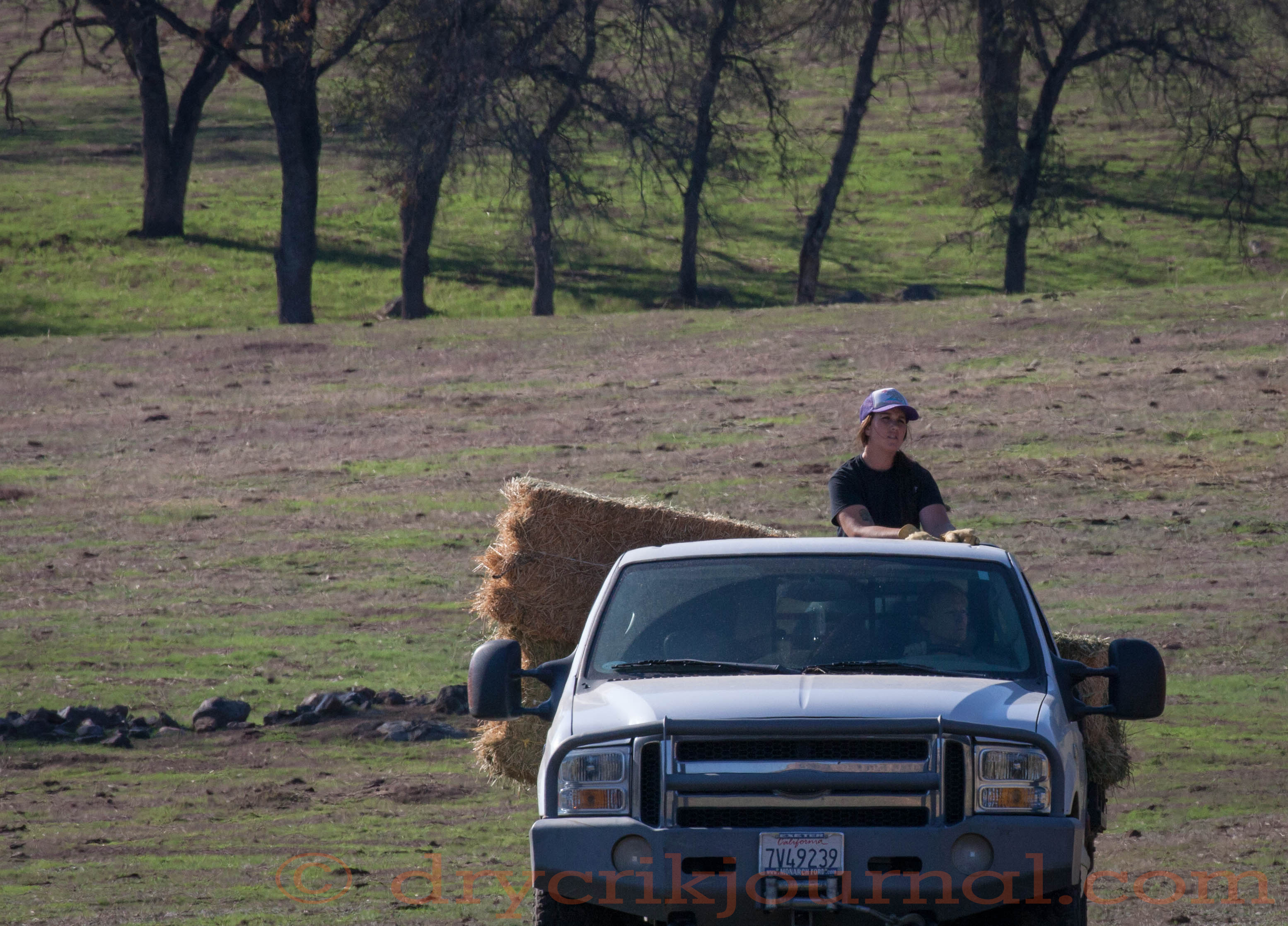
It looks like Terri and Lee were having too much fun yesterday loading the hay truck before heading up into Greasy to check the cattle and stockwater. We’re feeding somewhere everyday as the calves come, giving the cows a little extra as they raise new calves, while also trying to keep the cows in shape so they’ll cycle and breed back in December. Hopefully we’ll get some rain and green grass before then.
Rather than let the cows get thin before starting to feed, we feel it’s easier to keep the flesh on and more economic to start feeding early. While making our circles to monitor our stockwater, we began taking hay in early August, gradually increasing the amount to where we’re feeding full time now until the grass comes.
With more dry feed and less cows in our upper country, we make the 4-wheel drive trek to Greasy and the Paregien Ranch once a week, while feeding our younger cows down low three times a week. Stockwater in our upper country is more tentative and needs to be checked regularly.
Robbin and I were waiting to load the Kubota to feed another bunch as the girls were tossing 130 pound bales around. We followed behind them later and managed to see all the cows, calves and replacement heifers on the east side of Dry Creek, very pleased with all we saw.
Summer harbinger:
a lightning strike beckoning
red shiny engines.
151,493 acres
85% containment
When we weaned her last year’s calf last May, we sorted the gray cow to an accessible pasture, so when time allowed we could bring her off the mountain to remove a horn that would soon be growing into her head. Four weeks ago after feeding the Greasy bunch, Terri and Lee let me know the horn was in her head. They chummed the small bunch she was with into the Gathering Field. Then about ten days ago, Robbin and I went up the hill and brought her down to the squeeze chute to remove her horn, thankful she had not calved yet.
We have several gray cows due to a combination of some recessive genes that have offered a little extra heterosis or hybrid vigor, both in size and maternal traits. Like the others, she’s gentle and stood cooperatively as I cut the end of her horn off with a pruning saw, smearing pine tar and applying ample commercial products to ward off flies.
I knew Saturday that she had had her calf, though I never saw it. She’d been sucked, showed telltale signs of afterbirth and hidden it somewhere in the tall grass of the irrigated pasture. On my way to shut my irrigation water off on Sunday, I saw her lying next to the fence, looking suspiciously like the calf was on the other side. The pastures are open to one another, but a day-old calf wouldn’t know that.
Before coming home, I thought I’d investigate, hoping for another gray heifer calf. Cord still wet, it was hiding in the grass and came to the Kubota, circling and bumping the machine, looking for breakfast. Having found fresh bear tracks along the creek, I wanted to see them reunited but not wanting to play too much cowboy, so I followed the pair at a distance on either side of the fence towards the gate.
When the calf left the fence to lay back down in the pasture, I left them alone to close an irrigation gate valve. As soon as I was out of the picture, the gray cow sailed through the gate to find her big bull calf.
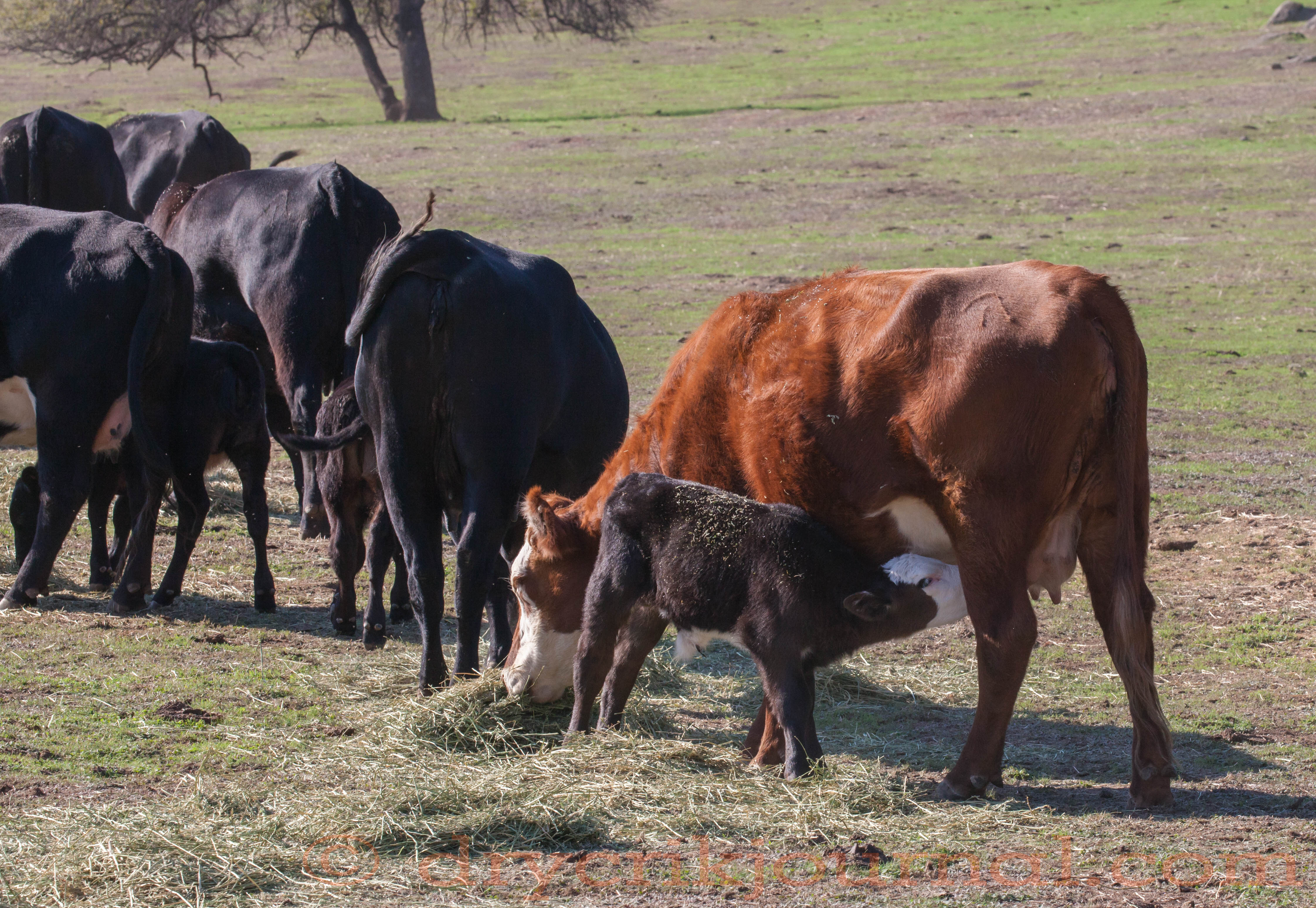
Like most newborns, finding milk is often a process of ‘trail and error’.
When I arrived yesterday to change my irrigation water, a coyote was nonchalantly studying these cows and calves from just outside the fence. The cow beneath the Valley Oak was lying close to her calf, hours old. The cows, of course, knew he was there well before I did. Taking an indirect approach, coyotes will gradually work their way among the cattle acting preoccupied and harmless until they become familiar to a bunch, all the while looking for any weakness among the calves—hence the Trickster moniker.
We have completed our first month of calving and pleased with 50% of our calves on the ground, a bright spot in the middle of this drought, though our total cow numbers have been reduced by half these past four years. This is the third calf for this particular bunch of cows bred by Vintage Angus bulls.
As the light turns softer and shadows longer, early mornings can be rewarding with lots of wildlife this time of year, especially where there is water. About twenty Canadian Geese are stripping the ripe seed of the water grass elsewhere in the pasture and our little bunch of wild turkeys, that are becoming used to me and the Kubota, are rummaging for bugs where I’ve completed my irrigation.
I take my camera, never knowing what I’ll see.
Posted in Photographs, Ranch Journal
Tagged Calves, camera, Canadian Geese, cows, coyotes, dawn, irrigation, Trickster, water, wild turkeys