Monthly Archives: March 2016

Wild Hyacinth Dichelostemma capitatum (Brodiaea pulchella)


20160309-IMG_1732


Even prior to our past four drought years, the number or population of Wild Hyacinth has seemed much less than when I was a boy emulating stories of the local Yokuts by digging the bulb (corm) up to eat, an important source of starch for Native Americans. It is believed that the Wild Hyacinth was cultivated, the corms thinned and separated in the process of harvesting prior to, during and after their period of bloom.

This year, however, due to whatever circumstances and weather conditions, many hillsides and slopes exude a purple haze with their sheer number, more than I’ve ever seen in this area. It may be that the hoof action of our cattle during the dry years with short feed simulated cultivation and separation, and also aerated the ground for our early rains.


A Chance for Spring


20160308-IMG_5249


Ten days ago, I was bemoaning a warm and dry February and the prospect of weaning calves two months early. But within that time we have received over two inches of rain that has rescued our spring grass. Already our south slopes have recovered. To vacillate between the anxiety and dread of another tough year and our current relaxed gratefulness, in such a short time, might be alarming if this canyon didn’t look so good—it’s that overwhelming. And it’s not that we haven’t gotten rain this season, we’re above average, but with over half of the days in February above 70 degrees, the ground was dry and the grass was heading out.

Yesterday we went up to the Paregien Ranch to check the rain gauge, (2.27”), check the cattle and put out salt and mineral supplement, also taking a shovel and chain saw just in case. Cows looking great, it’s hard to believe that these same calves have grown so much since we branded three months ago. The time has flown. With more forecast for the end of the week, it seems El Niño is back on track and we have a chance for spring.


TREES


20160306-IMG_1705-2


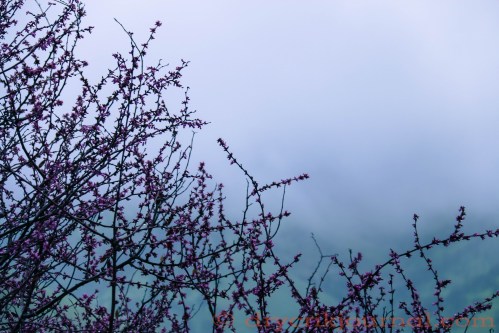
Horizons close-in
with a slow rain,
infinity becomes

a short reach
over the ridge
into the gray.

We begin to think
like old oaks
on north slopes

awakening
to leaf and fruit
with moisture.

We’ve seen the creek
swell and disappear
for centuries,

the road flow
with carts, wagons,
pickups and goosenecks,

stream with Christians
and bright busloads bound
for glory and awe

in the distance. Unseen,
we are rooted just
where we want to be.


BLACK RAIN


20160301-IMG_5680


No moon, no stars,
she sneaks up canyon
in the dark an hour late

gently whispering
from the black
as if she never left.

A sprinkle kisses the roof
I cannot see, but hear
find its way to earth.

After midnight, my mother
would turn the porch light off,
so no one knew I wasn’t home

when we had neighbors, trails
between cabins in the mountains
I knew by braille

and by the sound
of my young feet, light
upon the night trails.

In the end, no one cares
exactly when it rained—
only that it came.


AT ONCE


20160306-IMG_1692


Canyon gray,
light warm rain,
glass of wine at dusk,

and we enjoy the sound
of small drops
on a metal roof,

tinkling ricochets
in stereo downspouts
that insulate

our momentary sighs,
escaped breath rising
on words overheard

only by the gods
and fickle goddesses
somewhere overhead.

Not the storm predicted,
not the flood
to erase the drought

that won’t release its grip
for years, if ever,
talons sunk in our flesh—

this crease of earth and rock
that’s heard it all before
from generations of oaks

and sycamores, cattle
people and natives,
all sighing at once.


SET IN STONE


IMG_5207 (1)


Not much time to learn
to pour and finish concrete
before it’s over.


Conundrums


20160301-IMG_5729


Our springtime activities can seem confusing. Around the house, barns, corrals, and gates we use frequently, we spray weeds. Though the grass species are essentially the same on either side of the barbed wire, the fence arbitrarily determines what are weeds and what is feed for cattle. It seems a bit sacrilegious, even to me, to be spraying weeds in a business dependent on grass.

Routine for so many years, I have become obsessed with the distasteful job of clearing the grasses that can hide rattlesnakes where we work and live, or make the difference of losing a barn full of hay to a fire. I am relieved when the job is done—and confess to enjoying watching the weeds die along clear lines of green and blond.

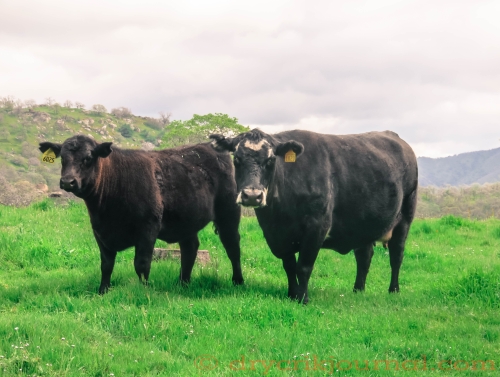
The grass was high in the small pasture in front of our house, so we let our second-calf heifers in to mow it down. Robbin and I enjoy having the cattle close, watching the calves grow and play. At first, they’re nervous, but after a couple of days they come into the pasture, morning and night, as part of their grazing routine. Checking-in, they seem to enjoy our company.

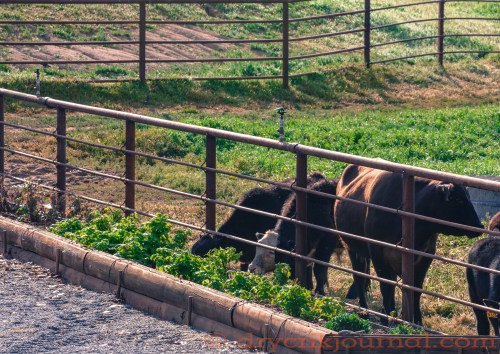
Readers may remember the planter we built last year to start our bare root raspberries. It looked a lot like a feeder for cattle. With so much grass, I didn’t think that our thorny raspberries would interest cattle, but the calves have become addicted, bucking straight through the gate for the raspberries’ new growth. But we seem to have hurt their feelings, bunched at the gates last night, confused with why the gates were closed.


Stellar Jays


20160301-IMG_5691


Well out of their territory, a pair of Stellar Jays moved in late last fall to spend the winter. Like the bears, drought conditions at the higher elevations have probably brought them here looking for food. These two are not as humanized as what can be found around High Sierra campsites where they can be a squawking nuisance, literally taking food right off your plate. With others on the ranch, I’ve never seen Stellar Jays this low before.

Our mornings are a flutter of birds getting breakfast, the usual finches, sparrows, killdeer and quail scouting nesting sites, blackbirds and phoebes busy in leafless trees. It’s not quite spring yet, but with urgency in the air. Taking coffee with my camera as the sun breaks over the ridge presents some tough lighting, and I’m learning that photographing birds is a bit more of challenge than wildflowers that only move when the wind is blowing.


HERE


jddc1


There might have been another way,
other people, places, things—more or less
obstacles to overcome, rest upon—

but no straight line, no short cuts
across the board to get to this spot
along the creek waiting for a rain.

I believe the weatherman, refresh
my contact with the goddess,
send my love in letters, words

rearranged to attract her
attention, but I’m no lackey
to scrape and bow, grovel at her

pretty feet. It’s not the same as before
she left without a sign or warning.
There might have been another way:

studied harder, charged more
for a shorter trip across the board—
but how could HERE ever be the same.


THE SONG


20160217-IMG_1485


It’s not about you—
and not about to change
the weather or politics.

You are helpless,
at the mercy of the swirl
of elements colliding,

ricochets and explosions,
occasional clear views
of space and landscape

that keep you leaning forward
into the sun, your shadow cast
upon a fading track of small

accomplishment. After a rain
every tree frog sings
as if spring depended on it.