
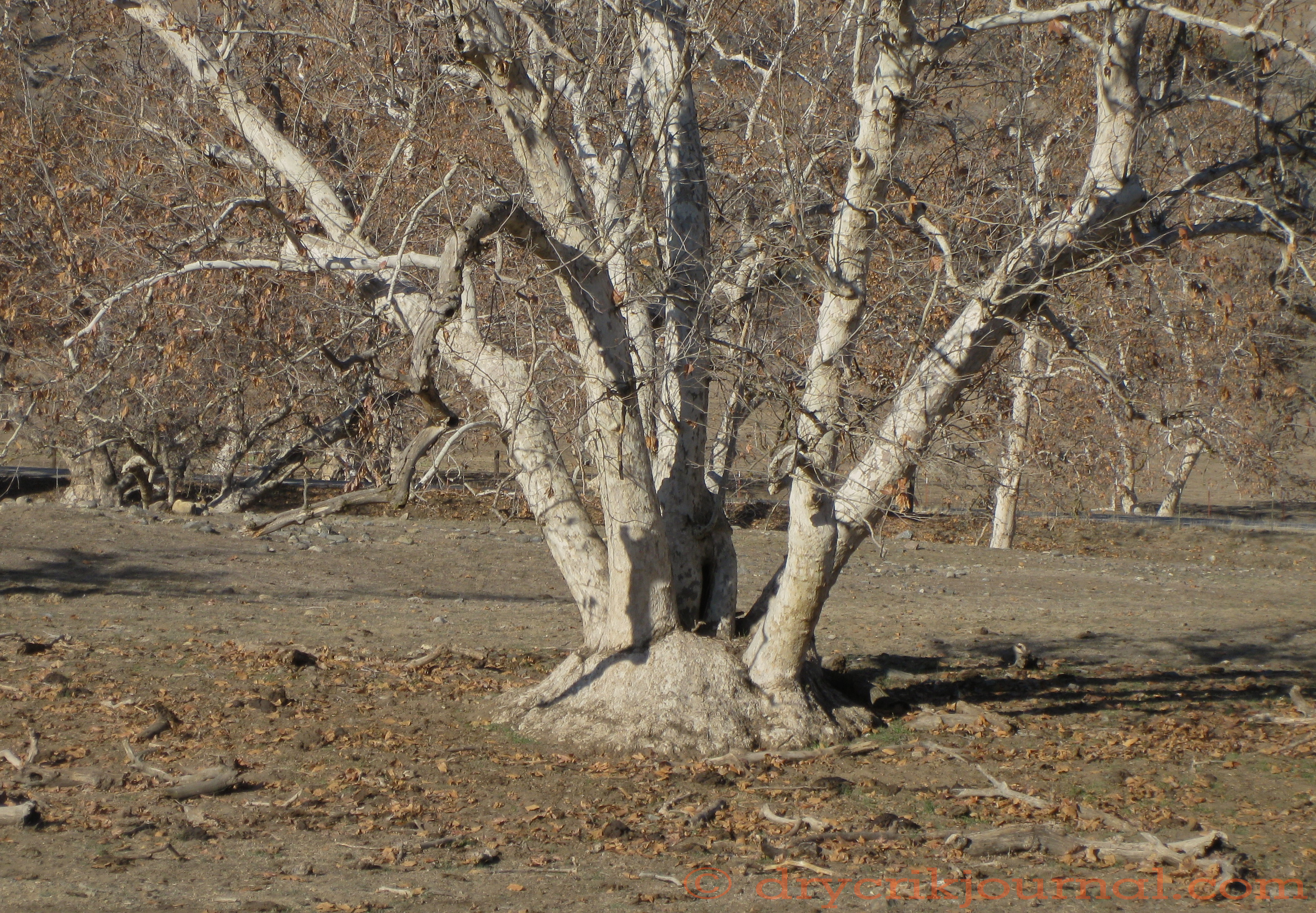
This family of sycamores (Platanus racemosa) is among the largest Sycamore Alluvial Woodlands in the Sierra Nevada ecoregion and one of 17 stands over 10 acres remaining on the planet. Located on Dry Creek (Tulare County, California), it is connected by a common root ball. Rarely exposed, some root balls measure 15 feet in diameter and have been pushing new stems for centuries. Some stems here are three to four hundred years old—alive, perhaps when Sir Francis Drake claimed California for Spain. Imagine how old the root balls must be!




 drycrikjournal
Recovering from my own private drought over the past year was directly dependent on the endurance, ingenuity and shear beauty that these ancient trees embody… All of which they inherited from their common rootball…
Thank you for this post! Robin’s pic?
LikeLike
This is really interesting, John. Thank you for sharing. We have a very similar stand in our back “yard” with the root ball partially exposed, as in your photo. Did someone do core samples to determine the age of the stems? Didn’t realize that sycamores are so long-lived. Maybe they’ve survived some droughts as bad as this one in the past. Magnificent, aren’t they, these alabaster-trunked trees? Our County of Big Trees should count not just the sequoias (although they’re premier), but also our Valley oaks and sycamores. Long may they thrive.
LikeLike
California Fish & Game completed a study of the SAW in the 90s, during which they determined that some of the sycamores on Dry Creek were 300-400 years old by utilizing core samples. It was Bard McAllister that drew my attention to the root balls, inferring they may be over a thousand years old. Though there’s been no study of the root balls that I’m aware of, the exposed dome on some as large as a room. In any event, they are much older than our record-keeping, more than likely surviving droughts greater than our current one (that now according to the pundits is the worst since 1849).
The decade of the 1860s alternated between extreme flood and drought, culminating with the Flood of 1867 when a portion of Dennison Ridge and 1/3 of the Congress Grove of redwoods slid off into the South Fork of the Kaweah, damming it before flooding Visalia and the Valley. According to Katherine Small’s ‘History of Tulare County’, food and freight were shipped by boat from Stockton to Visalia clear into May 1868. Our history here is short and our knowledge of where we live is unfortunately less, or mostly forgotten.
I suspect we will learn much, in the years following this current dry spell, having to do with the utilization of both surface and ground water. When the sycamores take on more water than their stems and limbs can bear, they lose them and start over.
Thanks for instigating a bit of a rant in my reply.
LikeLike