Category Archives: Photographs

SFO

Sunup at SFO

Sunup at SFO

Among the cobbles of a novel
waiting for the plane sent-on
without us, last night, vouchers

dangling at the end of a chain
reaction of late take-offs—midnight
dinner delivered to a Comfort Inn

for roaches, instead of falling
dead into our own beds
after the quarter-mile jog

to a shuttle and another terminal—
bushy-tailed guard at the gate,
arms folded like a Samoan

before our parked aircraft.
A novel about efficiency
and how we got here—

how we’ve become helpless
as cattle in a corral to make
work-enough for everyone.

Jessica & Jaro

Jessica & Jaro

Jessica & Jaro

Robbin & I have been in Kauai, a tropical paradise, this past week for my daughter Jessica’s wedding. I’ll attempt to post some more photos in the coming days. While we were gone, our country was blessed with an 1.5″ of rain. We were welcomed home to puddles and hillsides greening. A great start to another season.

Jess & Jaro - 11/29/12 - Taro Patch, Anatola, Kauai

Jess & Jaro – 11/29/12 – Taro Patch, Anatola, Kauai

November Sycamores

November 24, 2012

November 24, 2012

November 24, 2012

Wagyu Bulls Arrive

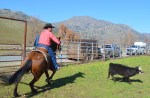
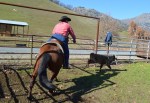
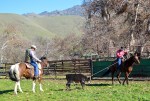
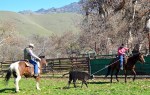
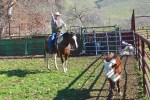
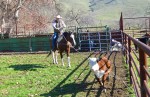
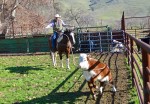
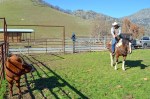
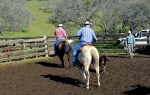
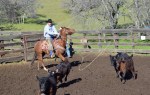
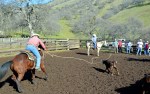
In the spirit of Thanksgiving, Clarence and I put the Wagyu bulls out to the heifers yesterday morning. They arrived early Tuesday from Snake River Farms in good shape, but we fed and let them rest before putting them to work anyway. As an answer to the often asked question as to what a Wagyu bull looks like, I’ve included some photos. These are yearling heifers and yearling bulls. And the cycle begins again.

Image

Happy Thanksgiving!!

Moving the Wagyu

Having pulled the Wagyu bulls on February 8th, Monday and Tuesday we moved the first-calf heifers with Wagyu X calves up the hill where there’s more dry feed, after sorting off the heifers that are open or haven’t calved yet from our Angus clean-up bulls.

The Wagyu bulls were with the heifers for 80 days, providing 70% live calves as of today, one born dead and three unaccounted for. In the range of 3%, more than likely these MIAs fell prey to coyotes or the young Golden Eagle that hangs close by. Some of these heifers may have misplaced or forgot their calves, as the three mothers without calves are still wet, nursing someone else’s calf. In the mix with the numbers, the Wagyu X calves tend to be milk stealers, much more persistent than straight English calves, that also contributed to our MIAs. But all in all, we’re pleased with the percentages from our two year-old heifers.

Our remaining heifers have already begun having Angus calves, fairly easy to differentiate from the Wagyu X. When we brand the Wagyu X, we will tag and take a nasal swab of each to send to Snake River Farms to confirm what we think with DNA testing.

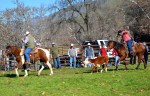
Douglas Thomason, Robbin, Zach and Clarence – November 13, 2012

Doe and Fawn

I ran up into Paregien’s yesterday to put mineral and salt out to the cows, plus look for the hay hook I lost somewhere the day before. Found these two instead along the road.

The coyotes are with the cows almost everywhere I went, waiting to catch a newborn calf alone. The cows told me where two of the three less were.

October

With the increasingly lower angle of the sun, October brings fiery color to the foothills, longer shadows crisp with contrast as well as a welcome relief from the summer heat, persisting, this year, with 90+° into its first week. As the angle of the sun also drops below the brim of my hat, I notice renewed impacts to my face.

But aesthetically, it’s one of the loveliest months of the year, and psychologically positive as it precedes our rainy season and the beginning of green grass through winter and spring. With rains too early, the new green fades with the heat before the next rain arrives. Typically, the first of November is ideal for our first rain, and our best chance this year, based on the Farmer’s Almanac and my own forecasting methods, looks to be the 11th or 12th of November.

But October is a tough month on cows, two-thirds of which have calved in the last sixty days. The flat ground, where we watch and keep our first-calf heifers is short, but with access to ample dry feed at the higher elevations. Supporting calves for sixty days draws the heifers down despite supplementing with alfalfa regularly. Even in our upper pastures, both young and old cows tend to be thin. Furthermore, everyone and everything is on the acorns including deer, bear, feral hogs, woodpeckers, turkeys, Mallards, Wood Ducks and quail, a diet that keeps cows thin, and changing, I suspect, the pH in their digestive system to make efficient conversion of the dry feed more difficult. Moreover, the acorns seem to have an addictive quality. Bottom line, October is not a month to show off your cows.

October is a month of tough choices, also. Whether to feed more hay, or not, as we make our rounds in the upper pastures, will require more physical work, more time and money, more fuel, and wear and tear on the 4-wheel drive. But supplementing after the cows have gotten thin is often too late, especially if the rains don’t arrive on time, so we watch the weather patterns closely. Anxiety can be high, but not near the panic level as in November and December without a start to our new feed.

October is a transition month in the Southern Sierras, and we are there.

Light Dusting

Alta Peak & Morro Rock- October 25, 2012

Just enough snow to see the elephant on Alta Peak (11,208′) with Moro Rock (6,735′) in the foreground, redwoods of Sequoia between them, from the Top in the Greasy Creek watershed @ approx. 2,000′.

More Color

Rabbit Flat – Top Greasy

Buckeyes – Rabbit Flat

Great Western Divide – October 24, 2012