
Making the loop up Ridenhour Canyon through the Paregien Ranch yesterday to check stockwater and put out mineral and supplement tubs, I photographed a few trees to record the impact of our dry spring and prolonged heat spell. At the 2000-foot elevation it seems the impact is slightly less, but more apparent, in the less-healthy trees, or those that seem less-healthy to me, no expert. The only green in the tree below is mistletoe.

Paregien, July 20, 2013
Since the July 8th post , we’ve had a couple of windy days associated with monsoon flow into the Sierras that has denuded many of the oaks whose leaves had turned.
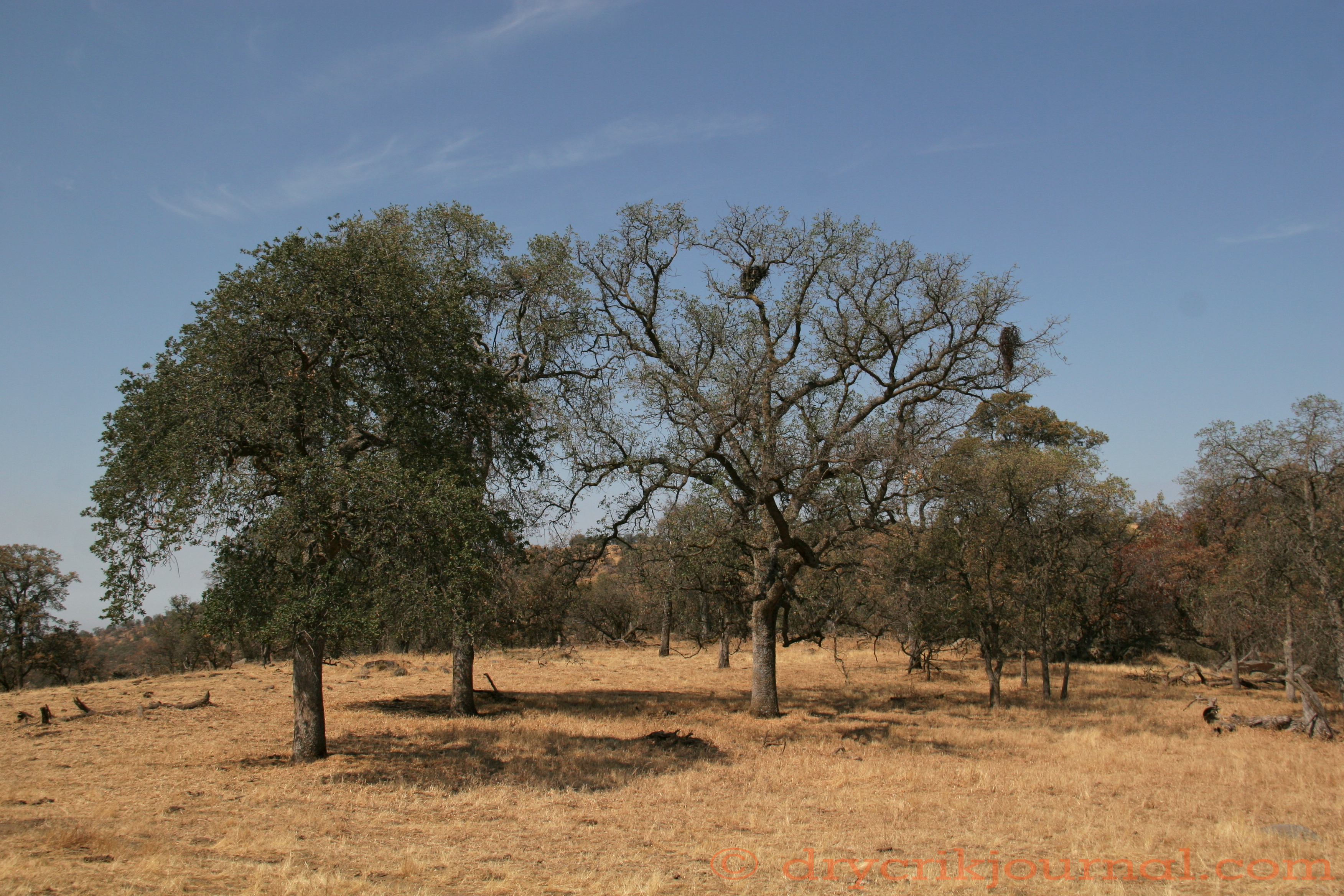
Paregien Ranch, July 20, 2013
Hawk’s nest exposed in the top, mistletoe to the side.
Looking towards the Great Western Divide, these young trees on the initial east slope that falls into Dry Creek seem especially hard hit.

Paregien Ranch, July 20, 2013




 drycrikjournal
Hi!
The mistletoe may be part of the problem. If you can get rid of it the tree may be better able to take care of itself. Mistletoe is a parasite. I don’t know how to get rid of it, maybe ask a tree expert, Arborist.
LikeLike
Thanks, Lenore. Considering the number of trees, mistletoe is an uncontrollable factor present in both wet and dry years. Since the windy days, we can see that not every leaf was given up, 15-20% retained and still green on the affected Blue Oaks. What’s intriguing to me is that each tree knows its individual health and adjusts, or not, as needed to survive. The trees in this group of photos are on the periphery of one of the healthiest stands of Blue Oaks on the ranch, some over 200 years old that seem unaffected by the heat/dry spring.
LikeLike